A B2B sales company can fill your calendar and still leave your reps starting every conversation from scratch. The missing information is often what makes a meeting useful: why the buyer engaged, what they asked, which concerns remain and what someone already promised them.
When you outsource prospecting, qualification or appointment setting, evaluate more than meeting volume. Evaluate whether the partner can carry buyer context into your sales process without distorting it. This guide gives you a practical way to compare providers, test their handoffs and structure a pilot before committing to a longer contract.
Match the partner to the work you need done
“Sales company” can describe several different services. Before building a shortlist, identify where your process actually breaks. A team that needs more outbound conversations has a different problem from one that already attracts visitors but loses their questions between the website and the first call.
- Partner type: Outbound prospecting agency — Typical responsibility: Research accounts and start conversations — Context risk to investigate: Personalization based on assumptions rather than verified information
- Partner type: Appointment-setting service — Typical responsibility: Qualify interest and schedule meetings — Context risk to investigate: Calendar bookings without a clear buyer need
- Partner type: Outsourced SDR team — Typical responsibility: Handle prospecting, qualification and follow-up — Context risk to investigate: Conversations split across systems or individual inboxes
- Partner type: Fractional sales leadership — Typical responsibility: Improve strategy, management and process — Context risk to investigate: Recommendations that never become operational handoff rules
- Partner type: Full-cycle sales provider — Typical responsibility: Manage multiple stages through closing — Context risk to investigate: Unclear ownership of account history and commitments
These categories overlap, so ask each provider to define its actual scope. Who answers inbound questions? Who follows up after a no-show? Who owns an opportunity once your account executive accepts it?
A proposal should identify those boundaries before it presents activity targets. Otherwise, both teams may believe the other is responsible for the same buyer.
What a B2B sales company must preserve
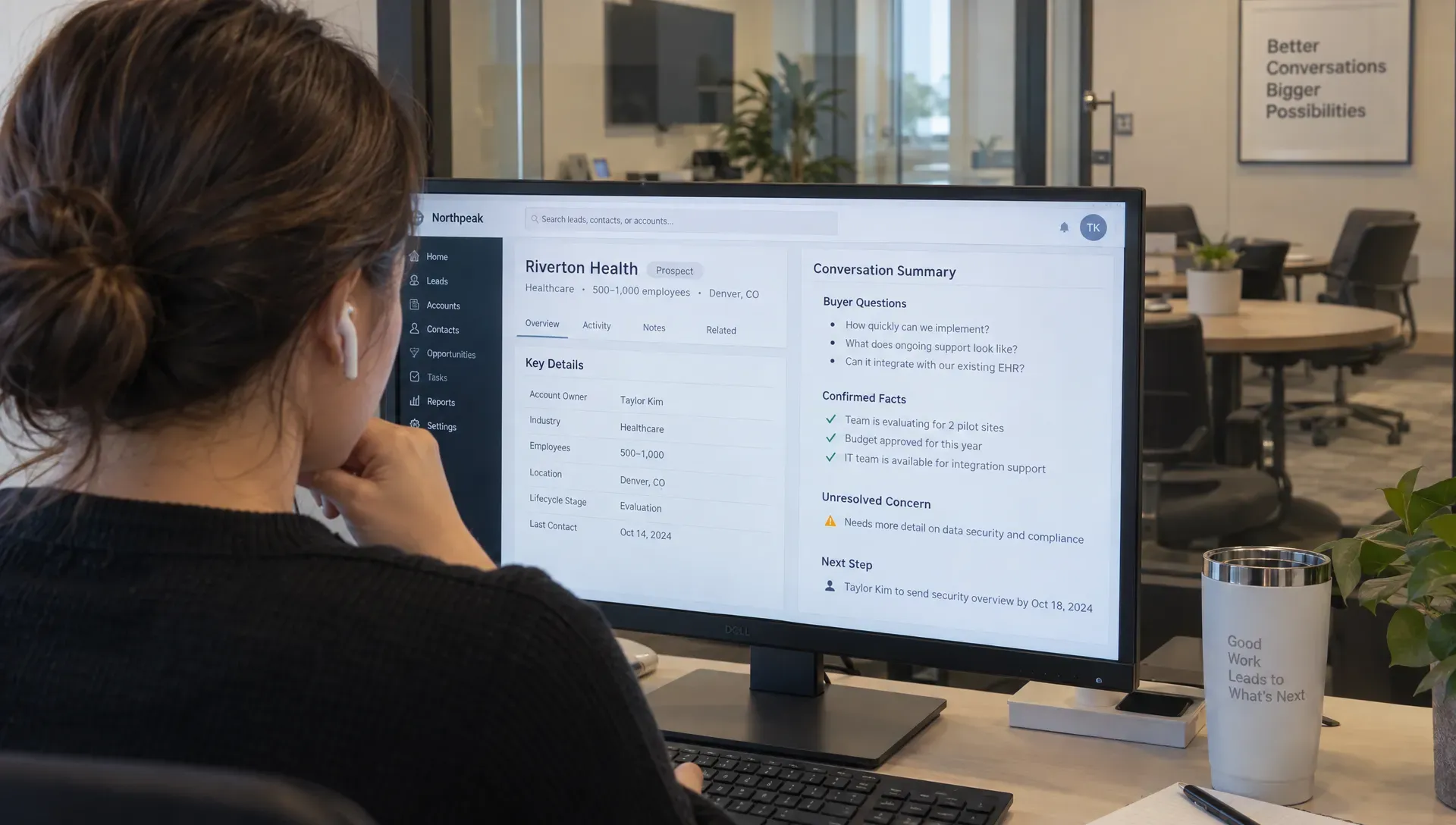
A contact record is not the same as a usable handoff. Names, job titles and company size tell a rep who someone is. They rarely explain why the next conversation matters.
Define a minimum context record that travels with each accepted lead:
- Reason for engagement: The buyer’s stated problem or the question that started the conversation.
- Relevant history: Messages, substantive answers and content shared, with dates and source references.
- Qualification evidence: What the buyer actually confirmed about fit, timing and the purchase process.
- Open questions: Unresolved technical, commercial or operational concerns.
- Commitments made: Anything promised about capabilities, pricing, implementation or follow-up.
- Next step and owner: What happens next, when it happens and who is responsible.
Separate what is required for a first conversation from what can be learned later. Demanding a complete buying committee and approved budget too early can encourage a provider to guess or reject worthwhile prospects.
Your inbound lead qualification criteria should guide this record, rather than a generic agency definition of a “qualified appointment.” Unknown information should remain explicitly unknown.
Separate observed facts from assumptions
Good account research provides relevance, not proof of buying intent. Require the partner to label public information, buyer statements and its own hypotheses differently.
For a hypothetical vendor selling practice-management software, Dr. Monica Filipescu’s digital orthodontics website offers public context about services such as digital orthodontics and 3D treatment planning. Those details could help a researcher understand the practice. They do not establish that it needs new software, has a particular budget or wants sales outreach.
Ask a B2B sales company to show how it maintains that distinction in a real handoff. “The website describes digital treatment planning” is an observation. “The practice needs a replacement system” is an unverified hypothesis.
Apply the same discipline to conversation summaries. “Asked about annual pricing” should not become “Budget approved.” A question about an integration should not become confirmation that the integration exists. Reps need enough source material to check important claims without rereading every message.
Test the handoff before evaluating the pitch
A polished presentation cannot demonstrate context retention. Give each shortlisted provider the same fictional buyer scenario and ask it to run through its proposed workflow.
For example, your test buyer is an operations manager evaluating a product for two business units. They ask about a CRM integration, explain that procurement cannot start until next quarter and request a technical discussion before a commercial demo.
Ask the B2B sales company to show what your account executive would receive, not just describe what its team would do. Inspect the meeting invitation, CRM record, conversation history and follow-up message together.
The handoff should retain the delayed timeline and technical-first request. It should distinguish an unanswered integration question from a confirmed capability. The invitation should describe the meeting the buyer agreed to attend.
Then have a rep unfamiliar with the scenario prepare for the call using only that material. If they cannot explain the buyer’s situation, unresolved concern and expected next step, the handoff has failed its most basic test.
For system-level checks, use a separate evaluation of your B2B sales CRM workflows. A partner’s integration claim is less useful than seeing exactly where information appears and who can access it.
Include exceptions, not just a successful booking
Repeat the exercise with situations that expose operational gaps. A returning prospect may already have an account owner. Someone may request a reschedule after discussing a technical objection. A buyer may correct an earlier statement about timing.
Ask how the provider prevents duplicates, preserves corrections and alerts the right person. Verify what happens when a CRM update fails or a calendar connection becomes unavailable. The response should include a recovery process, not an assumption that the software always works.
Also test what happens when someone declines further contact. Their preference needs to reach the systems and people responsible for subsequent outreach, subject to your applicable requirements.
An effective B2B sales company should be able to explain which steps are automated, which require judgment and who resolves exceptions. “Our team handles it” is not enough unless you can see the ownership and escalation rules.
Score evidence rather than sales claims
Use a shared evaluation sheet so stakeholders assess the same things. Marketing may focus on responsiveness, sales on meeting quality and operations on data reliability. All three matter, but none should substitute for the others.
- Evaluation area: Context accuracy — Evidence to request: Anonymized handoffs checked against source conversations — Warning sign: Summaries add claims the buyer never made
- Evaluation area: Qualification — Evidence to request: Written acceptance criteria and rejected-lead examples — Warning sign: A calendar booking automatically counts as qualified
- Evaluation area: Rep readiness — Evidence to request: A rep prepares using only the delivered record — Warning sign: Essential details live in the provider’s private inbox
- Evaluation area: Workflow reliability — Evidence to request: Demonstration of duplicates, corrections and failed updates — Warning sign: Only the ideal path can be demonstrated
- Evaluation area: Accountability — Evidence to request: Named owners and a documented review process — Warning sign: Quality problems have no clear resolution path
- Evaluation area: Data continuity — Evidence to request: Sample export and documented access arrangements — Warning sign: Conversation history cannot leave the provider’s system
Treat serious weaknesses as gates rather than allowing them to disappear inside an average score. High activity should not compensate for fabricated qualification details or inaccessible records.
The best B2B sales company for your team is the one whose operating evidence matches your requirements. Relevant industry experience helps, but recognizable client logos do not prove that your handoffs will work.
Compare the full cost, including your team’s work
Pricing models can include retainers, per-meeting charges, performance fees or combinations of these. Compare the obligations behind the price rather than assuming one model creates better incentives.
A per-meeting arrangement needs a precise definition of an accepted meeting. A retainer needs clear staffing, deliverables and quality review. Performance-based terms need agreement on attribution, especially when an existing prospect returns through another channel.
When comparing a B2B sales company with another option, include internal work that may not appear in its proposal. Your reps may spend time correcting records, researching context, removing duplicates or pursuing meetings that should never have qualified.
A practical calculation is:
Cost per accepted, held meeting = total relevant delivery cost ÷ meetings that both took place and met the agreed acceptance criteria.
For this calculation, define delivery cost consistently across providers. It can include provider fees, required tools, onboarding and internal review time. Track no-shows and rejected meetings separately rather than hiding them in a single total.
This measure is more useful than cost per booking, but it is not a substitute for pipeline quality. Once enough time has passed, assess whether those meetings progress into genuine opportunities.
Run a bounded pilot with written acceptance criteria
A pilot should test a specific operating model, not merely offer a discounted introduction. Limit the initial scope to a defined audience, offer and handoff destination so you can diagnose problems.
Before launch, agree on who reviews leads, how disagreements are resolved and which outcomes would justify expansion. Set the pilot duration around your outreach process and likely response times. A short pilot may reveal execution quality without providing meaningful evidence about closed revenue.
Have the B2B sales company report outcomes alongside context quality. Useful measures include:
- Context completeness: The share of reviewed handoffs containing every required field, including explicitly marked unknowns.
- Summary accuracy: Whether important statements match the underlying conversation.
- Accepted, held meetings: Meetings that occurred and satisfied your written criteria.
- Preparation burden: Time reps spend reconstructing information that should have arrived with the lead.
- Opportunity progression: Movement into agreed sales stages, tracked by comparable lead cohorts.
Review early handoffs closely enough to identify patterns, rather than waiting for an end-of-pilot report. Give the provider specific corrections and check whether later records improve.
Keep results segmented by source and campaign. Combining warm inbound inquiries with cold outbound prospects can conceal where the service is helping and where it is struggling.
Put continuity and exit rights in the agreement
Context preservation depends on contractual arrangements as well as daily execution. Before signing, establish what your organization can access during the engagement and what it receives when the relationship ends.
Document ownership and permitted use of contact data, conversation records, account research and campaign materials. Define export formats, delivery timing and responsibility for removing access. Where recordings are involved, address applicable notice, consent and retention requirements with appropriate legal guidance.
Ask the B2B sales company to provide a sample export before you commit. Check whether conversation records remain attached to the correct contacts and accounts, and whether timestamps, source references and unresolved tasks survive the transfer.
The agreement should also state who can make product or pricing claims on your behalf and which commitments need approval. Incorrect promises can be more costly than incomplete notes.
Finally, decide who continues active conversations after termination. Your lead nurturing process should resume from the buyer’s last meaningful interaction, not restart with a generic introduction. An exit plan should preserve that continuity without creating conflicting outreach from two teams.
Frequently asked questions
What does an outsourced B2B sales provider do? Depending on its scope, it may research accounts, conduct outreach, qualify prospects, book meetings or manage later sales stages. Confirm the responsibilities in writing because provider labels do not consistently describe the same service.
Should I choose a B2B sales company or hire internally? Compare management capacity, required expertise, access to buyer conversations and total cost. An external partner can add capacity, while an internal team may give you more direct control. Either model needs clear qualification criteria and reliable handoffs.
Should we buy lead lists as part of the engagement? A list supplies contact information, not confirmed interest or conversation history. Ask about sourcing, permitted use, freshness and fit. Keep list-derived prospects distinct from people who have actively engaged with your business.
What is the biggest warning sign during evaluation? A provider that reports large booking numbers but cannot show what buyers said, why meetings qualified or what your reps receive. Protecting client confidentiality is reasonable, but a fictional demonstration or appropriately anonymized example should still be possible.
Keep buyer context available to your closers
Before signing, require three things: a demonstrated handoff, measurable pilot criteria and a workable exit process. Together, they reveal more than a promise to generate meetings.
If your gap starts with unanswered website questions, Nudge addresses that part of the workflow. It engages B2B visitors, answers questions using your content with citations and books meetings. Its agents also follow up, identify returning prospects and prepare sales meeting briefs.
Whether you use an external team, software or both, make the final test practical: can your closer continue the buyer’s conversation without asking them to start over?