A free trial can remove friction or leave buyers stranded. A sales-led demo can resolve uncertainty or add a meeting nobody needs. In SaaS B2B sales, the right approach depends on what a buyer must understand, prove and approve before purchasing, not simply whether your company calls itself product-led or sales-led.
The practical goal is to make straightforward purchases easy while giving complex purchases enough support. That often means offering both routes, with clear reasons for choosing each.
Self-service vs. sales-led demos: the practical difference
Self-service lets buyers evaluate and purchase without a required sales conversation. That might involve a free trial, a freemium plan or a direct purchase. These are different commercial models, but all can support an independent buying journey.
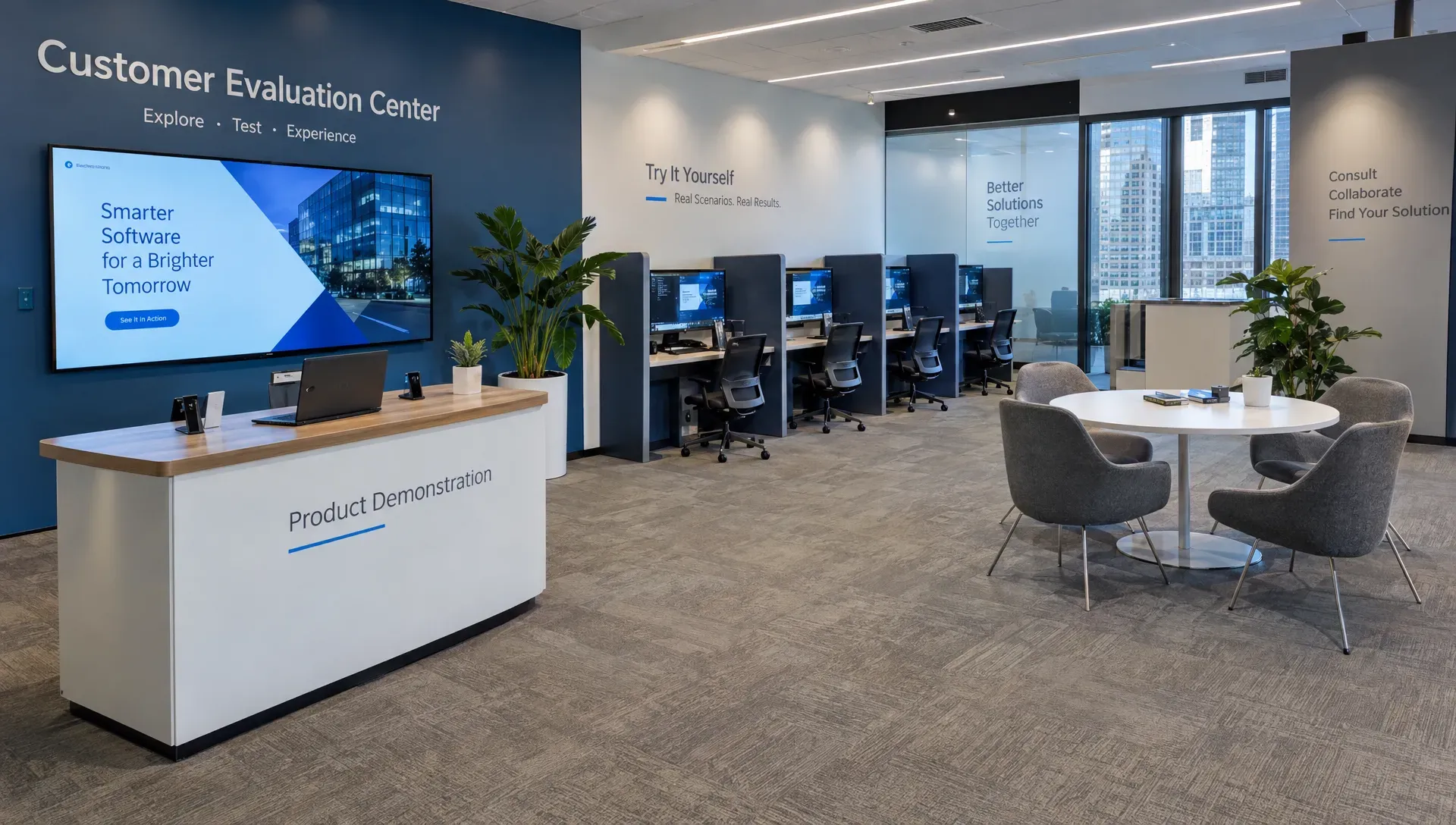
Sales-led evaluation makes a rep part of the purchase process. A useful demo connects the product to a specific workflow, surfaces requirements and establishes what evidence the buyer needs next.
- Dimension: First meaningful step — Self-service path: Try a workflow or purchase — Sales-led demo path: Discuss the use case and see relevant functionality
- Dimension: Evidence of fit — Self-service path: Results achieved in the product — Sales-led demo path: Demonstrated fit, followed by validation where needed
- Dimension: Buyer effort — Self-service path: Setup, learning and independent testing — Sales-led demo path: Scheduling, preparation and stakeholder coordination
- Dimension: Common obstacle — Self-service path: Getting stuck before experiencing value — Sales-led demo path: Waiting for a meeting that adds little information
- Dimension: Commercial fit — Self-service path: Repeatable purchases with limited assistance — Sales-led demo path: Purchases requiring discovery, coordination or negotiation
Neither route guarantees a shorter buying cycle. In SaaS B2B sales, a trial can stall just as easily as a demo when the buyer lacks a clear next step.
When self-service is the better starting point
Self-service works best when buyers can experience meaningful value without extensive implementation. A focused scheduling tool, for example, might let one user complete a useful workflow before involving anyone else.
Look for a repeatable use case, understandable pricing and a setup process buyers can complete themselves. The person evaluating should also have enough authority to begin using or purchasing the product.
That does not mean every question must disappear. Buyers still need clear answers about limits, integrations, data handling and billing. Your SaaS pricing page should explain the billing unit, plan differences and purchase conditions before someone commits time to a trial.
A common mistake is treating account creation as proof that self-service works. Registration only shows that someone was willing to start. The stronger signal is whether a qualified account completes a useful task and returns to repeat it.
For SaaS B2B sales, self-service is commercially useful when buyers reach value at an acquisition cost and retention level the business can sustain. High signup volume alone does not establish that.
When a sales-led demo earns its place
A demo is valuable when a conversation can reduce uncertainty that the product experience cannot resolve on its own.
Consider software that changes a shared workflow across finance, operations and IT. One evaluator may understand the interface but still need answers about deployment, permissions, procurement and organizational adoption.
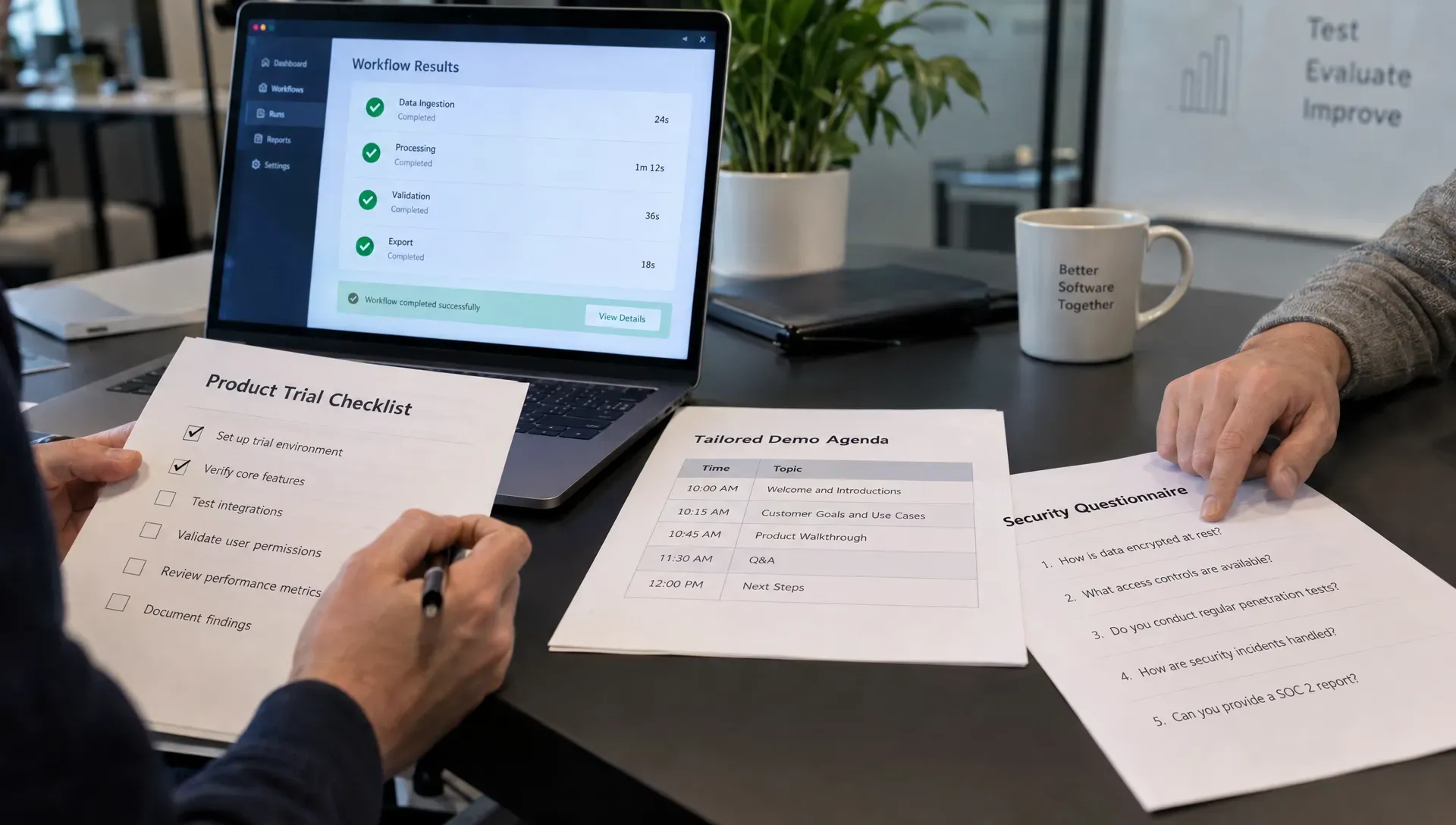
A rep can help establish who needs to participate, which requirements are essential and what a successful evaluation would demonstrate. The demo should then focus on those requirements rather than presenting every feature.
Three conditions make this route especially useful:
- The buyer cannot test safely alone: A realistic evaluation needs production-like data, integrations or technical guidance.
- The purchase requires coordination: Multiple stakeholders have different approval criteria.
- The commercial structure needs discussion: Scope, implementation or contractual requirements affect the purchase.
A required meeting is harder to justify when buyers only need a price or a simple product answer. In SaaS B2B sales, a demo should remove a buying obstacle, not serve as the price of accessing basic information.
If scheduling creates unnecessary delays, reconsider the friction in your demo request process before concluding that demand is weak.
Compare the economics of SaaS B2B sales
Buyer preference matters, but the delivery model must also make financial sense. A low-priced subscription may not support repeated live demos, while a larger contract can still be unprofitable if evaluation and implementation consume too much effort.
Calculate acquisition cost by motion
Compare the sales and marketing costs associated with each route, including acquisition campaigns, rep time, sales engineering and trial assistance. Allocate shared costs consistently so one path does not look artificially inexpensive.
A simplified calculation is:
CAC payback in months = customer acquisition cost ÷ monthly gross profit per customer.
For an illustrative subscription with $2,400 in annual revenue and an 80% gross margin, monthly gross profit is $160. A $480 acquisition cost implies three months of payback. A $1,440 acquisition cost implies nine months.
These are hypothetical figures, not market benchmarks. The calculation also does not capture churn, expansion or the timing of cash collection.
Check whether assistance changes customer quality
Higher acquisition cost is not automatically wasteful. Rep assistance might help customers select a better-fit plan, deploy successfully or purchase a broader scope.
Conversely, a rep might close customers who never activate and cancel soon afterward. Compare retention and contribution over time, not just initial contract size.
Track sales capacity separately, too. An assisted path that generates attractive deals but consumes all available rep hours may need tighter qualification or a more focused evaluation process.
Build a hybrid path without creating a maze
A hybrid approach is not simply placing “Start trial” and “Book a demo” buttons beside each other. Buyers need to understand what each route helps them accomplish.
A useful distinction is between learning to use the product and reducing purchase risk. Someone testing a straightforward workflow may need onboarding guidance. Someone coordinating a rollout may need a discussion about requirements, even if they have already activated.
In SaaS B2B sales, route buyers according to the obstacle they face, then let them change paths when their needs change.
Keep the handoff specific
An independent evaluator should be able to request help without repeating everything. With appropriate permissions, preserve useful context such as the intended workflow, the question they asked and what remains unresolved.
The reverse handoff matters as well. A demo should end with a clear evaluation task, owner and success criterion where a trial is the appropriate next step.
Make assistance available without forcing it
Offer a clear way to ask a question during evaluation. A buyer asking whether an integration supports their workflow may need a factual answer, not an immediate calendar invitation.
Escalate when a conversation would genuinely help: an unresolved technical requirement, several stakeholders with conflicting needs or a request for implementation guidance. Avoid treating every returning visit as permission for aggressive outreach.
Use buyer evidence to choose the default route
Before changing your website, review where qualified buyers actually struggle. Interview recent customers, lost opportunities and trial users who stopped before reaching value.
Ask what they needed to verify, which information was missing and whether speaking with someone would have helped. “I wanted a demo” can mean several things: the product was unclear, the buyer needed internal reassurance or the purchase genuinely required consultation.
Public discussions can reveal the language buyers use before they contact a vendor. A guide to SaaS lead-generation subreddits can help you locate relevant communities and buying-intent discussions. Use those conversations to investigate concerns and respect community rules, rather than treating every participant as a lead.
Combine this qualitative evidence with your own account-level behavior. In SaaS B2B sales, external conversations can suggest hypotheses, but they do not prove which purchase path converts your audience.
Measure both paths against customer outcomes
A trial signup and a booked meeting are not equivalent outcomes. Comparing them directly can make either route look successful without showing whether customers bought or received value.
Use a shared scorecard, then add diagnostic measures for each path.
- Shared measure: Qualified account to paid customer — Self-service diagnostic: Activation-to-paid conversion — Sales-led diagnostic: Completed-demo-to-paid conversion
- Shared measure: Time to first value — Self-service diagnostic: Time to a meaningful product outcome — Sales-led diagnostic: Time from first conversation to validated outcome
- Shared measure: Acquisition cost — Self-service diagnostic: Acquisition and assistance costs — Sales-led diagnostic: Acquisition, rep and technical evaluation costs
- Shared measure: Customer retention — Self-service diagnostic: Retention by activation behavior — Sales-led diagnostic: Retention by evaluated use case
- Shared measure: Human effort per acquired customer — Self-service diagnostic: Support and assisted-trial hours — Sales-led diagnostic: Discovery, demo and follow-up hours
Define activation as a meaningful outcome, not a convenient click. For a reporting product, generating a useful report from relevant data is stronger evidence than opening the dashboard.
Segment results by customer profile, acquisition source and purchase complexity. SaaS B2B sales comparisons become misleading when one path receives small independent buyers and the other receives large organizations with procurement requirements.
Also distinguish bookings from completed meetings. A full calendar is not useful if buyers do not attend or the conversations never progress.
Test a routing change before redesigning everything
Start with one audience and one buying obstacle. For example, test whether small teams with a standard use case perform better with a self-service default while keeping access to help visible.
Write down the hypothesis, eligibility rules and decision criteria before launch. Where practical, assign comparable accounts to different experiences and keep users from the same account on a consistent path.
Do not change pricing, onboarding and demo qualification simultaneously if you want to understand the effect of routing. Record how much human assistance each group receives, including help delivered outside the formal sales process.
Choose an observation period that reflects your buying cycle. A 30-day test may reveal activation problems, but it cannot establish long-term retention or the final conversion rate of a purchase that normally takes several months.
For SaaS B2B sales, the winning path is the one that improves sustainable customer acquisition within your capacity constraints. If results are inconclusive, keep collecting evidence rather than declaring a winner from a handful of deals.
Frequently asked questions
Is self-service the same as product-led growth? No. Self-service is a way to evaluate or purchase. Product-led growth is a broader strategy in which product usage drives acquisition, conversion or expansion. A product-led business can still employ salespeople.
Should every enterprise prospect book a demo? Not necessarily. Enterprise buyers may want to explore independently before involving a rep. Make assistance easy to access, then use actual implementation and approval requirements to determine what support is necessary.
Should a sales-led demo replace the free trial? Only when independent testing adds little value or cannot be supported safely. A tailored demo followed by a focused trial can be more useful than either experience alone.
Can AI replace the sales conversation? AI can handle repeatable questions and help buyers reach the next step. Complex discovery, negotiation and unresolved technical or contractual issues still need accountable human involvement.
Help buyers choose their next step
Buyers should not have to choose between an unanswered question and a mandatory meeting. Nudge engages website visitors, answers questions with content-based citations and books meetings. Personalized follow-ups, returning-visitor identification and sales preparation briefs support the conversation beyond the first visit.
Use that support where it removes friction, while keeping independent evaluation available to buyers who are ready to proceed.