A B2B sales funnel describes how potential customers move from discovering your business to agreeing to buy. For a website-led sales motion, that journey might begin with a pricing-page visit and end with an accepted order. Between those moments, buyers need answers, internal agreement and evidence that your product can solve their problem.
The useful version of a funnel does more than label leads. It tells your team what the buyer has confirmed, who owns the next conversation and what must happen before an opportunity advances. A booked meeting is progress, but it is not proof of purchase intent.
Below is a practical six-stage model, with clear milestones from first visit to closed deal. Adapt the stage names to your sales process, but keep the underlying rule: advance deals on buyer evidence, not seller activity.
How a B2B sales funnel is structured
The funnel summarizes conversion between stages. Your sales pipeline shows the individual opportunities moving through those stages. A CRM stores the records, activities and ownership needed to manage them. They work together, but they are not interchangeable.
For an inbound sales motion, the journey can look like this:
- Stage: First visit and engagement — What the buyer is doing: Researching a problem or potential solution — Evidence needed to advance: A meaningful inquiry or permission to continue
- Stage: Qualification — What the buyer is doing: Exploring whether there is a relevant fit — Evidence needed to advance: A plausible use case and agreement to explore it
- Stage: Discovery — What the buyer is doing: Defining the problem and purchase process — Evidence needed to advance: A shared understanding of needs and next steps
- Stage: Evaluation — What the buyer is doing: Testing suitability and building internal support — Evidence needed to advance: Agreed success criteria addressed with evidence
- Stage: Proposal and approval — What the buyer is doing: Reviewing terms and securing authorization — Evidence needed to advance: Required approvals and accepted commercial terms
- Stage: Closed won — What the buyer is doing: Making the purchase commitment — Evidence needed to advance: The binding milestone defined by your business
This is a management model, not a prediction that buyers move in a straight line. A new stakeholder can reopen evaluation. A budget change can pause a qualified opportunity. Several people from one account may enter through different pages and channels.
Early activity is often measured by visitor or contact. Later activity should usually be organized around accounts and opportunities so that three interested employees do not become three separate deals.
Stage 1: Turn a first visit into a useful conversation
The first job of a B2B sales funnel is to help a relevant visitor take a useful next step. That does not always mean booking a demo immediately.
Imagine an operations director at a logistics company researching approval software. They arrive from a search result, read a use-case page and check whether the product could work with their existing systems. Their immediate need is an answer, not a discovery call.
Marketing owns the clarity of those pages and the paths between them. Whoever handles inbound conversations, whether a person or an AI agent, should answer the question accurately and offer a next step appropriate to the visitor’s intent.
A visitor comparing integration requirements may need documentation. Someone asking about implementation for a specific team may be ready to speak with sales. Treating both visitors identically creates unnecessary friction.
Page views alone are not enough to establish an opportunity. Look for an explicit question, a relevant request or permission to follow up. If someone shares contact details to receive a resource, respect that context rather than treating the action as an automatic demo request.
Exit evidence: The visitor has expressed a relevant interest and chosen to continue the conversation.
Stage 2: Qualify fit without turning the conversation into an interrogation
Qualification asks whether there is a credible reason for both sides to invest more time. It should uncover the use case, the business context and the buyer’s willingness to explore a solution.
At this point in the B2B sales funnel, avoid confusing complete data with genuine readiness. A fully populated form can still represent a poor-fit lead. A short inquiry from the right company can justify a discovery conversation even when budget and purchasing details remain unknown.
In the logistics example, useful questions include what needs approval, where the current process breaks down and which systems are involved. Asking all the procurement questions before answering the integration question would reverse the buyer’s priorities.
Your team’s inbound lead qualification process should distinguish between missing information and actual disqualification. An unknown budget is different from a confirmed requirement your product cannot meet.
Marketing, an SDR or an account executive can own this stage, depending on the sales model. The important handoff is a concise record of the buyer’s question, relevant context and agreed next action.
Exit evidence: There is a plausible fit and the buyer agrees to explore it. Track meetings booked separately from meetings held, since a calendar event does not establish that discovery happened.
Stage 3: Use discovery to define the purchase, not just the demo
Discovery turns general interest into a shared understanding of a business problem. The seller needs to learn why the buyer is considering change, what a useful outcome looks like and how the organization would make a decision.
This is where the B2B sales funnel should become account-specific. The operations director may care about reducing approval delays, while IT cares about access controls and finance needs a defensible business case. One enthusiastic contact cannot answer for every stakeholder.
A productive discovery conversation establishes:
- The current workflow and the consequences of leaving it unchanged.
- The desired outcome and how the buyer would assess it.
- The people involved in evaluation, approval and implementation.
- The next action, its owner and the reason it matters.
For the logistics company, the problem might be exceptions sitting in email inboxes without clear ownership. The next step could be a demonstration using that workflow, with an IT stakeholder present to discuss integration requirements.
Record what the buyer actually said. Separate confirmed facts from seller assumptions, particularly around urgency, budget and authority. If there is no reason to act now, that is useful information rather than a gap to conceal.
Exit evidence: Buyer and seller agree on the problem, the evaluation goal and a concrete next step.
Stage 4: Help the buying group evaluate the solution
Evaluation is the work of establishing whether the solution is suitable and whether the organization can adopt it. Depending on the deal, that may involve a tailored demonstration, technical review, references or a proof of concept.
A B2B sales funnel becomes less reliable when every demo automatically moves a deal forward. The meaningful milestone is not that the presentation happened. It is that the buyer gained evidence against an agreed requirement.
Before a trial or proof of concept, define its scope and success criteria together. For the logistics buyer, those criteria might include handling a representative approval workflow and validating integration feasibility. Do not substitute whichever product features are easiest to demonstrate.
The account executive should also help the internal champion communicate the decision. A concise summary of the problem, expected benefits, unresolved questions and implementation needs is easier to share than a long recording.
Bring in the right specialists when required. Sales should not improvise security commitments or promise implementation work without confirmation from the people responsible for delivery.
Exit evidence: The buying group has addressed its essential evaluation criteria and identified any remaining conditions for purchase. If a critical requirement fails, resolve it, adjust the scope or qualify the deal out rather than advancing it on enthusiasm alone.
Stage 5: Turn a proposal into an actionable approval process
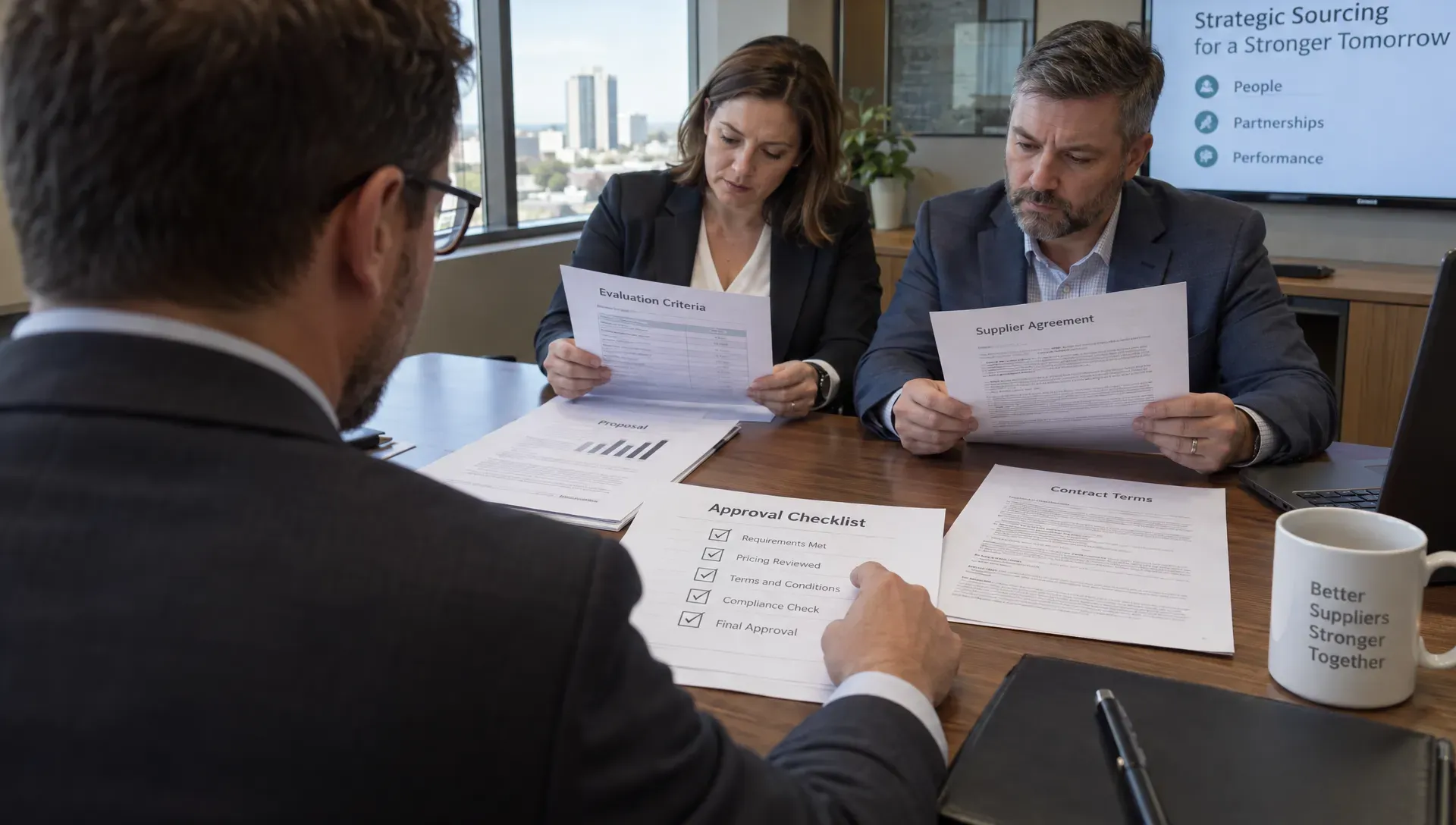
A proposal should reflect an understood purchase, not attempt to create one from scratch. It brings together scope, pricing, responsibilities and terms so that the buyer can make an informed commitment.
Late in the B2B sales funnel, much of the work shifts from product fit to organizational approval. Procurement, legal, finance or security may need to participate. Their involvement is not automatically an objection, but it does need to be understood.
Ask who must approve the purchase, what documentation they require and whether there are contractual or timing constraints. Confirm these details with the relevant people where possible rather than relying entirely on a champion’s estimate.
A mutual action plan can keep the remaining work explicit. It should identify the outstanding decision, its owner and the agreed timing. “Follow up next week” is seller activity. “Buyer’s legal team returns its contract review by the agreed date” describes progress toward a decision.
If the buyer raises an objection, identify its substance before offering a discount. Unclear value, unsuitable scope and a genuine spending limit require different responses.
Exit evidence: Required stakeholders have approved the purchase and commercial terms are ready for acceptance. A verbal indication that the proposal “looks good” is not the same as an authorized commitment.
Stage 6: Close the deal and preserve the context
Define closed won using a binding commercial milestone appropriate to your business, such as an executed agreement or an accepted order. Apply the definition consistently. Do not mark a deal won because the champion expects approval.
Closing also requires an internal handoff. The implementation or customer success team needs the agreed scope, desired outcomes, stakeholder roles and any commitments made during evaluation. A signed contract does not replace that context, and closed won is not the same thing as revenue recognition.
Not every opportunity will reach this point. Record lost reasons accurately, distinguishing a competitor win from a decision to do nothing. Keep “not now” opportunities out of active forecasts when there is no current buying process.
For buyers with a credible future need, lead nurturing based on their questions and timing can preserve the relationship without repeated meeting requests. Reopen the opportunity when there is fresh evidence of an active purchase, not merely another email open.
Measure conversion without misleading yourself
A B2B sales funnel is useful only if its numbers describe comparable groups. Track stage entries, exits and elapsed time, then examine where qualified buyers stop progressing.
For example, imagine a hypothetical cohort of 40 qualified opportunities. Over a sufficiently long observation period, 24 complete discovery, 12 enter evaluation, eight receive proposals and three become customers. Discovery completion is 60% of the original cohort. Proposal-to-win conversion is 37.5% if all eight proposal-stage deals have reached a final decision.
Those figures illustrate the calculation, not a benchmark for your business.
- Metric: Stage conversion — Calculation or method: Opportunities advancing ÷ opportunities entering the stage — What it helps diagnose: Where progression breaks down
- Metric: Opportunity win rate — Calculation or method: Won opportunities ÷ won plus lost opportunities — What it helps diagnose: Outcomes among decided deals
- Metric: Time in stage — Calculation or method: Elapsed time since entry, reviewed across opportunities — What it helps diagnose: Stalled decisions or process delays
- Metric: Sales cycle length — Calculation or method: Time from a consistently defined starting milestone to close — What it helps diagnose: Planning and forecasting assumptions
Do not divide this month’s wins by this month’s new leads and call it a cohort conversion rate. Those customers may have entered months earlier. Similarly, open opportunities are not automatically losses.
Review results by source, customer segment and deal size when volume permits. Keep visitor-to-inquiry metrics separate from opportunity conversion unless your tracking can reliably connect the records. Measure both volume and quality: more meetings help only when enough of them become worthwhile opportunities.
Where AI helps, and where sales judgment still matters
Automation can keep context from disappearing between stages of a B2B sales funnel. Useful jobs include answering routine questions, arranging meetings, following up on an expressed need and preparing the next seller for the conversation.
Nudge supports these jobs through AI website conversations, content-based answers with citations, automated meeting booking and personalized follow-ups. Its returning-visitor identification, sales preparation briefs and CRM integrations can support continuity as prospects move between visits and sales conversations. Pipeline and conversion analytics help teams inspect what happens after the initial engagement.
Set boundaries around that automation. Keep product content current, specify when a question needs human review and make ownership clear when a conversation moves to a rep. Returning-visitor recognition should be implemented in line with applicable privacy and consent requirements, without assuming every visit identifies a specific person.
Human sellers still need to interpret business impact, navigate stakeholder disagreement and negotiate commitments. An automated booking is an operational milestone. A buyer confirming that the proposed solution meets their requirements is decision evidence. Your reporting should preserve that distinction rather than treating every automated action as forward movement.
Frequently asked questions
How do I create a B2B sales funnel for my team? Map a representative set of recent won and lost deals. Identify the buyer milestones that actually occurred, define evidence for entering and leaving each stage, assign ownership and configure those stages in your CRM. Review exceptions before adding more stages or automation.
Is a funnel the same as a CRM? No. The funnel is a model of progression and conversion. A CRM is the system used to store contacts, accounts, opportunities and related activity. Good software cannot compensate for unclear stage definitions.
How many stages should the process have? Use enough stages to distinguish meaningful changes in buyer commitment and ownership. This guide uses six, but your process may need fewer or more. Avoid creating a new stage for every email, call or internal task.
How is this different from a marketing funnel? A marketing funnel often emphasizes awareness, engagement and demand creation. A sales-focused model follows qualification, evaluation and purchase commitment more closely. Teams should agree on their handoff criteria rather than assuming the labels mean the same thing.
Connect the first conversation to the next decision
Start by auditing one handoff: what does the next person need to know, and does that information arrive with the lead? Then define the buyer evidence required for the next stage.
If your team needs to connect website conversations with booking, follow-up and sales preparation, explore Nudge. Evaluate it against those handoffs, not just the number of meetings added to the calendar.