The best preparation for sales meetings often starts with something the buyer has already told you. Before booking, they may have asked your website agent about an integration, raised a pricing concern or explained why they are replacing their current tool. That conversation gives your rep a better starting point than a name, company and calendar invite.
The challenge is turning that history into useful preparation without treating every question as buying intent. This guide shows how to build a source-backed brief, choose better discovery questions and plan a relevant conversation without making the buyer repeat themselves.
Start with the buyer’s words, not an intent score
A page visit tells you what someone opened. A conversation can tell you what they wanted to understand. Those are different levels of evidence.
Someone who visits an integrations page might be researching, troubleshooting or comparing vendors. Someone who asks, “Can you sync contact records with Salesforce?” has expressed a specific requirement worth exploring. Neither signal proves purchase authority or an approved budget.
Use website conversations to identify what the buyer has stated, what remains unresolved and what your team should verify. Treat browsing activity as supporting context, not a substitute for their words.
If your team is still building this capture process, the principles of B2B conversational marketing explain how an exchange can surface needs before a visitor books.
A five-step workflow for preparing sales meetings
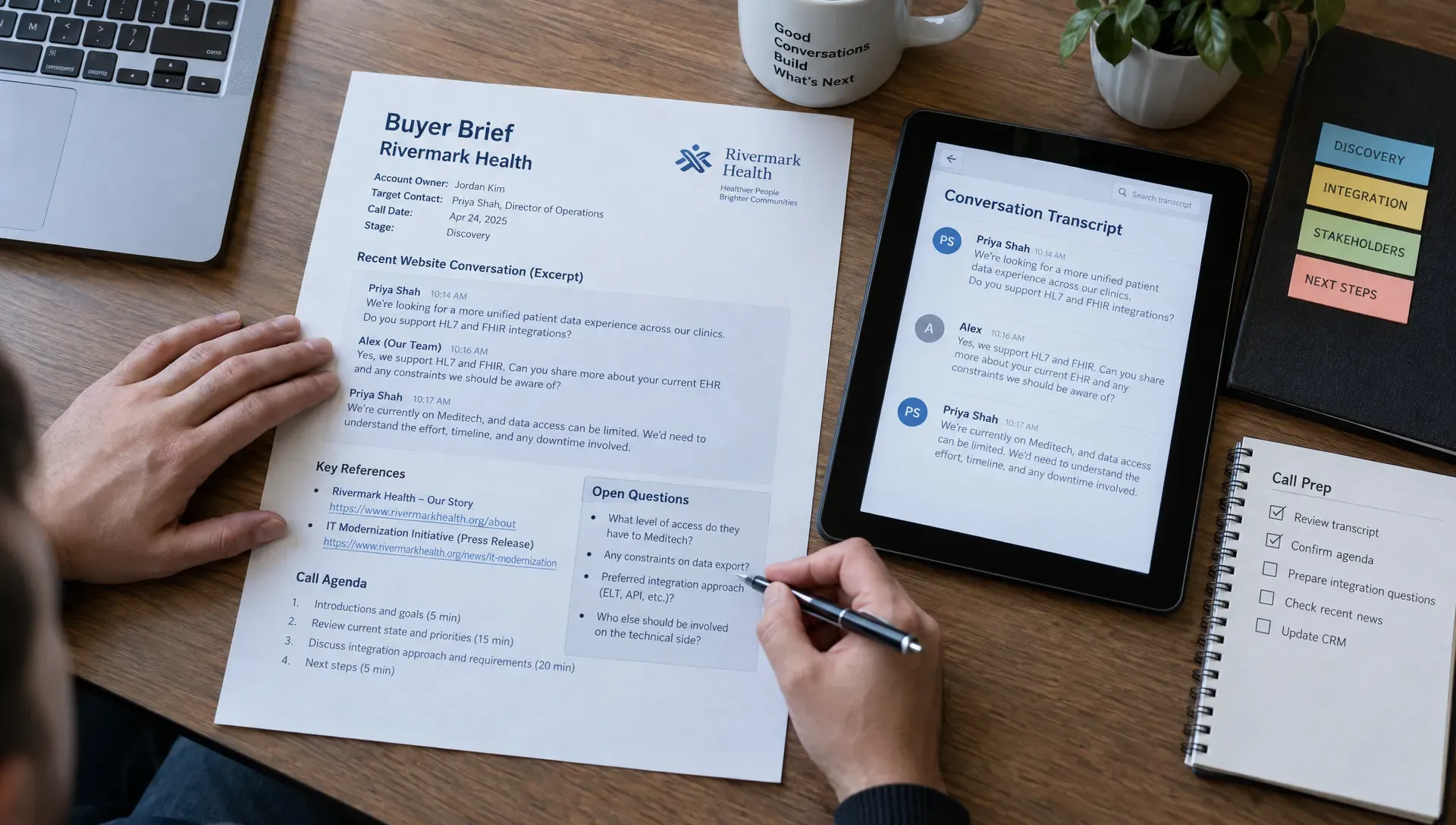
The output should be a brief your rep can scan before joining the call. Keep the transcript available as evidence, but do not make reading the entire conversation a prerequisite for understanding the opportunity.
1. Confirm whose conversation you are using
Start by matching the booked attendee to the conversation using information your systems actually captured, such as an email address supplied during booking. Check the associated company and existing CRM record before attaching notes.
A returning browser is not automatically a verified person. A shared device, forwarded booking link or company-level match can introduce ambiguity. If the identity connection is uncertain, label it rather than merging histories confidently.
Also check when the conversation happened. A requirement from an earlier evaluation may no longer apply. Anchor relative phrases such as “next month” to the original conversation date.
Use only information your organization is authorized to process. Apply data minimization: exclude unrelated personal details, restrict access and follow your retention policy. A useful brief does not need every detail the visitor disclosed.
2. Extract the evidence that changes your preparation
Useful preparation for sales meetings focuses on information that changes what the rep asks, shows or verifies. A long summary of every exchange creates more reading without necessarily improving the call.
Use a consistent structure:
- Brief field: Desired outcome — What to capture: The result the buyer explicitly wants — What not to assume: A quantified business case they never provided
- Brief field: Current situation — What to capture: Tools, workflows or problems they described — What not to assume: Their entire technology stack
- Brief field: Evaluation criteria — What to capture: Requirements and comparison questions — What not to assume: That every question is a mandatory requirement
- Brief field: Timing — What to capture: A stated renewal, deadline or project date — What not to assume: That a renewal date is also a deployment deadline
- Brief field: Stakeholders — What to capture: People or roles the buyer mentioned — What not to assume: Their purchasing authority
- Brief field: Open questions — What to capture: Unanswered requests or claims needing verification — What not to assume: That the website agent’s answer was correct
Preserve short buyer quotes where wording matters. Each important point should have a source reference, such as a conversation link and timestamp, so the rep can check the context quickly.
3. Separate facts, hypotheses and unknowns
A summary becomes unreliable when it silently turns an inference into a fact. “Asked about pricing” does not mean “has budget.” “Mentioned the operations lead” does not mean “operations owns the decision.”
For sales meetings, keep three labels visible: stated fact, working hypothesis and unknown. A hypothesis can guide a discovery question, but it should not appear in the CRM as confirmed qualification.
Separate the buyer’s statements from the agent’s responses, too. If the agent said an integration was supported, verify that answer against current documentation before building your demo around it. An answer with citations gives you something to inspect, not permission to skip inspection.
When sources conflict, preserve the disagreement. A recent buyer statement may update an older CRM note, but the rep should know what changed rather than seeing a silently overwritten account history.
4. Translate each signal into an action
Every important signal should lead to a preparation choice. That might be a discovery question, a demo segment, an objection to address or a request for help from a technical colleague.
If the visitor asked about implementation effort, prepare to explain the setup process and confirm ownership on their side. If they raised a security requirement, check the relevant documentation and decide whether a specialist needs to attend. If they challenged pricing, clarify what they are comparing before preparing a discount discussion.
This is where website data improves sales meetings: it changes the plan rather than merely adding background notes.
Choose one primary objective for the call. For example, “Confirm whether the integration requirement is supported and agree on the next evaluation step.” Do not let a broad list of interests turn a short discovery call into an unfocused product tour.
5. Deliver a short brief with a route back to the source
Put the brief where the rep already prepares, whether that is the CRM record or your team’s meeting workspace. Treat the following as a handoff standard, not a promise about any particular tool’s interface.
Include the buyer’s stated goal, two or three relevant facts, unresolved questions, the proposed agenda and source references. Identify any claim the rep must verify before the call. Leave unsupported fields marked “unknown.”
Assign responsibility for reviewing the brief. Automation can draft it, but someone needs to catch an incorrect identity match, an outdated answer or a missing requirement.
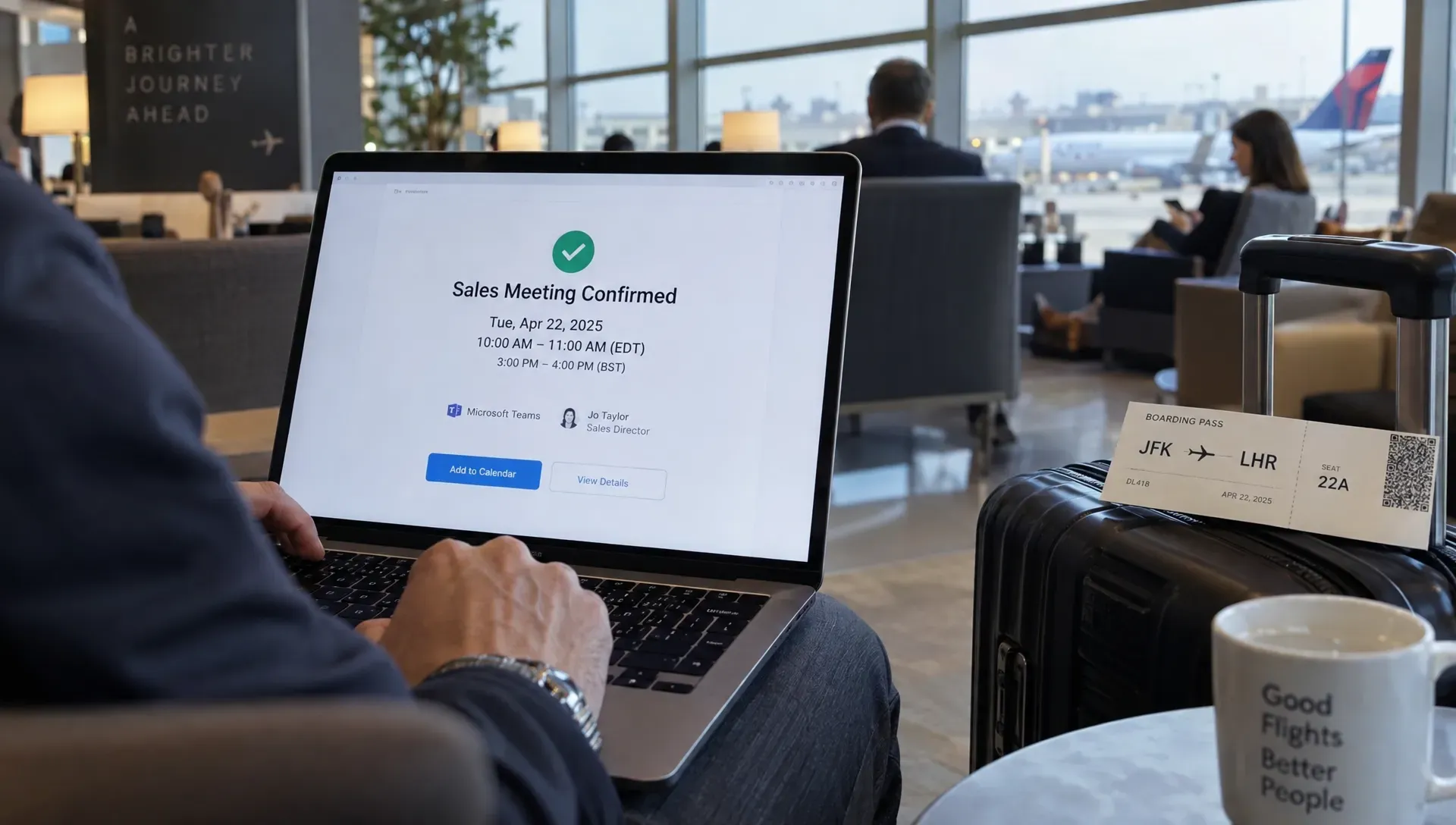
If your website already uses an AI appointment setter, make conversation context part of the booking handoff. A calendar event tells the rep when to attend; the brief explains what deserves attention.
Worked example: turn a transcript into a meeting plan
Consider this hypothetical exchange with an unnamed B2B software vendor. It illustrates preparation for sales meetings, not a real Nudge customer conversation:
“We use Salesforce. Can the two systems exchange contact data? Our current contract renews in six weeks. I need to show our operations lead how setup works.”
The buyer has supplied several useful signals, but there are still limits to what you know.
- Evidence from the conversation: Uses Salesforce — Preparation action: Verify documented integration capabilities — Question to ask live: “Which contact data needs to move, and in which direction?”
- Evidence from the conversation: Contract renews in six weeks — Preparation action: Prepare to discuss evaluation timing — Question to ask live: “Does the renewal create a decision deadline, or are you exploring options?”
- Evidence from the conversation: Operations lead wants setup context — Preparation action: Prepare a relevant setup explanation — Question to ask live: “What does your operations lead need to validate?”
Do not label this opportunity “ready to buy in six weeks.” The buyer has not confirmed replacement intent, budget, decision authority or a required go-live date.
The resulting agenda is specific: confirm the contact-data workflow, demonstrate only the relevant supported capabilities and clarify who should join the next discussion. If integration support remains unverified, flag it before the call rather than presenting an assumption as a capability.
Use AI to draft the brief, with explicit evidence rules
An AI summary can reduce preparation work, but an unconstrained prompt can also fill gaps with plausible details. Ask for evidence extraction before recommendations.
Use a prompt like this in an approved tool, providing only the information needed for the task:
```text Create a concise pre-meeting brief from the supplied website conversation and CRM context.
Separate buyer statements from agent responses. Label each point as a stated fact, hypothesis or unknown. Include a source reference for every factual claim. Preserve the original date for relative timing statements. Flag conflicting information and product claims needing verification. Do not infer budget, authority, urgency or purchase intent.
Return the buyer’s stated goal, relevant context, open questions, a proposed agenda and three discovery questions. ```
For sales meetings, the most valuable output is not polished prose. It is a reliable distinction between what the buyer said and what the rep still needs to learn.
Review the draft against the original conversation. Check names, dates, negation and who said what. “We do not need SSO” and “We need SSO” can lead to very different preparation, even if both summaries contain the same product term.
Use the context without making the opening feel intrusive
A good opening acknowledges volunteered context and invites correction:
“In your website conversation, you asked about Salesforce contact data and mentioned an upcoming renewal. Are those still the right priorities for today?”
This establishes continuity without pretending the rep already understands the entire account. It also gives the buyer room to update the situation.
Avoid narrating passive tracking details that add no value. “You visited our pricing page four times” is usually less helpful than discussing the pricing question the buyer chose to ask.
Keep the first part of the conversation focused on confirming context, filling the biggest gaps and agreeing on the agenda. Then show the relevant workflow or evidence. If another attendee joins, check their priorities rather than assuming the original visitor represents everyone.
Website context should make sales meetings more responsive, not rigid. If the buyer’s priorities have changed, abandon the prepared sequence. The brief is a starting hypothesis about the conversation, not a script the buyer must follow.
Measure whether the handoff improves the conversation
Evaluate preparation quality before attributing revenue changes to it. Start with a few practical measures your team can define consistently:
- Brief coverage: The share of eligible booked calls with a source-backed brief available before the meeting.
- Preparation time: How long reps spend gathering and checking context, using the same measurement method across comparable calls.
- Repeated-question rate: How often reps ask buyers to restate information already supplied, excluding useful confirmation.
- Agreed-next-step rate: The share of held calls ending with a mutually accepted action, owner and date.
Track corrections as well. Frequent identity errors or unsupported product claims signal a handoff problem even if reps like the summaries.
When comparing sales meetings with and without conversation context, keep differences in lead source, rep experience and meeting type visible. Buyers who engage on your website may already be more motivated, so a higher progression rate alone does not establish that the brief caused it.
Use the findings to improve the process: shorten unread briefs, fix missing sources and adjust discovery questions that buyers consistently find repetitive.
Frequently asked questions
What website conversation data belongs in a meeting brief? Include volunteered goals, current workflows, stated requirements, timing, mentioned stakeholders and unresolved questions. Add source references and distinguish buyer statements from agent answers. Exclude unrelated personal information and unsupported assumptions.
Should a rep read the entire transcript? Not for every call. Start with the brief, then inspect the source for ambiguous requirements, sensitive objections or claims that could shape the demo. More complex opportunities may justify a fuller review.
How should reps prepare for sales meetings when no conversation history exists? Use the booking details, relevant CRM history and appropriate public company information. Mark gaps as unknown and plan discovery questions. Missing conversation data is not permission to manufacture a buyer narrative.
Can AI qualify the opportunity from the transcript alone? It can extract qualification evidence and identify missing information. A transcript does not establish budget, authority or purchase intent unless the buyer actually supplied that information, and those details may still need confirmation.
Give your reps continuity from the first conversation
Nudge engages website visitors, answers questions and books meetings. Its other agents follow up, reconnect with returning prospects and prepare sales reps with lead briefs and pipeline insights. CRM integrations help connect that activity with your sales workflow.
Explore Nudge if your team needs a better connection between the website conversation and the rep who takes the meeting. Start with a clear standard: a short brief, traceable evidence and a plan built around what the buyer actually said.