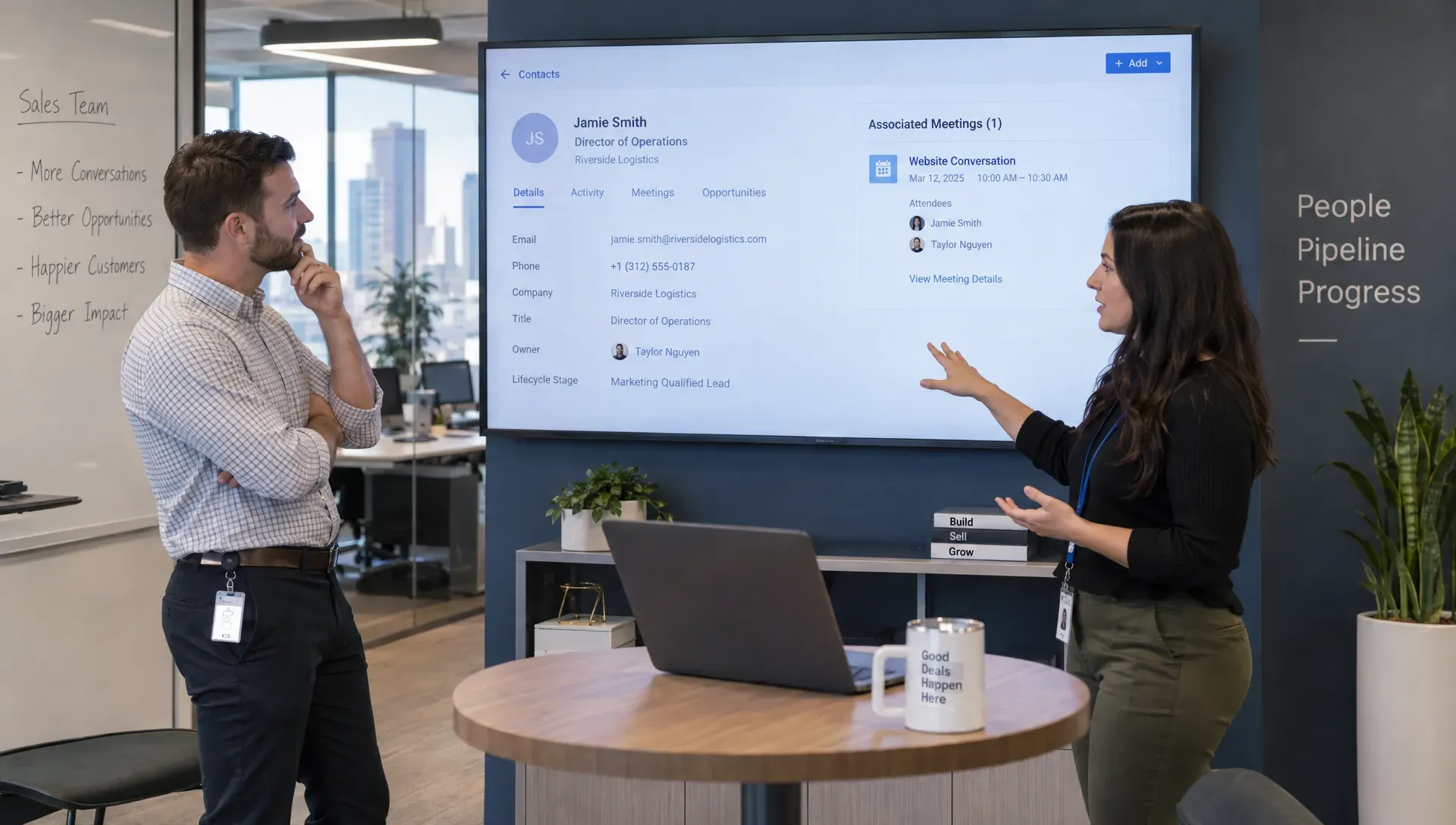
A dashboard showing 100 meetings booked can describe very different realities: 100 genuine buyer appointments, 100 calendar invitations or 70 appointments mixed with reschedules and duplicates. If those records all feed pipeline reporting, activity starts looking like revenue potential before anyone has established whether a real sales opportunity exists.
The fix is to separate three things: the booking event, the meeting outcome and the commercial opportunity. Each needs its own definition, identifier and reporting date. Calendar activity can show whether your scheduling process works. Attendance shows whether conversations happen. Qualification and opportunity creation show whether those conversations move the business forward.
This guide sets out a practical measurement framework for sales, marketing and revenue operations. It covers what counts, how to handle messy calendar events and which conversion rates belong together. The goal is a dashboard that explains performance rather than simply displaying a larger number.
What should meetings booked actually count?
Use this operational definition: a booked meeting is one distinct buyer appointment with an agreed time, an assigned host and evidence that the prospect chose or agreed to that time.
An unsolicited invitation does not qualify just because it appears on a rep’s calendar. A scheduling-link click without a completed booking does not qualify either. A prospect selecting an available slot does qualify, even if they never separately click “Accept” in their calendar.
Keep these measures distinct:
- Measure: Invitation sent — What it establishes: A calendar invitation was issued — What it does not establish: Prospect agreement
- Measure: Booked — What it establishes: A prospect agreed to a scheduled appointment — What it does not establish: Attendance or commercial fit
- Measure: Calendar accepted — What it establishes: An attendee returned an affirmative RSVP — What it does not establish: Attendance or qualification
- Measure: Held — What it establishes: The buyer and seller had a substantive conversation — What it does not establish: A qualified opportunity
- Measure: Qualified meeting — What it establishes: The appointment meets your documented qualification criteria — What it does not establish: Guaranteed opportunity creation
“Accepted” needs particular care. Some teams mean a calendar RSVP; others mean an account executive accepted an SDR handoff. Store those as separate fields rather than combining them into one ambiguous status.
Also distinguish booking-time qualification from post-meeting qualification. A prospect can appear suitable before the call but reveal a disqualifying requirement during discovery. Both observations are useful, provided the dashboard labels them clearly.
Count buyer appointments, not calendar changes
The cleanest way to measure meetings booked is to assign a stable logical appointment ID and attach calendar changes to it. Calendar event IDs alone may be insufficient when systems create replacement events during rescheduling.
Use a consistent policy for common exceptions:
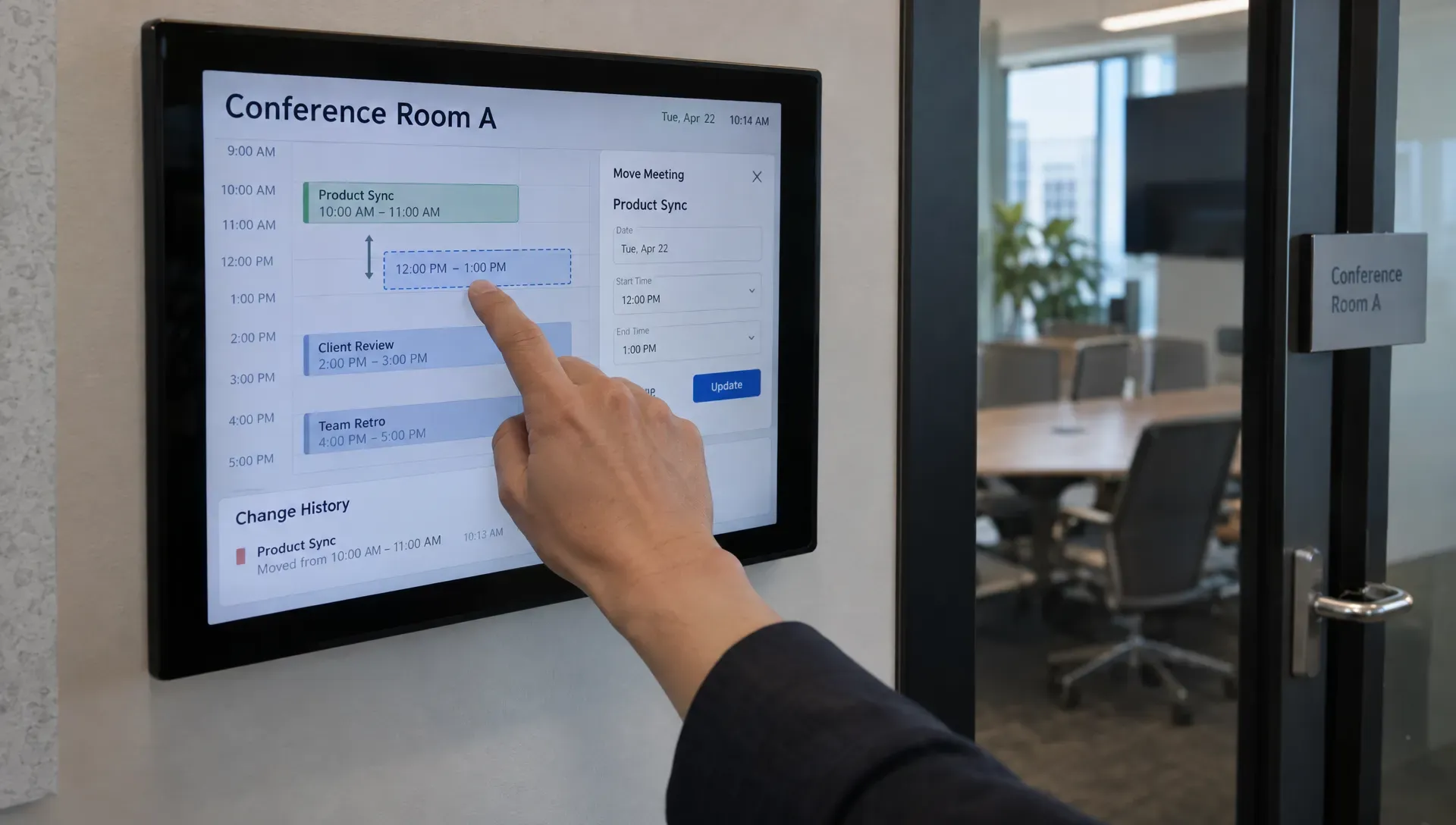
- Reschedules: Retain the logical appointment ID and original booking date. Update the scheduled time and preserve the change history.
- Cancellations: Keep the original booking in gross activity reporting, but remove the appointment from the currently scheduled total.
- No-shows: Record the missed attempt explicitly. If the same unheld appointment is recovered, retain its logical identity and preserve the earlier no-show.
- Duplicate invitations: Merge records representing the same appointment, including duplicates created across connected systems.
- Multiple attendees: Count one appointment, not one booking per attendee or sales rep.
A substantive follow-up after a completed discovery call is a new meeting. Moving an unheld discovery call to Thursday is not.
This distinction requires judgment in edge cases, so document the rule rather than letting individual reps decide. Define internal-only meetings, recruiting calls, support appointments and test bookings as exclusions from the sales acquisition metric.
Keep gross bookings and current scheduled inventory visible side by side. The first measures new booking activity during a period. The second measures appointments still on the calendar. Neither should silently replace the other.
Build a minimum CRM measurement model
Reliable reporting depends on preserving history, not just displaying the latest calendar status. Your CRM, scheduling system or reporting layer should let you reconstruct what happened and when.
For meetings booked, the minimum useful record includes identity, timing, outcome and opportunity linkage:
- Field group: Identity — Recommended fields: Logical appointment ID, source event IDs, contact ID, account ID — Reporting purpose: Deduplication and account matching
- Field group: Timing — Recommended fields: Original booking timestamp, original scheduled start, current scheduled start, timezone — Reporting purpose: Cohort and calendar reporting
- Field group: Lifecycle — Recommended fields: RSVP status, cancellation timestamp, attempt outcome, held timestamp — Reporting purpose: Attendance and exception handling
- Field group: Qualification — Recommended fields: Booking-time fit, post-call qualification, reason, reviewer — Reporting purpose: Quality measurement
- Field group: Ownership — Recommended fields: Booking owner, meeting host, account owner — Reporting purpose: Consistent credit assignment
- Field group: Commercial link — Recommended fields: Opportunity ID, relationship type, link timestamp — Reporting purpose: Opportunity-level reporting
- Field group: Attribution — Recommended fields: Booking source, campaign, supporting interaction ID — Reporting purpose: Traceable channel analysis
Preserve outcome history separately from the current appointment state. A no-show followed by a successful rebooking should not make the missed attempt disappear.
Qualification fields should include “unknown” or “pending.” Missing information is not the same as a failed qualification check, and an empty field should not automatically become a positive result.
If the booking process itself collects little useful context, improve that upstream. A process designed to help qualified visitors book a meeting gives reporting a stronger starting point, but it still needs post-call validation.
Separate booking cohorts from calendar-period outcomes
A booking cohort groups appointments by when they were first booked. A calendar-period report groups meeting activity by when it was scheduled or held. Both are useful, but they answer different questions.
Use the booking cohort to ask: “What happened to appointments generated by this campaign or team during October?” Use the calendar view to ask: “How many buyer conversations did our sellers hold in October?”
Dividing October’s held meetings by October’s meetings booked mixes populations. Some October calls were booked in September, while some October bookings will not happen until November.
For conversion reporting, follow the same logical appointment IDs from booking through outcome. Show how many are still pending and allow enough observation time before comparing cohorts. A cohort with many future appointments should not be ranked against one whose outcomes are complete.
Label every dashboard with its date basis, reporting timezone and cutoff. If qualification is assessed after a call, distinguish the meeting date from the assessment date.
For period-to-period comparisons, use a consistent observation window appropriate to your sales cycle. There is no universal number of days that makes every cohort mature. The important point is to disclose the window and avoid treating unresolved appointments as failures or successes.
A worked example with honest denominators
Consider an illustrative cohort with 100 incoming calendar records. An audit identifies 10 duplicate records and 20 replacement records from rescheduling. That leaves 70 distinct appointments, not 100.
At the reporting cutoff, their latest outcomes are:
- Cohort status: Held — Distinct appointments: 40
- Cohort status: Canceled before the scheduled time — Distinct appointments: 10
- Cohort status: No-show, not subsequently recovered — Distinct appointments: 12
- Cohort status: Scheduled for a future date — Distinct appointments: 8
- Cohort status: Total — Distinct appointments: 70
Assume the 62 non-future appointments were all due by the cutoff. The cohort’s held rate among appointments due is 40 ÷ 62 = 64.5%, with cancellations included in that denominator. Label it accordingly rather than calling it an undefined “show rate.”
The held-to-total-booked ratio is 40 ÷ 70 = 57.1%, but it remains provisional because eight appointments are unresolved.
Suppose 30 of the 40 held conversations meet your post-call qualification criteria. The qualified-held share is 30 ÷ 40 = 75%. That is a quality measure among completed conversations, not a booking conversion rate.
These meetings booked produced different answers depending on the question. Reporting the denominator beside each percentage prevents a technically correct number from becoming a misleading claim. These figures illustrate the method; they are not performance benchmarks.

Keep meeting quality separate from opportunity value
Qualification should describe evidence, not a rep’s optimism. Define the minimum conditions that make a conversation worth progressing, such as account fit, a relevant business problem and a plausible next step. Adapt the criteria to your sales motion rather than requiring information buyers cannot reasonably provide before a first call.
A useful comparison is appointment-only property sales. A scheduled viewing at Hermitage Park is an appointment to explore a home, not a completed purchase. The same distinction applies to a B2B demo: agreement to talk shows interest, not an established commercial opportunity.
Never convert meetings booked directly into pipeline dollars by multiplying them by an assumed deal value. That produces a planning estimate, not actual pipeline. If you use such a model for capacity planning, label it as a forecast assumption and keep it outside recorded opportunity totals.
Create opportunities under your documented stage-entry rules. Link relevant meetings to those opportunities, then deduplicate by opportunity ID before summing value.
For example, if three meetings relate to one $40,000 open opportunity, the associated open pipeline is $40,000, not $120,000. Use the opportunity’s recorded amount, current stage and reporting currency at the stated cutoff.
Track opportunity creation and current open pipeline separately. An opportunity created from a meeting may later close or be disqualified, so historical creation totals should not be confused with today’s open balance.
Attribute bookings without multiplying credit
Attribution needs a defined scope. A website interaction might generate the appointment, an SDR might arrange it and an account executive might host it. Those are different contributions, not three additional bookings.
For meetings booked, assign one primary booking source under a documented rule. Keep supporting touches in separate fields. A reschedule should not reset the acquisition source simply because a different link was used.
At opportunity level, distinguish two relationships:
- Sourced: The meeting meets your documented rule for originating the opportunity.
- Influenced: The meeting contributed to an opportunity that already existed or had another origin.
An influenced-pipeline report can legitimately associate several activities with the same opportunity. Its channel rows are therefore not necessarily additive. If leadership needs an additive total, deduplicate opportunities across channels or use an explicitly defined fractional allocation.
Apply the same discipline to people. Booking owner, host and account owner can each receive role-specific credit, but their individual totals should not be summed into a company-wide appointment count.
Keep evidence behind attribution decisions: the originating conversation, scheduling interaction or campaign record. Attribution is a reporting convention supported by that evidence, not proof that a single touch caused the deal.
Give sales, marketing and RevOps one reporting contract
Write a short metric specification before adjusting dashboards or compensation. It should identify the counting unit, qualifying conditions, exclusions, date basis, denominator rules and accountable owner.
Agree on what “sales accepted” means separately from calendar acceptance. Then establish who reviews qualification and how disputed or missing outcomes are resolved. Otherwise, two teams can use identical labels while measuring different things.
Review meetings booked alongside held conversations, qualified-held meetings and unique opportunities created. This makes it harder for higher scheduling volume to conceal weak attendance or poor fit.
During a regular reconciliation, inspect a sample of records from the calendar through to the CRM opportunity. Look for replacement events counted as new appointments, missing outcomes and opportunity amounts duplicated through meeting-level joins.
When a definition changes, record its effective date and annotate the dashboard. Do not quietly compare a new definition with an old one as though performance alone changed.
For SDR evaluation, keep booking effort visible without making it the only rewarded outcome. Attendance and qualification add context, but downstream opportunity results also depend on routing, seller execution and the buying cycle. Assess those factors before attributing every loss to booking quality.
Frequently asked questions
Does a calendar invitation count as a booked meeting? Not by itself. Count it when there is evidence that the prospect chose or agreed to the scheduled time. Track unsolicited invitations as outreach activity instead.
Should canceled appointments remain in meetings booked? Yes, in the historical gross booking cohort, provided they met the original definition. Exclude them from currently scheduled inventory and show cancellation outcomes separately. This preserves both acquisition activity and calendar reality.
Should a rescheduled meeting count twice? No. Moving the same unheld appointment changes its scheduled time, not its identity. Preserve any earlier missed attempt. A genuinely new follow-up conversation after a held meeting can receive a new appointment ID.
What is a good meeting-to-opportunity conversion rate? There is no universal target that fits every sales motion. Define whether the denominator is booked, held or qualified-held appointments, then compare mature cohorts with similar sources and qualification standards. Deduplicate opportunities and disclose unresolved records.
Connect the conversation to the commercial outcome
Nudge helps B2B teams engage website visitors, answer questions, book meetings and continue with personalized follow-ups and sales preparation briefs. Its CRM integrations and pipeline analytics can support a connected workflow, but your team still needs shared measurement rules.
If you are evaluating Nudge for your inbound sales process, bring those rules into the discussion: what counts as an appointment, how outcomes are recorded and when a conversation becomes an opportunity. Start with a definition your teams can reconcile, then measure whether more bookings lead to more qualified conversations and real pipeline.