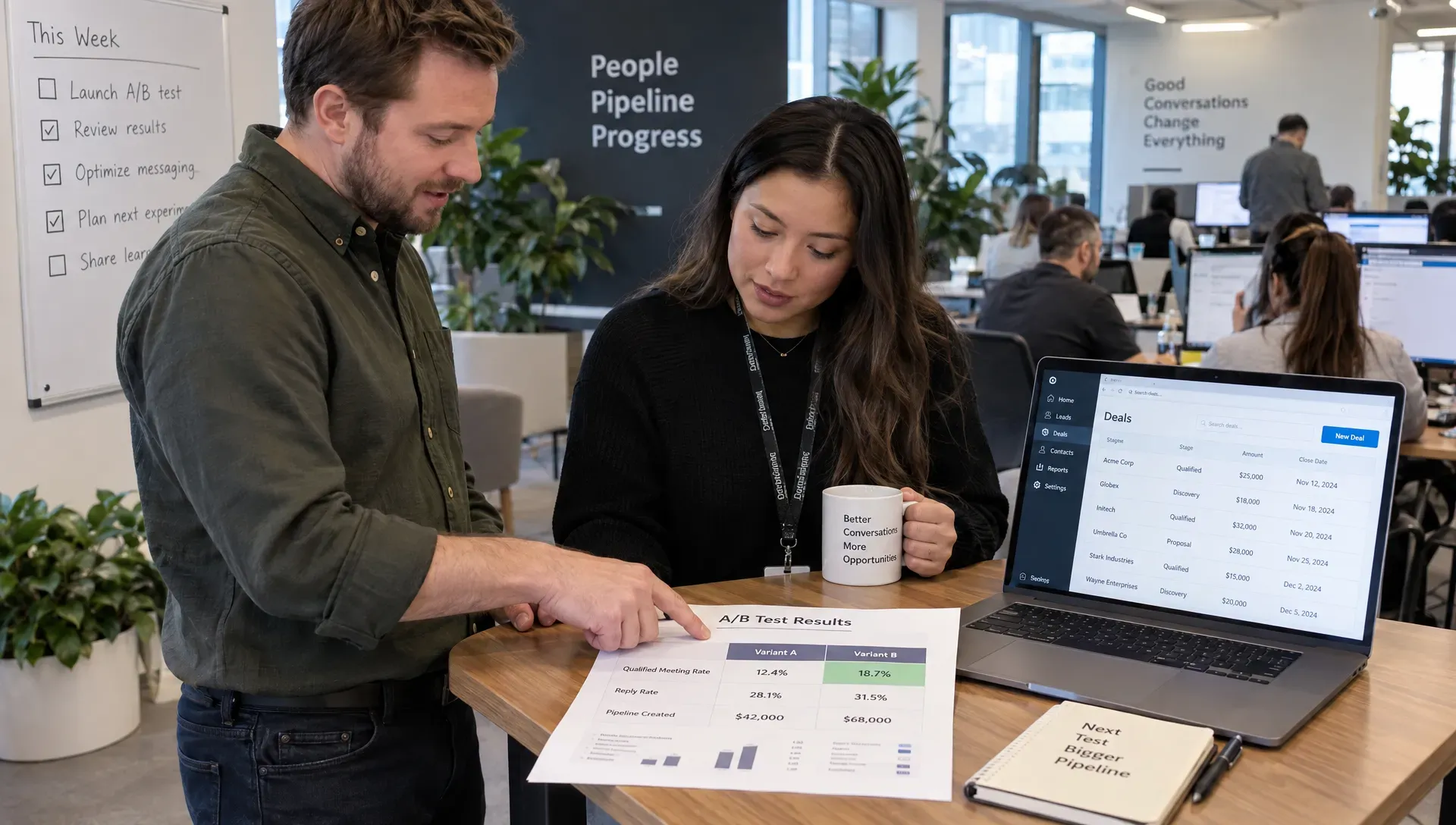
An A/B test on your website sales agent should tell you whether a specific change creates more qualified sales conversations, not just more chats. That means comparing randomly assigned groups, tracking outcomes beyond the booking button and deciding what counts as success before the experiment starts.
A new opening message might increase engagement while attracting fewer qualified buyers. An earlier meeting invitation might generate bookings that never turn into attended calls. Your test needs to distinguish those outcomes.
This guide covers experiments on a production-ready agent. If you have not yet checked answer accuracy, booking behavior and escalation rules, first test your website agent before it talks to buyers.
1. Choose a business outcome, not an engagement metric
Start with the decision you need to make: should this version replace the current experience?
For many B2B teams, a useful primary metric is qualified meetings held per eligible visitor assigned to the experiment. It connects website behavior to a conversation sales can actually use.
Define each part before launch:
- Eligible visitor: Someone who meets predetermined inclusion rules, such as visiting selected product or pricing pages, excluding known employees and bots.
- Qualified meeting: A meeting that meets written account-fit and use-case criteria, applied consistently across both groups.
- Measurement window: A fixed period after assignment during which the meeting must occur, such as 30 days if that fits your booking cycle.
The denominator must include all eligible assigned visitors, including people who never open the agent. Comparing only people who chat creates selection bias because the treatment can change who starts a conversation.
Count qualifying meetings booked through other website routes too, where identity matching permits. Otherwise, an agent that moves buyers from a demo form into chat can appear to create demand when it merely changes the booking path.
Use conversation starts and booking clicks as diagnostic metrics, not substitutes for the primary outcome.
2. Change one part of the website sales agent experience
A useful hypothesis identifies a buyer obstacle, a specific change and an expected business effect.
For example:
On integration pages, offering to answer CRM compatibility questions before suggesting a demo will increase qualified meetings held per assigned visitor compared with our current generic greeting.
Keep the control as the current experience. Change the opening message in the treatment, but hold the knowledge sources, qualification criteria, scheduling rules and follow-up sequence constant.
The principle is easy to see outside software. Lulu Location’s electric-cart rental page in Terre-de-Haut presents seating, rates and pickup details alongside its booking offer. Those details answer readiness-to-book questions. On a B2B site, the equivalent obstacle might be CRM compatibility or implementation requirements.
Other useful variables include when the agent appears, when it offers a meeting and whether it asks a qualification question before scheduling. Choose one for the first experiment.
If you change the greeting, timing, qualification flow and follow-up together, you can evaluate the entire package, but you cannot identify which component caused the difference. For a message-only experiment, use specific, intent-matched CTA wording rather than changing the surrounding sales process as well.
3. Randomize visitors and keep their assignment stable
A 50/50 split is a practical default for a two-variant experiment because it usually provides the most statistical precision for a fixed audience size.
Assign visitors when they first become eligible, before either experience can influence their behavior. Keep that assignment stable on return visits using an appropriate first-party identifier, subject to your consent requirements.
Your website sales agent test should not randomly assign each conversation independently. A prospect who sees both versions may carry information from one experience into the other.
B2B buying groups introduce another complication: several visitors may belong to the same account. If reliable account identity is available before assignment, account-level randomization can reduce cross-variant exposure. Analyze at that level or use methods that account for clustering. A visitor-level sample-size calculation is not sufficient for an account-randomized experiment.
When identity is incomplete, document the limitation. Browser-level assignment cannot guarantee that someone using a phone and laptop receives the same treatment. Track known crossover where possible without resorting to invasive identification.
Run both variants concurrently across the same traffic sources. Comparing last month’s control with this month’s treatment confounds the change with campaigns, seasonality and shifts in buyer intent.
4. Track assignment through the CRM outcome
Logging conversations is not enough. You need an experiment assignment that can be connected to booking and qualification outcomes.
Use a measurement plan like this, adapting event names to your analytics stack:
- Event or record: Experiment assignment — Minimum information: Experiment ID, variant, assignment time and visitor or account ID — What it establishes: The randomized population
- Event or record: Agent displayed — Minimum information: Assignment ID, page and timestamp — What it establishes: Whether delivery worked as intended
- Event or record: Conversation started — Minimum information: Assignment ID and conversation ID — What it establishes: A diagnostic engagement outcome
- Event or record: Meeting booked — Minimum information: Assignment ID, booking ID and booking time — What it establishes: The scheduling outcome
- Event or record: Meeting outcome — Minimum information: Booking ID, held or canceled status and qualification result — What it establishes: The primary business outcome
For the primary rate, count each assigned unit at most once as a success, even if it generates multiple qualifying meetings. If you randomize visitors, analyze visitors. If you randomize accounts, analyze accounts.
Keep the qualification rubric identical across variants. Where practical, have sales assess qualification without seeing experiment assignment.
Document how you handle reschedules, duplicate leads, existing opportunities and unmatched CRM records. Investigate whether missing outcomes differ by variant rather than silently dropping incomplete records.
Store only the identifiers and fields needed for measurement. Avoid copying full transcripts or unnecessary personal information into analytics events.
5. Calculate sample size before starting the clock
There is no universal rule that an A/B test should run for two weeks. Required traffic depends on your baseline conversion rate and the smallest improvement worth detecting.
Consider an illustrative website sales agent experiment, not an industry benchmark:
- Baseline qualified-meeting rate: 2.0%.
- Target rate: 2.5%.
- Minimum detectable effect: 0.5 percentage points, equivalent to 25% relative lift.
- Statistical design: A fixed-horizon, two-sided test with a 5% significance level and 80% power.
A conventional two-proportion calculation requires roughly 14,000 independent visitors per variant, or 28,000 total. Account clustering, missing outcomes or a different analysis method can change that requirement.
At 2,000 eligible visitors per week, enrollment alone takes about 14 weeks. You then need to let the final cohort complete its outcome window. A 30-day meeting window means the last visitor needs the same 30 days of follow-up as the first.
Record the sample target and stopping rule before launch. Do not repeatedly check for statistical significance and stop at the first favorable result. If you need continuous statistical monitoring, use a properly configured sequential method instead of treating every daily check as a fresh fixed-horizon test.
Low traffic may make small effects impractical to detect. Test a larger, plausible change or accept that the result will remain uncertain. Lowering the evidence standard afterward does not solve the traffic problem.

6. Validate delivery and monitor safety
Before opening the experiment to the full eligible audience, verify the complete path from assignment to CRM outcome with clearly labeled test records. Exclude those records using predetermined rules.
Check that returning visitors retain their assignment, both variants receive the intended content and booking records preserve the experiment identifier. Test mobile layouts and verify that fallback behavior works when scheduling is unavailable.
A website sales agent experiment also needs a delivery check. If a planned 50/50 allocation produces an unexpectedly uneven split, investigate a possible sample ratio mismatch before interpreting conversion results. Causes can include assignment bugs, inconsistent eligibility rules or missing events.
Keep calendar access, routing rules, sales response expectations and knowledge sources consistent across groups. Avoid changing the underlying model or prompt halfway through the experiment. If a material change is unavoidable, document it and assess whether the test needs to restart.
Predetermine safety conditions that justify pausing, such as unauthorized pricing promises, disclosure of restricted information or broken booking flows. Safety monitoring is separate from repeatedly searching for a favorable conversion result.
Also monitor complaints, opt-outs and no-shows. Higher booking volume is not a useful improvement if buyers receive misleading answers or sales inherits an unmanageable calendar.
7. Read absolute lift, uncertainty and lead quality together
Suppose the completed experiment produces these hypothetical results:
- Outcome: Assigned visitors — Control: 14,000 — Treatment: 14,000
- Outcome: Qualified meetings held — Control: 280 — Treatment: 350
- Outcome: Qualified-meeting rate — Control: 2.0% — Treatment: 2.5%
The treatment produces an observed increase of 0.5 percentage points, or 25% relative lift. Reporting both prevents the relative figure from overstating the practical size of the change.
Under a simple independent-visitor, fixed-horizon analysis, an approximate 95% confidence interval for the absolute difference is +0.15 to +0.85 percentage points. Different randomization units or statistical methods require the corresponding analysis.
Read that result alongside your original decision criteria. Does the estimated improvement justify implementation and operating costs? Did booking failures or complaints increase? Are the meetings still meeting the same qualification standard?
For your website sales agent, downstream opportunity creation can provide valuable confirmation, but compare cohorts with equal follow-up time. Do not replace an unsuccessful primary metric with whichever secondary metric happens to look best.
Treat unplanned segment findings as hypotheses. A promising result among a small group of returning pricing-page visitors is not automatically a reliable winner. It may justify a follow-up experiment designed specifically for that audience.
8. Roll out the winner without losing the learning
Before deployment, save a short experiment record containing the hypothesis, exact variants, eligibility rules, randomization unit, outcome window, sample size and result.
State the decision plainly: ship the treatment, keep the control or gather more evidence through a new experiment. An inconclusive result does not establish that the variants are equivalent.
Roll out gradually when operational risk warrants it, then confirm that answer quality, booking reliability and meeting quality remain stable. A small continuing holdout can help measure persistent impact when traffic and operational constraints allow it, but it should have a defined purpose and analysis plan.
Do not describe all pipeline associated with the treatment as incremental or recovered pipeline. Randomization estimates the difference between experiences. Actual opportunity value also needs adequate CRM coverage and time to mature.
Start with one measurable buyer obstacle
Choose one unresolved visitor question, one controlled change and one business outcome. Confirm the assignment and CRM data flow before launch, then let the experiment reach its planned endpoint.
For teams evaluating Nudge, website conversations, meeting booking, personalized follow-ups and sales preparation briefs are workflows to assess against this scorecard. Confirm how variant delivery and experiment tracking will work in your setup rather than assuming native A/B testing controls are available.
Frequently asked questions
How long should an A/B test on a website sales agent run?
Long enough to reach the planned sample size, cover relevant traffic cycles and allow every included visitor’s outcome window to mature. Two weeks is not sufficient simply because it is a common testing interval.
Should I compare an agent with no agent?
Yes, if your question is whether the agent adds incremental value. Keep the rest of the site consistent and define whether automated sales follow-up is part of the treatment. Measure qualifying outcomes across all booking routes, not just agent-attributed meetings.
Can I run multiple experiments at once?
Only if you can manage overlap and interactions. A simultaneous landing-page change can alter the effect of an agent message. For a first test, avoid overlapping changes on the same audience unless your experimentation design explicitly handles them.
What if there is not enough traffic for a reliable result?
Use transcript reviews and usability sessions to identify larger buyer obstacles, then test a more meaningful change. Those methods can improve the experience, but they do not establish causal conversion lift on their own.