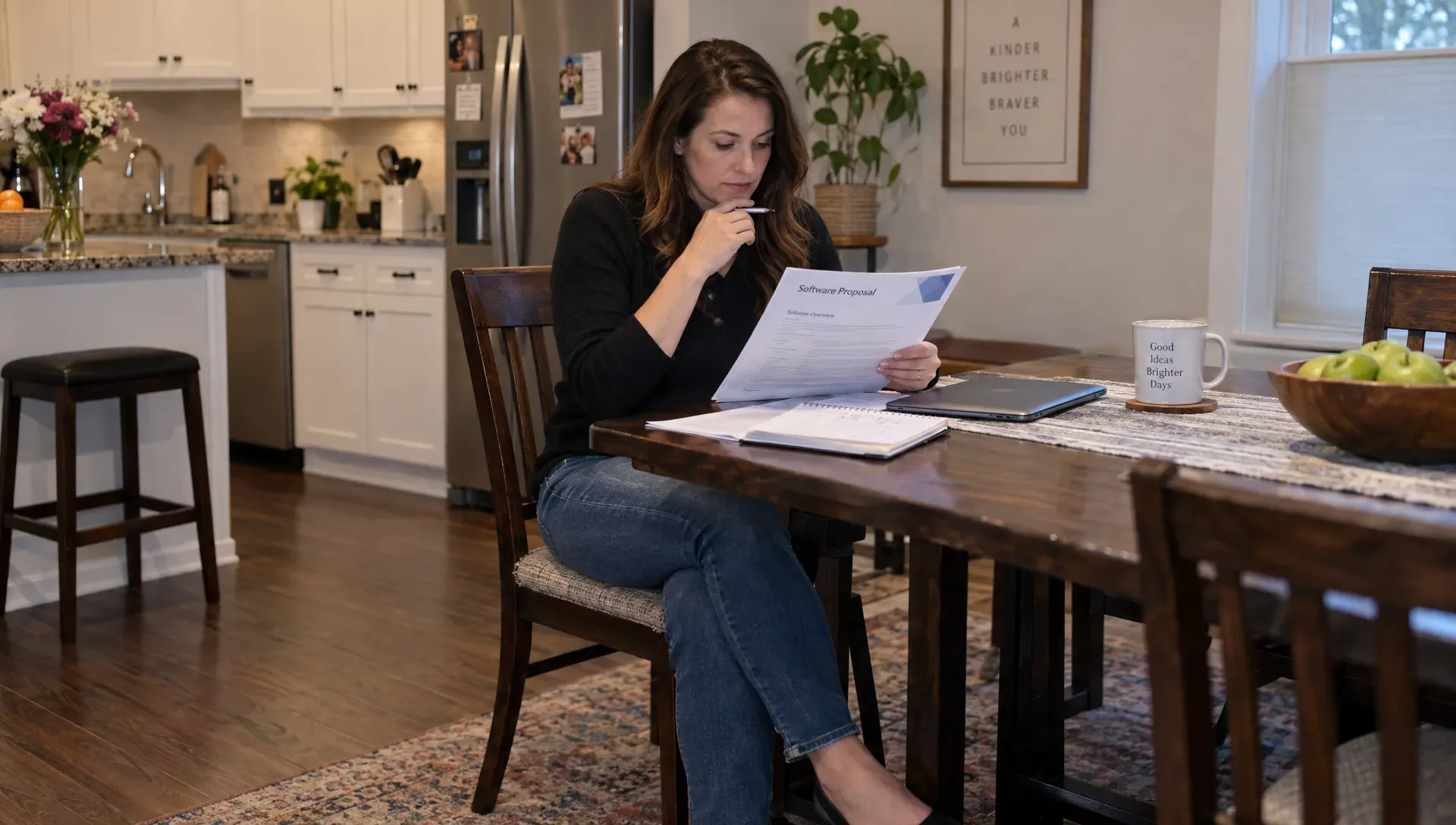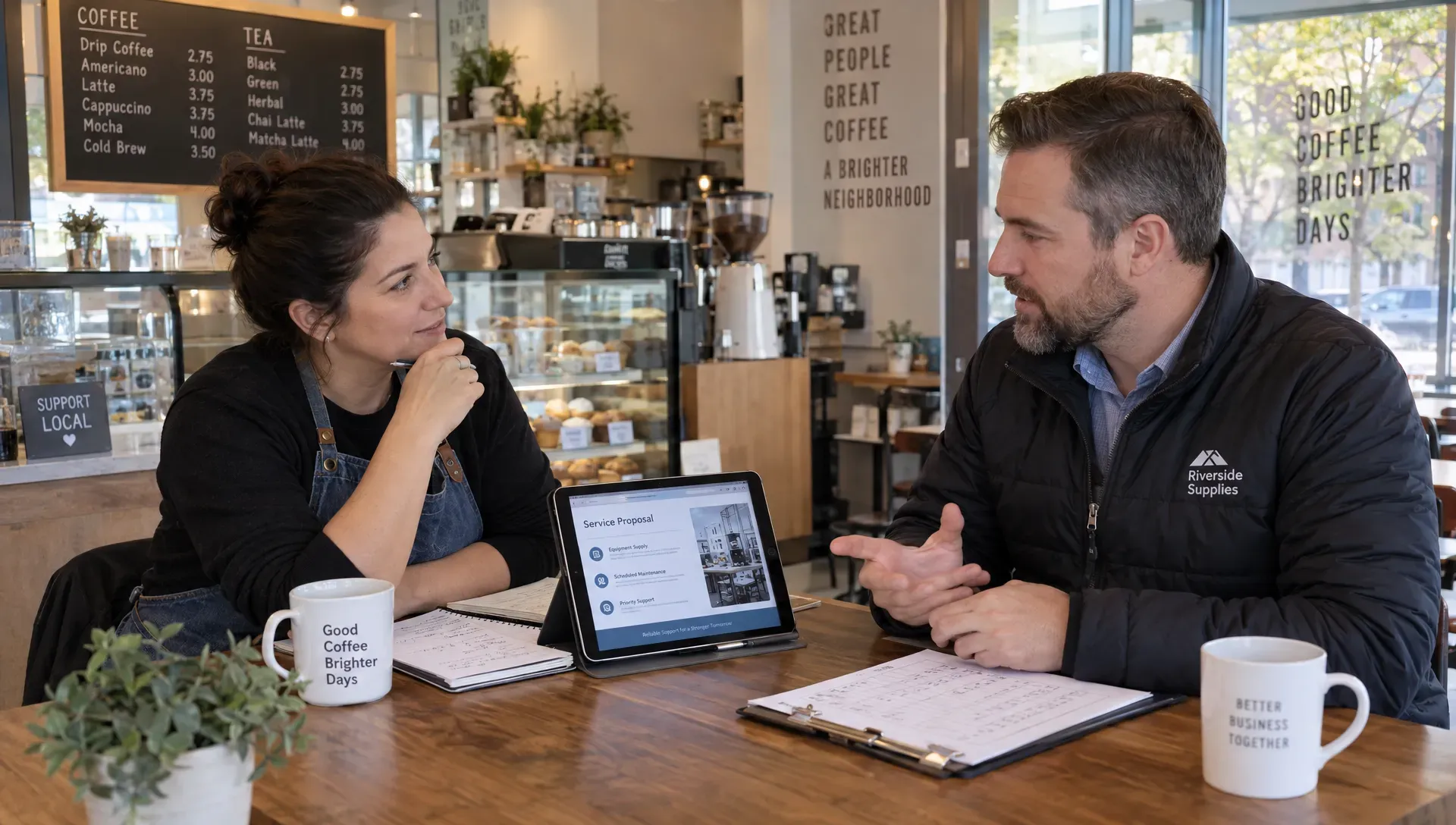
B2B sales means selling products or services from one business to another. The buyer purchases on behalf of an organization, whether that means software for a finance team, machinery for a factory or consulting for a growing company.
The transaction might take one conversation or months of evaluation. What makes it different from a consumer purchase is the organizational decision behind it: someone must establish the need, justify the expense and secure any required approvals.
This guide explains who participates, how buying cycles work and which deal stages help sellers distinguish genuine progress from a busy calendar.
What the business-to-business model includes
The defining factor is who buys, not what gets sold. A laptop purchased for personal use is a consumer transaction. The same laptop purchased by an employer for its staff is a business transaction.
Common examples include a software company selling an accounting subscription, a manufacturer supplying components to an equipment maker and an agency providing marketing services to a retailer.
How it differs from consumer selling
B2B sales often involves several stakeholders, negotiated terms and requirements that extend beyond the individual user. A department might want a product while finance questions its cost and IT reviews its security.
Those differences are tendencies, not universal rules. A small business can purchase a standard subscription immediately, while a consumer may spend months choosing a home. Price alone does not determine the sales model.
The practical distinction is accountability. A business buyer usually needs to explain how a purchase supports an operational goal, addresses a risk or produces an acceptable financial outcome. Sellers need to understand that justification, not simply demonstrate attractive features.
Who participates in a deal?
There are two sets of roles to understand: the people responsible for selling and the people responsible for deciding. Neither side always follows a neat organizational chart.
Seller-side roles
Titles vary by company, but these responsibilities commonly appear:
- Sales development representative (SDR): Engages potential buyers, assesses initial fit and arranges qualified conversations. Some teams use business development representatives (BDRs) primarily for outbound prospecting.
- Account executive (AE): Leads discovery, coordinates evaluation, develops proposals and works toward a purchasing decision.
- Sales engineer or solutions consultant: Tests technical fit through demonstrations, architecture discussions or proof-of-concept work.
- Customer success or account management: Supports adoption, ongoing value, renewals or expansion, depending on how the company divides responsibilities.
- Revenue operations: Maintains CRM processes, reporting, routing and the systems that connect marketing, sales and customer teams.
In a small B2B sales team, one person may perform several of these jobs. Clear ownership matters more than having every title: someone should know who responds to an inquiry, who runs the evaluation and who owns the next step.
Buyer-side roles
A contact who likes your product is not necessarily authorized to buy it. Useful distinctions include:
- Buyer role: End user — Main concern: Whether the solution improves daily work — What the seller needs to establish: Real workflows and adoption needs
- Buyer role: Champion — Main concern: Whether the purchase solves an important internal problem — What the seller needs to establish: Willingness and ability to build support
- Buyer role: Economic buyer — Main concern: Whether the investment is justified — What the seller needs to establish: Budget authority and decision criteria
- Buyer role: Technical or security reviewer — Main concern: Whether the solution meets organizational requirements — What the seller needs to establish: Integration, security and implementation constraints
- Buyer role: Procurement or legal — Main concern: Whether the supplier and terms are acceptable — What the seller needs to establish: Purchasing procedures, contract requirements and timing
One person can hold multiple roles. A founder might be the user, budget owner and contract signer. In a larger organization, those responsibilities may sit across several departments.
A champion is especially useful because they can explain how the organization actually makes decisions. Enthusiasm alone is not enough; look for concrete actions such as introducing a budget owner or helping define evaluation criteria.
How the buying cycle works
The B2B sales cycle is the elapsed time from a defined starting point to a closed deal. Teams use different starting points, such as the first substantive conversation or the creation of a qualified opportunity, so comparisons require consistent definitions.
The buyer’s journey is related but different. Buyers move through recognizing a problem, researching options, comparing approaches, building internal agreement and authorizing a purchase. Much of that work may happen before a seller becomes involved.
Why some purchases take longer
Cycle length depends on the work required to reach a decision. A replacement for an existing tool may already have an approved budget. A new category of software may require a business case, security review and changes to established workflows.
Other sources of delay include implementation complexity, annual budgeting, competing priorities and uncertainty about who owns the problem. A responsive contact does not eliminate these constraints.
There is no single useful average for every business purchase. A self-service subscription and a multi-site equipment contract are different buying processes.
Why the journey is not linear
Buyers revisit earlier decisions. A security review can change the shortlist. A new finance leader can reopen the business case. An internal project can lose priority even after a successful demonstration.
Treat the cycle as a coordinated decision process rather than a countdown. For each active deal, identify what the buyer still needs to decide, who must participate and what evidence would resolve the uncertainty.
The deal stages: from interest to a signed agreement
A B2B sales pipeline translates the buying process into stages a team can manage. The stages should reflect buyer progress, not just seller activity.
Prospecting and initial inquiries usually happen before an opportunity enters the pipeline. A downloaded guide or booked introductory call does not, by itself, prove that an active purchasing process exists. Define your threshold using consistent inbound lead qualification criteria.
A practical seven-stage pipeline
The following is a starting model, not a universal sequence. Smaller purchases may combine stages, while complex deals may run technical and commercial reviews in parallel.
- Stage: 1. Qualified opportunity — What happens: Seller and buyer establish a plausible fit — Evidence needed to move forward: A relevant problem, suitable account and agreed next conversation
- Stage: 2. Discovery — What happens: Both sides examine the problem and desired outcome — Evidence needed to move forward: Confirmed impact, requirements and decision process
- Stage: 3. Solution validation — What happens: The buyer evaluates the proposed approach — Evidence needed to move forward: Agreed evaluation criteria and evidence of fit
- Stage: 4. Business case and consensus — What happens: Stakeholders assess value, cost and organizational support — Evidence needed to move forward: Support from relevant decision-makers and a credible funding path
- Stage: 5. Commercial negotiation — What happens: Both sides work through scope, pricing and terms — Evidence needed to move forward: Alignment on the commercial proposal, subject to remaining approvals
- Stage: 6. Procurement and contracting — What happens: Required purchasing, legal and supplier checks are completed — Evidence needed to move forward: Final approvals and an agreement ready for execution
- Stage: 7. Closed won — What happens: The purchase is formally committed — Evidence needed to move forward: An executed agreement or accepted order under the company’s documented policy
A B2B sales opportunity can move backward when new information invalidates an earlier assumption. That is more useful than leaving it in a late stage simply because the seller has already sent a proposal.

Record stalled and lost deals honestly
“Proposal sent” describes an action. “The budget owner has accepted the scope and requested contract review” describes buyer progress. Stage definitions should favor the second kind of evidence.
Every active stage should also allow a closed-lost outcome. Record a meaningful reason, such as a competitor selection, insufficient fit, unavailable budget or no decision. Losing to the status quo is different from losing to another vendor.
When a buyer pauses indefinitely, an opportunity should not remain active just to preserve pipeline value. Close it or move it into a clearly defined nurture process according to your team’s policy. Keep the context so a later conversation can resume without repeating the entire evaluation.
How to manage a B2B sales process
A process works when another team member can open the record and understand the buyer’s situation without reconstructing months of emails. Consistent notes, ownership and stage rules make that possible.
Establish the next buyer commitment
End each substantive conversation with an agreed action, owner and date. That action might be a technical workshop, a budget discussion or a review of evaluation results. Sending another brochure is not equivalent to advancing a decision.
Use a shared action plan for complex purchases. Keep it short and tie milestones to the buyer’s intended outcome, including approvals and implementation dependencies. Confirm dates with the buyer rather than treating the seller’s target close date as a commitment.
Measure progress with consistent definitions
Useful B2B sales metrics connect activity to outcomes rather than counting every interaction as success.
Track stage-to-stage conversion to see where opportunities stop progressing. Review time in stage to identify aging deals, but investigate the cause before assuming that every delay signals a problem.
For a clearly defined closed-won cohort, average sales cycle length is the sum of elapsed days for won deals divided by the number of won deals. State when the clock starts and report lost opportunities separately if they are excluded from that calculation.
Win rate also needs a denominator. Won deals divided by won plus lost deals is different from won deals divided by all opportunities created in a period, many of which may still be open.
At the beginning of the process, track how quickly inquiries receive a useful response. Improving speed to lead addresses a different problem from improving negotiation or procurement, so avoid combining them into one vague conversion initiative.
Where AI can support the team
AI can help with repeatable coordination in B2B sales: answering initial questions, arranging meetings, following up and preparing account context. Its value depends on whether the interaction helps the buyer complete a useful next step.
For example, a visitor researching integrations needs an accurate answer before a meeting invitation becomes relevant. A returning prospect may need continuity rather than another introductory qualification sequence. A sales rep needs a concise brief that distinguishes confirmed facts from unanswered questions.
Human sellers still need to understand organizational priorities, resolve conflicting requirements and negotiate commitments. Automation should preserve context and make those conversations better informed, not manufacture confidence about budget, authority or purchase intent.
Frequently asked questions
What does B2B stand for? B2B stands for business-to-business. It describes transactions in which one business sells to another, rather than directly to an individual buying for personal use.
How do you get started in B2B sales? Learn the customer’s business problem, understand the product and practice discovery conversations. SDR and BDR positions can provide experience in prospecting and qualification, although entry paths vary. Focus on listening, clear writing, accurate CRM records and reliable follow-through rather than memorizing a pitch.
Is Coca-Cola B2B or B2C? The Coca-Cola system includes both kinds of transactions. Sales between businesses in its bottling and retail distribution network are business-to-business. A shopper buying a drink from a retailer is making a consumer purchase. Classify the specific transaction, not just the brand.
How long does a business buying cycle take? There is no universal duration. It depends on the purchase, approval requirements, risk and implementation effort. Compare similar deal types using the same start and end definitions instead of applying one benchmark to every opportunity.
What is the difference between a lead and an opportunity? A lead is a potential buyer or account that may warrant further investigation. An opportunity represents a sufficiently qualified potential deal under your team’s rules. Interest alone does not establish a purchase requirement, funding or an active decision process.
Give buyers a useful next step
Better execution starts with clear responsibilities, evidence-based deal stages and an accurate understanding of what the buyer needs to decide next.
For teams that need help turning website questions into conversations, Nudge engages visitors, answers questions using content-based responses with citations and books meetings. Its agents also support personalized follow-ups, returning-visitor identification and sales meeting preparation briefs, helping reps continue the conversation with relevant context.