
Choosing round-robin vs. account-based lead routing comes down to one question: should this inquiry go to the next eligible rep or to the team that already owns the account relationship? Round-robin distributes work across a pool. Account-based routing preserves ownership across contacts from the same company.
Neither model works well without eligibility rules, reliable account matching and a fallback when the intended owner cannot respond. For many B2B teams, the strongest approach combines both: honor established ownership first, then distribute genuinely unowned demand across qualified sellers.
Round-robin vs. account-based lead routing at a glance
Round-robin optimizes distribution. Account-based routing optimizes relationship continuity. Those are different goals, so equal assignment counts are not always evidence of a good routing decision.
- Dimension: Primary decision — Round-robin routing: Who is next among eligible reps? — Account-based routing: Who owns this account or related opportunity?
- Dimension: Best fit — Round-robin routing: Unowned inbound demand with similar coverage needs — Account-based routing: Existing relationships, named accounts and active opportunities
- Dimension: Fairness model — Round-robin routing: Balanced assignment counts, potentially adjusted by weights — Account-based routing: Allocation follows account ownership, even when volumes differ
- Dimension: Required data — Round-robin routing: Eligibility, availability and assignment history — Account-based routing: Reliable account identity, ownership and opportunity context
- Dimension: Common failure — Round-robin routing: Sending a known buyer to an unrelated seller — Account-based routing: Sending demand to an outdated or unavailable owner
- Dimension: Essential safeguard — Round-robin routing: Ownership checks before entering the rotation — Account-based routing: Backup coverage and an exception workflow
The distinction is not necessarily how leads are generated. A website inquiry, event response or outbound reply can use either model. The deciding factors are the buyer’s relationship with your company and the coverage policy that applies.
When round-robin is the better default
Round-robin is useful when several sellers can handle an inquiry equally well and no existing relationship takes precedence. A pooled commercial sales team receiving new demo requests is a typical example.
In a simple, uninterrupted rotation, 12 assignments across four equally eligible reps produce three assignments each. That balances count, not necessarily workload or opportunity value. One rep may receive three complex evaluations while another receives three straightforward requests.
Weighted round-robin can assign different shares to reps with different capacities. It still needs explicit rules for absences, ramping sellers and reassigned leads. Otherwise, apparent fairness can hide uneven work.
Define eligibility before rotating
Do not put every seller into one universal pool. Language, geography, product expertise and customer segment can determine who should receive the inquiry before the rotation starts.
Businesses with several audiences make this distinction clear. Koann, a skills- and mindset-based recruitment platform, serves employers, candidates and schools. For a business with that audience mix, an employer sales inquiry and a school partnership inquiry could require different teams. That calls for separate eligible pools, not necessarily named-account ownership.
Specialization determines who can receive a lead. Round-robin determines who receives it next. Keeping those decisions separate makes routing easier to explain and maintain.
When account-based routing is the better default
Account-based routing assigns an inquiry according to the company relationship rather than treating every contact as an independent lead.
It is particularly useful when several people from one buying committee may arrive through different channels. A procurement manager requesting security information should not automatically enter a general rotation if an account executive is already working with that company’s technical evaluator.
The same principle applies to named target accounts and existing customers. However, account-based routing does not mean every inquiry goes to an account executive. A customer’s support question may belong in a service workflow, while an expansion request may belong with an account manager.
Account-based routing is also not synonymous with account-based marketing. A team can preserve account ownership without running an ABM program.
Account matching is the critical dependency
Ownership rules cannot compensate for an incorrect company match. Shared email domains, subsidiaries, consultants and personal email addresses can all make identity resolution ambiguous.
Use available evidence together, such as authenticated identity, CRM account IDs, verified company information and the relationship stated by the buyer. Do not automatically merge records or redirect ownership based on a weak company-name resemblance.
Also decide what “account” means operationally. A subsidiary may have its own seller even when its parent company has a global account owner. Your policy should specify which level wins.
If these issues are common, strengthen your account matching and CRM data quality checks before expanding automatic routing. Low-confidence matches should enter an explicit exception workflow rather than silently becoming confident assignments.
Build a hybrid policy with explicit precedence
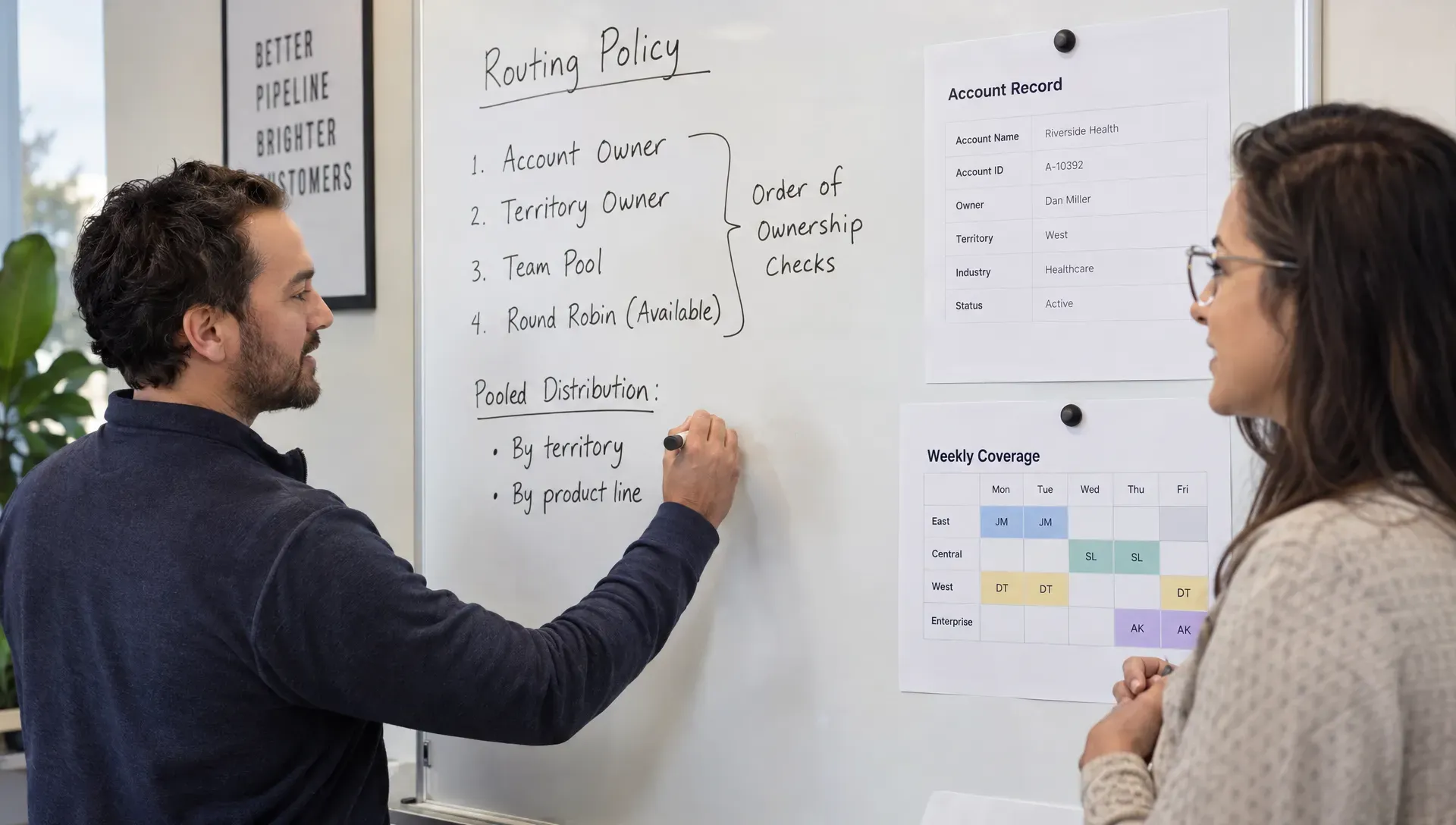
A hybrid approach works when ownership checks happen before pooled distribution. Without a documented order, different systems can make conflicting decisions about the same inquiry.
The following is an example policy, not a universal hierarchy:
- Classify the request: Separate sales inquiries from support, recruiting, vendor outreach and other non-sales requests.
- Resolve account identity: Match the person to an account using approved evidence. Send conflicting matches to review while allowing genuinely new companies to continue.
- Check related active opportunities: Route to the responsible opportunity team when the request clearly belongs to an existing evaluation.
- Honor applicable account ownership: Apply customer, named-account or other established coverage rules when no higher-priority opportunity rule applies.
- Distribute unowned demand: Select the correct territory or specialist pool, then use round-robin or weighted distribution among eligible reps.
- Apply a fallback: Send unresolved or unassignable inquiries to a monitored queue with an accountable owner and a response deadline.
Some organizations will place account ownership above opportunity ownership. Others need a distinct channel-partner rule. What matters is that the order is deliberate, documented and consistent across intake channels.
Record a reason for each decision, such as “related opportunity owner,” “named account owner” or “commercial pool rotation.” That gives operations a way to diagnose disputes without reconstructing the entire buyer journey.
Separate ownership from availability and meeting hosting
The person responsible for an account does not have to be the only person allowed to respond or host a meeting.
Suppose a named-account owner is away when a buyer requests a demo. Waiting indefinitely protects ownership on paper but leaves the buyer unsupported. Sending the inquiry through unrestricted round-robin may create a competing relationship. A backup rep or account pod can provide coverage without changing commercial ownership.
Define three responsibilities separately: who owns the relationship, who responds now and who hosts the meeting. One person may hold all three, but the system should not assume that they are identical.
For example, an SDR could respond and coordinate a meeting, a specialist could join the call and the account executive could remain the owner. The handoff should carry the buyer’s questions, relevant conversation history and next agreed action.
Once that policy is settled, evaluate whether your meeting-booking workflow can support the routing rules. Calendar availability should implement coverage policy, not silently redefine it.
Measure routing quality, not just equal lead counts
Round-robin can look successful because assignments are evenly distributed. Account-based routing can look successful because every inquiry has an owner. Neither measure proves that buyers reached the right person promptly.
Track assignment quality and buyer outcomes together:
- Metric: Account-routing accuracy — What it reveals: Whether audited, account-matched inquiries reached the policy-defined owner
- Metric: Time to resolved ownership — What it reveals: How long inquiries waited before a responsible person or team was established
- Metric: Reassignment rate — What it reveals: How often the initial routing decision needed correction
- Metric: Unassigned inquiry age — What it reveals: Whether exceptions are accumulating without action
- Metric: Booking and meeting completion — What it reveals: Whether routed inquiries progressed to scheduled and attended conversations
- Metric: Distribution within eligible pools — What it reveals: Whether pooled assignments followed the intended shares
Record inquiry receipt, ownership resolution, notification and first meaningful response as separate events. Distinguish automated replies from human responses rather than counting any system message as completed follow-up.
Compare results within similar segments and intent levels. Enterprise account inquiries and small-business demo requests may differ in complexity and conversion potential before routing happens.
For fairness reviews, examine opportunity value and workload alongside count. Account-based coverage may intentionally produce uneven volumes, while round-robin may need capacity adjustments. The question is whether the allocation supports the agreed coverage model, not whether every dashboard bar is identical.
Test the policy before changing live assignments
Start by replaying a sample of historical inquiries through the proposed rules without changing ownership. Include ordinary requests and the cases most likely to expose gaps: a returning contact, a second stakeholder at an active opportunity, a subsidiary, an unavailable owner and a record with conflicting company information.
For each case, compare the proposed recipient with the policy-defined recipient. Where reviewers disagree, resolve the policy before changing the automation. A system cannot consistently execute an ownership rule that the team itself interprets differently.
Then pilot the policy in one segment or inbound channel. Establish a baseline for assignment delay, routing errors and meeting outcomes. Give one operations owner responsibility for reviewing exceptions and approving rule changes.
Keep a versioned record of the policy and a way to return to the previous configuration. This matters especially during territory changes or account transfers, when an old ownership field can otherwise keep directing new inquiries to the wrong team.
Connect visitor conversations to the right sales handoff
Routing decides who should act. A useful handoff also explains what the buyer needs.
Nudge engages B2B website visitors, answers questions using content-based responses with citations and books meetings. Its follow-up, returning-visitor and meeting-preparation capabilities help carry context beyond the initial conversation.
Keep ownership, eligibility and fallback decisions explicit in your CRM or routing workflow. Then connect visitor engagement to that policy so the receiving seller gets both responsibility for the next step and the context needed to take it.
Frequently asked questions
Is account-based routing only for enterprise sales?
No. It is useful whenever relationship continuity matters, including smaller teams with existing customers or several contacts at the same company. Its value depends on the coverage model, not company size alone.
Can round-robin respect territories and named accounts?
Yes. Check named-account ownership and territory eligibility first, then rotate only among the remaining eligible reps. Round-robin is a distribution method within a pool, not a replacement for ownership rules.
Should every returning website visitor go to the same rep?
Not automatically. Recognizing a returning visitor provides context, but the current request, verified account identity and applicable ownership policy should determine the handoff. An unrelated service request may need a different destination.
What happens when an account owner misses the response deadline?
Use a documented backup or escalation path. Decide in advance whether coverage changes only the immediate responder or also transfers ownership. Avoid making permanent ownership changes simply because another rep had an available calendar slot.