An AI-generated sales meeting brief should help a rep continue the buyer’s conversation, not restart it. That means capturing more than a job title, company description and generic discovery questions. The rep needs to know what the buyer wants, what has already been discussed and which details still need verification.
The brief’s job is to separate evidence from assumptions and turn both into a useful meeting plan. A polished summary that invents budget or overlooks an unanswered question can mislead the rep before the call begins.
Use these eight details as an acceptance checklist. The examples describe a fictional prospect, not an actual customer or product capability.
1. Verified buyer identity, account and role
Start with enough context to identify the person and understand their likely involvement. Include their name, company, stated role and expected meeting participants. Make clear where each detail came from, such as a booking form, website conversation or CRM record.
A role is not proof of decision-making authority. A revenue operations manager might evaluate a tool without owning its budget. Similarly, an email domain can suggest an employer without proving that the visitor represents that company in this purchase.
Illustrative entry: “Morgan Lee, revenue operations manager at Northstar Analytics. Name and role supplied during booking. Morgan is evaluating options; purchasing authority and other attendees are unconfirmed.”
Account context belongs here only when it changes the conversation. A relevant business model or existing customer relationship may matter. A lengthy company history usually does not. Keep personal information limited to what is relevant and appropriate for the sales interaction.
2. The buyer’s stated problem and desired outcome
The brief should explain what the buyer is trying to change, preferably using their own language. Separate the current problem from the outcome they want and any measurable impact they have actually provided.
“Interested in automation” gives the rep little to work with. “Wants to reduce manual routing of qualified website inquiries” identifies a process worth discussing. If the buyer has not quantified the cost, leave that gap visible rather than generating a plausible number.
Illustrative entry: “Morgan says qualified website inquiries sometimes wait until the next business day for a response. Desired outcome: connect suitable prospects with sales sooner. Inquiry volume, response-time baseline and revenue impact are unknown.”
An AI-generated sales meeting brief should preserve that distinction between a reported problem and a calculated business case. It can recommend asking about the impact, but it should not present its own estimate as something the buyer said.
3. Relevant conversation history and previous commitments
Summarize the exchanges that affect the next meeting, not every message in chronological order. The useful details are the buyer’s questions, answers already provided, unresolved issues and anything the seller or website agent promised.
This prevents two common handoff failures: asking the buyer to repeat information and contradicting an earlier answer. It also shows the rep what the buyer has already heard, whether or not that answer has been independently verified.
Illustrative entry: “Morgan asked how meeting assignment works when several reps cover the same account. The website agent gave a general explanation and said the team would confirm the specific routing requirement during the meeting.”
Record that as an open commitment, not proof that the requirement is supported. If the earlier answer was inaccurate, the brief should flag the need to correct it.
Relevant website behavior can add context, but a pricing-page visit does not establish budget. Explicit buyer statements should carry more weight than browsing-based interpretations.
4. The buying trigger and actual timeline
Explain why the conversation is happening now. A contract renewal, process change or upcoming campaign may create urgency, but only when the buyer has connected that event to the purchase.
Keep different dates separate. The scheduled meeting, target decision date, implementation deadline and renewal date are not interchangeable. Booking a meeting this week does not mean the buyer intends to purchase this month.
Illustrative entry: “Morgan wants to review options before a planned website relaunch. The relaunch date was not supplied. No selection deadline or implementation commitment has been confirmed.”
The corresponding discovery question is specific: “When is the relaunch, and does a new solution need to be operational before it?”
If the CRM contains an older timeline, show its date and flag the discrepancy. Silently choosing the most recent-looking value can conceal a meaningful change in the deal.
5. Known stakeholders, decision criteria and commercial gaps
A useful brief explains what is known about the buying process without manufacturing a complete qualification record. Capture named participants, their stated involvement, evaluation criteria and any disclosed budget or procurement requirements.
Keep stakeholder roles provisional unless the buyer has confirmed them. Someone described as “involved in security review” is not automatically a blocker, approver or economic buyer.
Illustrative entry: “Morgan will assess operational fit. IT may review the proposed connection to existing systems. Selection criteria mentioned: assignment accuracy and ease of administration. Budget owner, purchasing process and approved spend are unknown.”
The gaps should guide discovery rather than label the prospect as unqualified. “Budget not discussed” is different from “no budget.”
For complex purchases, prioritize missing information that affects the next decision. A first conversation may need to establish who owns the problem before exploring every procurement step. The brief should help the rep sequence that discussion.
6. Objections, constraints and unresolved product questions
Capture concerns precisely enough for the rep to address them. Distinguish an objection from a question: “Does this connect to our CRM?” is not the same as “We cannot proceed without this CRM connection.”
Useful constraints may include technical dependencies, data-handling requirements, staffing limits or a need to preserve an existing workflow. Attribute each constraint to its source and note whether it is confirmed or still exploratory.
Illustrative entry: “Morgan asked whether assignment can follow existing account ownership. This is an unresolved requirement, not a confirmed capability. The rep should clarify the required behavior and verify support before making a commitment.”
This is where an AI sales assistant needs a clear boundary. It should not infer integrations, security certifications or contractual terms from general product descriptions.
A good brief also identifies who needs to resolve the question. Some answers belong with the account executive; others require a solutions specialist, security reviewer or approved documentation.
7. Evidence, freshness and uncertainty
Evidence should support the entire brief, not appear as an afterthought. Material claims need a traceable source, such as the relevant conversation message, CRM note or approved product document, along with a timestamp where available.
Use plain-language labels that tell the rep how to interpret the information:
- Buyer-stated: Directly supplied by the prospect, though not necessarily independently verified.
- Recorded: Present in an identified system or document, with its source and date visible.
- Inferred: An interpretation that needs confirmation, with the reasoning stated.
- Unknown or conflicting: Missing information or records that disagree.
Avoid unexplained confidence percentages. A numerical score does not tell a rep whether a claim came from a direct statement or a guess.
Illustrative entry: “Current CRM is unknown. An older account note names one system, but Morgan has not confirmed it.”
An AI-generated sales meeting brief should make uncertainty easy to spot. “Unknown” is useful when it prevents the rep from building the conversation around a false premise.
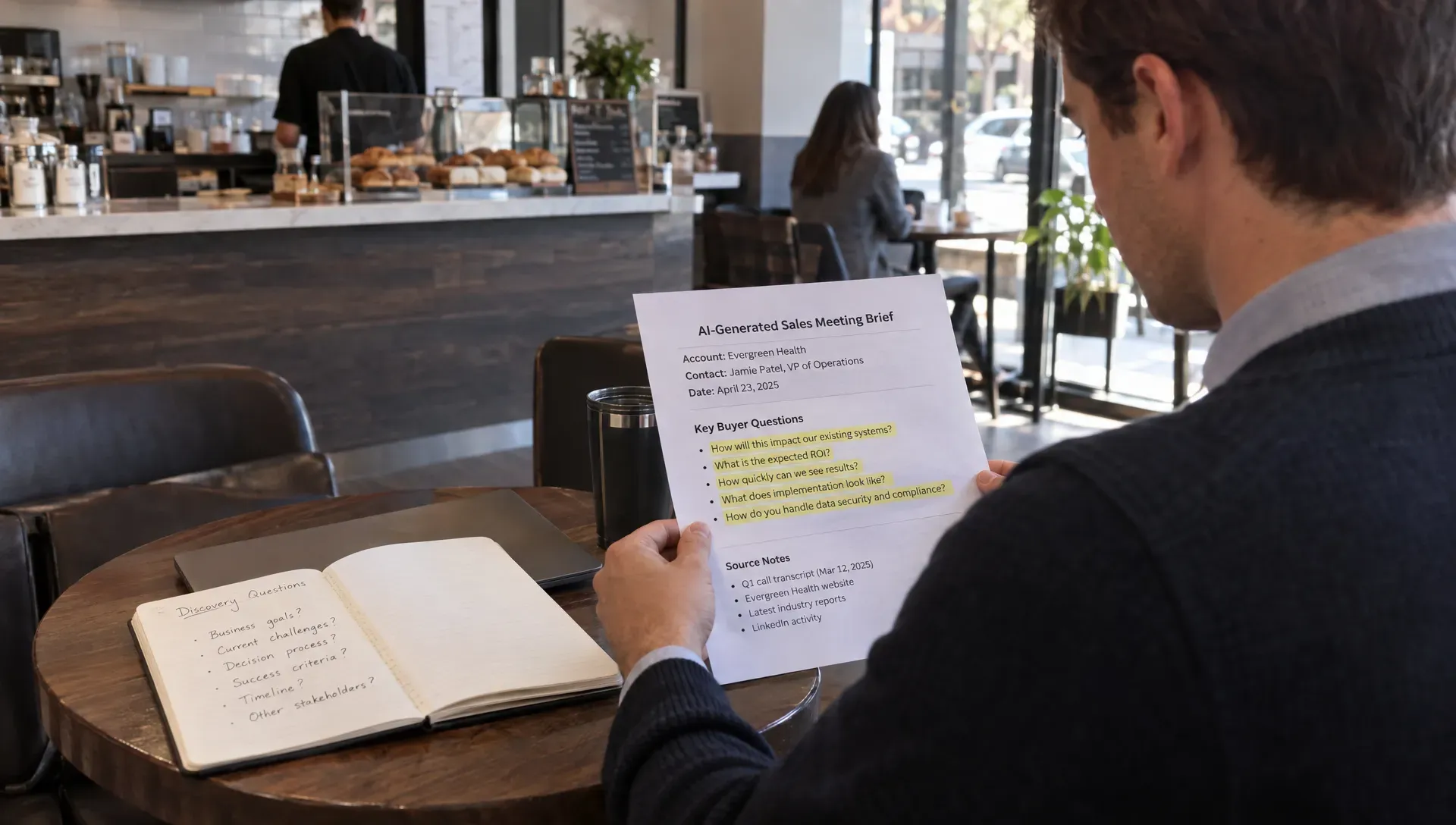
8. A proposed agenda, priority questions and next step
End with an actionable meeting plan derived from the evidence. The agenda should connect the buyer’s stated need to the unresolved questions, rather than defaulting to a full product demonstration.
Include a proposed meeting objective, a few high-value questions and a possible next step. Label these as recommendations unless the buyer has agreed to them. Booking a meeting does not establish consent to a pilot, technical evaluation or purchasing timeline.
Illustrative entry: “Proposed objective: understand the inquiry-assignment problem and determine whether a technical review is warranted. Confirm the relaunch date, current assignment rules and operational impact. If there is a fit, propose a session with the person responsible for CRM configuration.”
A suggested opening can help: “You mentioned that qualified inquiries sometimes wait until the next business day. Could we start with how they are handled today?”
That opening demonstrates continuity without pretending the rep already understands the entire situation.
A compact AI-generated sales meeting brief template
The following fictional example shows how the eight details can fit into one scannable handoff. In a production brief, attach the relevant source references and timestamps to individual claims.
- Detail: Buyer and account — Example brief entry: Morgan Lee, revenue operations manager at Northstar Analytics. Role supplied during booking; purchasing authority unconfirmed.
- Detail: Problem and outcome — Example brief entry: Reports delayed responses to qualified website inquiries. Wants faster connection to sales. Impact has not been quantified.
- Detail: Conversation and commitments — Example brief entry: Asked about assignment across reps. Team promised to clarify the specific requirement in the meeting.
- Detail: Trigger and timing — Example brief entry: Evaluating options ahead of a website relaunch. Relaunch and purchase dates are unknown.
- Detail: Buying process — Example brief entry: Morgan is evaluating operational fit. Possible IT involvement. Budget and approval process are unknown.
- Detail: Constraints and open questions — Example brief entry: Existing account-ownership rules may need to be preserved. Product support has not been confirmed.
- Detail: Evidence and uncertainty — Example brief entry: Buyer statements come from the booking conversation. An older CRM-system reference needs reconfirmation.
- Detail: Proposed meeting plan — Example brief entry: Validate the workflow, timing and impact. Consider a technical review if requirements and product fit align.
Use this as the input to a five-minute pre-call planning routine, not as a script the rep must read aloud. The brief supports preparation; the buyer still gets to correct the picture.
Review the output before trusting the format
A complete template can still contain a bad brief. Test the output against the underlying records: Does each quotation match its source? Has the summary dropped a qualification such as “possibly” or “next year”? Did a suggested next step become a supposed buyer commitment?
Evaluate representative cases, including sparse conversations, changed timelines and contradictory records. The system should preserve missing information rather than filling every field for visual completeness. It should also respect source permissions and avoid introducing unrelated personal data.
Implementation includes training the people who use the output. Providers such as Just Use AI offer AI adoption consulting and team training, which can support teams establishing review practices alongside agent workflows.
For AI agents for B2B sales, a practical quality measure is whether the rep can trace a consequential claim and identify what still needs asking. Summary length alone does not establish usefulness.
Give the closer context they can use
Nudge’s Handoff Agent prepares concise, evidence-based briefs that capture a lead’s needs, interests, objections and timing before meetings. Use these eight details to evaluate the handoff your reps receive, with particular attention to buyer statements, open commitments and visible uncertainty.
Frequently asked questions
How long should a sales meeting brief be?
Keep the main brief short enough to scan before the call. Put decision-relevant context first and link to supporting records instead of copying entire transcripts. Complex opportunities may need additional detail, but company background should not bury the buyer’s problem.
Should the brief include a lead score?
Only if the score has a defined meaning and helps the rep make a decision. Show the underlying evidence. A score should not replace stated needs, unresolved requirements or buying-process context.
What if the buyer provided very little information?
Produce a sparse brief with explicit unknowns and a proposed discovery focus. Do not infer budget, authority or urgency just to populate the template. Limited evidence calls for better questions, not a more confident narrative.