
A buyer asks whether your product supports a specific deployment region. Your website agent says yes and links to a security page. The answer looks credible, but the page only describes encryption. This is the problem with AI sales answers that have citations without real evidence: the link creates confidence without supporting the claim.
For B2B sales teams, that gap can turn a helpful conversation into an unsupported commitment about pricing, security or product capabilities. A reliable answer needs both a source the buyer can verify and a clear boundary around what that source actually establishes.
Why polished sales answers still create risk
A fluent response is not proof that a feature exists, an integration covers the buyer’s workflow or a contract permits a particular deployment. Language models can generate plausible details that are not supported by their sources.
The NIST Generative AI Profile identifies confabulation, including confidently stated false content, as a generative AI risk. In sales conversations, this can appear as an invented plan entitlement or an unjustified promise about implementation.
Retrieval-augmented generation, often called RAG, gives a model relevant material to work from. It does not guarantee that the model retrieves the right document, interprets it correctly or stays within its scope.
Citations make answers inspectable. Clear limits determine what the agent should say when inspection would reveal missing evidence. Both are necessary for trustworthy website lead conversion.
What citations in AI sales answers must prove
A useful citation connects a specific claim to evidence. Sending someone to a homepage or a lengthy document that merely mentions the topic is not enough.
The practical test is simple: could a buyer open the source and find support for the statement without having to supply the missing reasoning themselves?
Check the claim, not just the topic
Consider these hypothetical examples. Each source is relevant to the subject, but relevance alone does not justify the broader answer.
- Available evidence: Documentation lists a Salesforce integration — Unsupported answer: “We sync every custom object in both directions.” — Evidence-bounded answer: “Salesforce is listed as an integration. I need confirmation of custom-object coverage and sync direction.”
- Available evidence: A pricing page says “Contact sales” — Unsupported answer: “Your team will qualify for a volume discount.” — Evidence-bounded answer: “Volume pricing needs confirmation from sales.”
- Available evidence: Security documentation describes encryption at rest — Unsupported answer: “Your data will remain in your preferred region.” — Evidence-bounded answer: “The documentation confirms encryption at rest, but does not establish regional hosting availability.”
- Available evidence: A case study reports one customer’s outcome — Unsupported answer: “You can expect the same improvement.” — Evidence-bounded answer: “That customer reported this outcome. It is not a forecast for your team.”
When an answer contains several factual claims, each needs appropriate support. A citation after a paragraph about integration availability, setup time and pricing should not silently stand in for evidence on all three.
Check authority, scope and access
The source must also apply to the buyer’s situation. A feature may depend on the product edition, region, configuration or contract. A roadmap document is not evidence of general availability, and an old implementation guide may conflict with current documentation.
For important content, maintain an owner, an approval status and a review date. Define which source takes precedence when approved documents disagree. Until a conflict is resolved, the agent should surface the uncertainty rather than choose whichever answer sounds more helpful.
Access matters too. An internal note can inform an authorized sales rep without being suitable for a public citation. Retrieving a document does not create permission to disclose it. Buyer-facing answers need audience-appropriate evidence and links the buyer is allowed to open.
Set clear limits on AI sales answers
Good boundaries distinguish an established fact from a possibility and an authorized action from an unauthorized commitment.
A familiar example of constraint-based reasoning is a Wordle solver: it filters possible words using the guesses and tile colors supplied. A remaining candidate is not necessarily the confirmed solution. The same distinction matters in sales: an answer that seems compatible with the available documents is not automatically established by them.
For a website agent, define three response modes based on evidence and authority, not on how confident the wording sounds.
Answer directly when the evidence is sufficient
The agent can state an approved fact and cite its source when the evidence matches the buyer’s question and context.
For example, a public integration directory may support saying that an integration is available. It may not support a detailed claim about field mappings. The answer should preserve that distinction without forcing the buyer through unnecessary qualification questions.
Ask for context when the answer depends on it
A question about single sign-on might depend on the plan being evaluated. A question about an integration might depend on the objects or actions the buyer needs.
Ask the smallest useful clarification, such as “Which plan are you evaluating?” or “Do you need contact sync, opportunity sync or both?” Clarification is valuable when it changes the answer, not when it merely collects another lead field.
Escalate when evidence or authority is missing
Discounts, contract changes, legal interpretations, delivery guarantees and customer-specific security approvals need explicit authorization. Even a source-backed answer may not authorize an agent to make a binding commitment.
The agent should explain the unresolved point and offer a relevant next step. That could be routing a question to a specialist or helping the visitor book a meeting. The broader distinction between independent work and rep involvement is covered in what an AI sales assistant can handle without a rep.
What a useful boundary sounds like
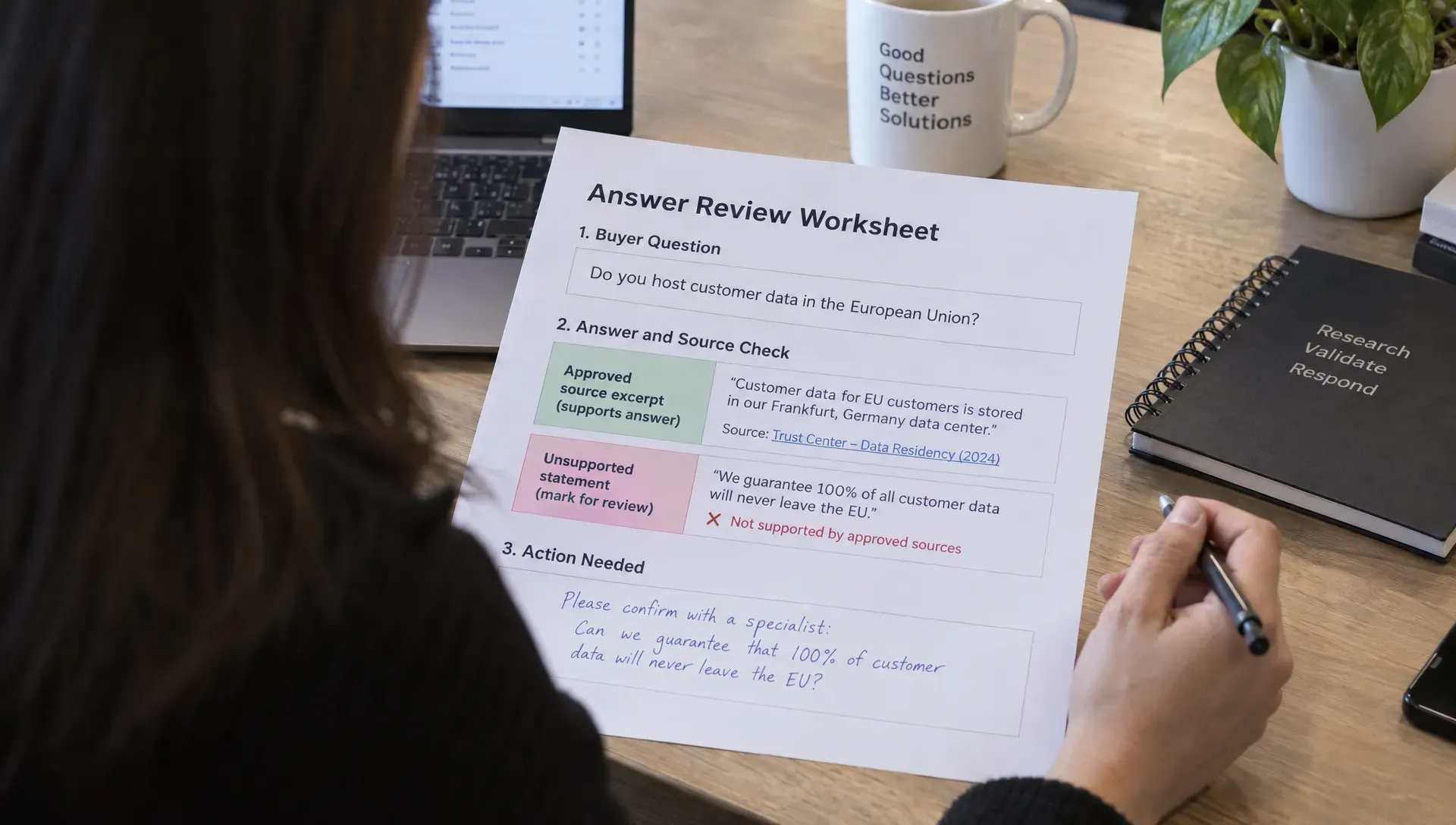
Suppose a prospect asks: “Can you guarantee EU-only data processing and get us live next week?” Approved documentation confirms an EU hosting option, but does not establish every processing location or a deployment deadline.
An unsupported answer bundles those separate issues into a confident yes. A useful response separates them:
Our approved hosting documentation lists an EU hosting option. That does not establish that all processing stays within the EU, and I cannot confirm a go-live date from the available material. I can help arrange a review of your data-location requirements and target launch date.
In an actual conversation, the hosting statement should include its approved citation. The unresolved requirements should travel with the handoff.
This response is not less useful because it contains a limit. It tells the buyer what is known, identifies what remains unresolved and proposes a next step tied to the question.
Avoid the opposite error as well: missing evidence is not proof that a capability does not exist. “I cannot verify that from the approved information” is different from “We do not support it.” Reliable AI sales answers preserve that distinction.
Keep evidence attached through follow-up and handoff
An accurate website conversation can become misleading later if uncertainty disappears from the CRM summary or follow-up email.
For example, “The buyer asked whether EU-only processing is available” must not become “EU-only processing confirmed.” Likewise, a requested launch date is not an agreed implementation deadline.
Preserve four elements in the conversation record:
- Buyer requirement: What the prospect actually asked for, using their wording where helpful.
- Verified answer: What the approved evidence establishes, with the supporting source.
- Open question: What remains unknown, conditional or disputed.
- Next owner: Who should resolve it and what the buyer was told would happen next.
These distinctions matter for automated sales follow-up as much as for the initial answer. A later message should not turn a tentative statement into a promise simply because a shorter summary omitted the qualification.
They also make AI-generated sales meeting briefs more useful: the rep can address the unresolved issue rather than rediscover it during the call.
Test evidence failures before optimizing conversion
Do not evaluate a website agent only on whether it answers smoothly or books meetings. Test whether its factual claims are supported and whether it stops at the right boundaries.
Build an evaluation set from real visitor questions, then add difficult variants: the wrong plan, an outdated feature name, conflicting documents, a requested exception and a capability absent from the knowledge base. Include questions that combine a supported fact with an unsupported guarantee.
Also test instructions embedded in retrieved content. Source material should be treated as evidence, not as authority to override the agent’s operating rules or reveal restricted information.
Measure support, not citation volume
A response with five links can be less trustworthy than one with a single precise citation. Review the relationship between claims and sources rather than counting links.
- Review measure: Claim support — What to inspect: Whether each material factual claim is justified by approved evidence
- Review measure: Citation accuracy — What to inspect: Whether the linked passage supports the adjacent claim
- Review measure: Scope preservation — What to inspect: Whether plan, region and configuration conditions remain intact
- Review measure: Boundary handling — What to inspect: Whether missing evidence triggers clarification or an appropriate handoff
- Review measure: Commitment control — What to inspect: Whether the agent makes unauthorized commercial or contractual promises
- Review measure: Handoff fidelity — What to inspect: Whether summaries preserve verified facts and unresolved questions separately
Define failures before running the test. An unauthorized contractual promise should be treated as a release-blocking issue, not averaged away by strong meeting-booking results.
Recheck AI sales answers after changes to pricing, product documentation or the knowledge retrieval process. A conversation that passed last month may fail when its underlying evidence changes.
Evaluate the answer and the boundary together
Nudge provides content-based answers with citations alongside website conversations, meeting booking, follow-up and sales preparation briefs. When evaluating Nudge for your B2B sales team, bring questions whose answers are conditional, missing or commercially sensitive.
Check whether the evidence supports the response, whether uncertainty remains visible and whether the next step resolves the buyer’s actual question. Those tests tell you more than a polished demonstration built entirely around easy answers.
Frequently asked questions
Does every sales chatbot message need a citation?
No. Greetings, clarification questions and scheduling prompts usually do not. Material claims about capabilities, security, pricing or compatibility should have appropriate support. Use a citation where it helps the buyer verify the answer.
Do citations prevent hallucinations?
No. A model can cite an irrelevant source, misread a relevant one or add unsupported details around an accurate statement. Citations support verification, but source quality, claim-level review and response boundaries still matter.
Should an agent give a confidence percentage?
Not as a substitute for evidence. A confidence score does not establish that a feature exists or that a commitment is authorized. Explain what the source confirms and what remains unknown instead.
What should happen when approved sources disagree?
Apply a documented source-precedence rule if one resolves the conflict. Otherwise, flag the discrepancy for the content owner and avoid presenting either version as settled fact.