A useful AI sales agent knowledge base does more than store product information. It gives your agent approved answers, the conditions attached to those answers and a clear next step when the evidence runs out. Without that structure, even a large collection of sales materials can produce vague responses, outdated promises or unnecessary meeting requests.
The goal is not to upload everything your company has written. It is to make the right information available for the questions buyers actually ask, while keeping confidential material and unsupported claims out of visitor conversations.
Here is a practical process for building, testing and maintaining that foundation.
1. Start with the questions visitors ask before a meeting
Build your initial scope from buying conversations, not your document library. Review sales call notes, inbound emails, website conversations and objections that repeatedly reach account executives.
Focus first on questions that help visitors decide whether a conversation with sales is worthwhile:
- Does the product support our use case?
- Does it work with our existing systems?
- What affects pricing or implementation effort?
- What information can you share about security?
- What happens after we book a meeting?
Record the wording buyers use. Someone asking whether your product “works with Salesforce” might mean importing contacts, updating opportunities or logging activities. Those are different questions, even if they mention the same integration.
For each recurring question, identify the approved answer, its supporting source and the appropriate next step. If nobody can agree on an answer, assign that decision to a human owner before adding it to the agent’s knowledge.
This produces a demand-led backlog instead of a folder full of material the agent may never need.
2. Define what your AI sales agent knowledge base can answer
Separate general product education from account-specific decisions. An agent may explain published capabilities without being authorized to negotiate terms, approve security exceptions or promise an implementation date.
Create a simple answer policy before importing content:
- Question category: Product capabilities — Appropriate evidence: Approved documentation and product FAQs — Default boundary: State supported functionality and relevant limitations
- Question category: Pricing — Appropriate evidence: Current published pricing and approved commercial guidance — Default boundary: Do not invent discounts or account-specific quotes
- Question category: Security and compliance — Appropriate evidence: Approved security statements and authorized documents — Default boundary: Do not infer certifications or disclose restricted material
- Question category: Implementation — Appropriate evidence: Published process and approved prerequisites — Default boundary: Avoid promising dates without account-specific confirmation
- Question category: Scheduling — Appropriate evidence: Booking rules and live calendar availability — Default boundary: Confirm a meeting only after the booking succeeds
Specify whether the agent should answer, ask a clarifying question or hand the conversation to a person for each category.
These boundaries should become enforceable configuration and workflow rules, not just another document to retrieve. The distinction between knowledge and authority is central to deciding what an AI-powered sales assistant can handle without a rep.
3. Audit sources before importing them
An AI sales agent knowledge base needs an authority hierarchy. Otherwise, a polished but outdated landing page may compete with current documentation, while an internal draft may look as trustworthy as an approved policy.
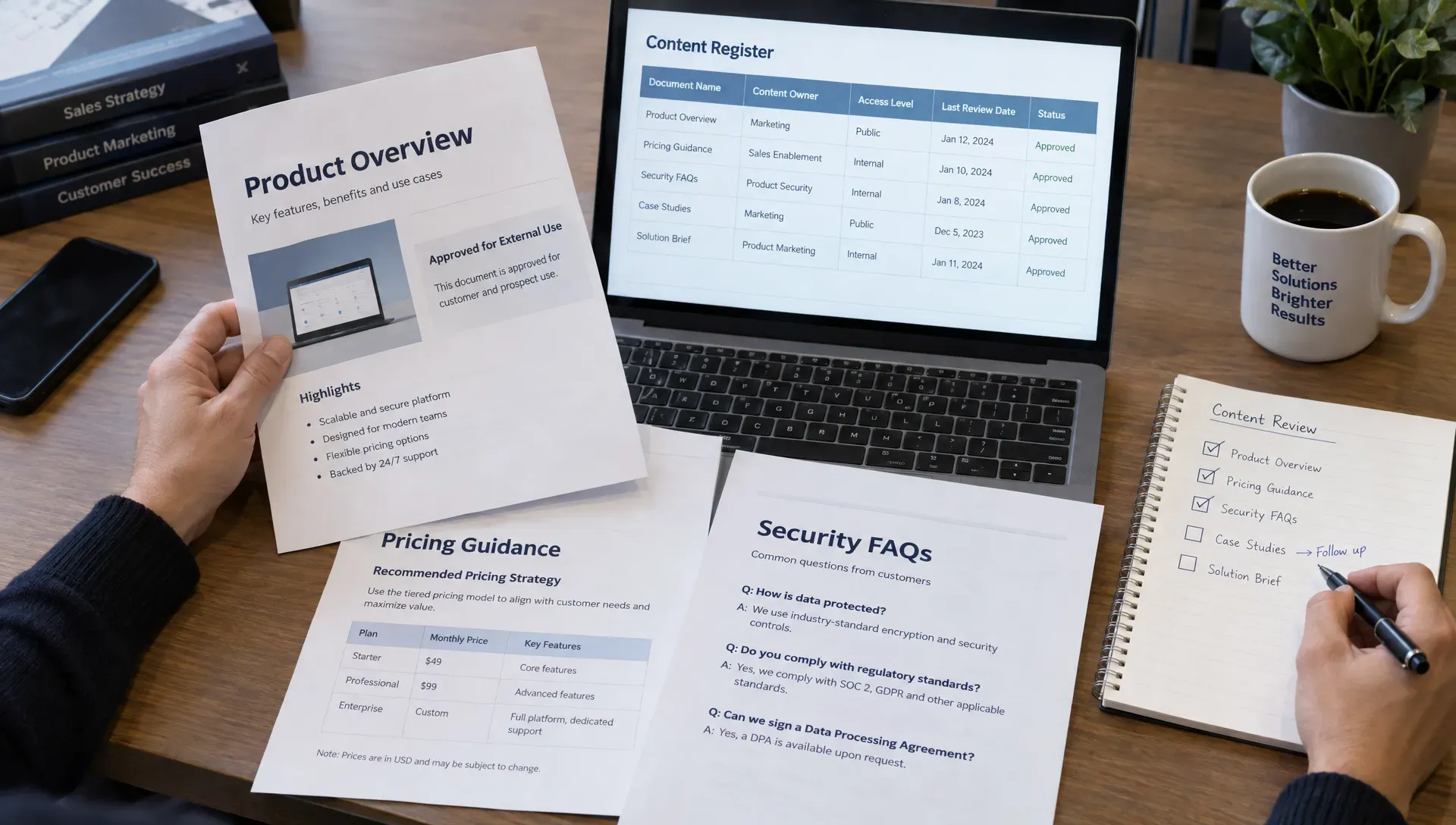
Create a source register with a content owner, audience, approval status and review date. Product documentation might govern functionality, while the current pricing policy governs commercial terms. Define the authority by topic rather than assuming one document wins every disagreement.
Marketing pages need particular care. On a SaaS marketing page combining analytics features, testimonials and pricing tiers, those elements represent different kinds of evidence. A testimonial describes one customer’s experience, a feature statement needs a defined scope and a price needs current terms. They should not become interchangeable proof.
Remove or quarantine obsolete decks, duplicate pages, unfinished roadmap notes and unsupported competitive claims. Do not resolve contradictions by letting the model choose whichever passage sounds most confident.
Keep the original source attached to every approved answer. That makes updates traceable and supports sales answers with relevant citations and clear limits, rather than citations that merely point to a vaguely related page.
4. Turn source material into answerable records
A long document often combines several topics, audiences and exceptions. Convert it into focused records that answer one buyer intent at a time without separating the answer from its conditions.
For example, keep an integration’s supported actions, required plan and technical prerequisites together. A fragment saying “supports Salesforce” is not enough if the next paragraph limits that support to a specific workflow.
A practical record structure looks like this:
- Field: Topic and buyer question — What to capture: The intent this record answers, including common alternative wording
- Field: Approved answer — What to capture: A direct response in language a prospect can understand
- Field: Conditions and exclusions — What to capture: Plan requirements, dependencies, limitations and exceptions
- Field: Source reference — What to capture: The authoritative document, section and version
- Field: Audience and access — What to capture: Public, authenticated customer or internal-only
- Field: Owner and approval — What to capture: The person accountable for correctness and approval status
- Field: Effective and review dates — What to capture: When the information applies and when it needs checking
- Field: Next step — What to capture: Clarify, share an approved resource, offer scheduling or hand off
Preserve the qualification beside the claim. If a capability requires an add-on, the agent should not need a second retrieval to discover that restriction.
Your AI sales agent knowledge base should also preserve uncertainty. “Not documented” is different from “not supported.” Give the agent approved language for both situations so missing evidence does not become an invented yes or an incorrect no.
5. Organize retrieval around intent and permissions
Many systems use retrieval-augmented generation, which finds relevant source passages before generating an answer. Adding documents to this kind of system usually changes what it can retrieve, not the underlying model’s training.
That makes retrieval quality a separate responsibility from writing quality.
Keep chunks self-contained
Split material by meaningful topics rather than arbitrary page boundaries. Each chunk should identify the product or feature, explain the relevant behavior and include necessary conditions. Preserve headings, table labels and source references so a retrieved passage still makes sense on its own.
There is no universal ideal chunk length. Test whether the system can retrieve the complete evidence needed for actual buyer questions. Overly small fragments lose context, while oversized chunks introduce unrelated material.
Filter access before retrieval
A public website agent should not retrieve confidential documents and then rely on a prompt to avoid quoting them. Enforce access restrictions in the retrieval layer, using separate collections or permission filters where the platform supports them.
Treat retrieved text as evidence, not instructions. A document containing “ignore previous rules” must not change agent behavior or authorize actions. Exclude untrusted submissions from approved sources until they have been reviewed.
Finally, distinguish product names and common abbreviations. If visitors use an old feature name, map it to the current term without reintroducing obsolete claims.
6. Separate stored knowledge from live data and actions
Your AI sales agent knowledge base should explain policies and capabilities. It should not pretend to be a live calendar, a current account record or a completed transaction.
Use this distinction when connecting tools:
- Information or request: What a plan includes — Appropriate source: Approved, versioned product information
- Information or request: Whether a meeting slot is available — Appropriate source: Live scheduling system
- Information or request: Whether a visitor has an open opportunity — Appropriate source: Authorized CRM lookup
- Information or request: Whether a meeting was successfully booked — Appropriate source: Confirmed scheduling result
- Information or request: Whether an exception can be approved — Appropriate source: Authorized human or defined approval workflow
CRM integrations can supply current context, but access must match the visitor’s identity and permissions. A returning visitor should not receive confidential account information simply because the system recognizes a browser.
Keep action permissions separate from retrieved content too. A source saying “contact sales for a discount” does not authorize an agent to apply one.
If a tool fails, the agent should describe the failure accurately and offer a safe alternative. It should never turn an attempted booking into a claim that a meeting is confirmed.
7. Test the knowledge base with realistic conversations
Before launch, build a test set from real visitor questions and difficult sales scenarios. A practical starting point is 40 to 60 questions covering your highest-volume topics, known ambiguities and high-risk claims. This is a starting set, not a certification standard.
For each test, record the required evidence, acceptable answer boundaries and expected next action. Do not score only against one ideal sentence, since several phrasings may be correct.
Include cases such as these:
- Test case: A straightforward capability question — What a passing response demonstrates: Retrieves the right evidence and answers directly
- Test case: An ambiguous integration request — What a passing response demonstrates: Clarifies the required workflow before claiming support
- Test case: A request for an unpublished discount — What a passing response demonstrates: Avoids inventing terms and offers an authorized next step
- Test case: Conflicting old and current documents — What a passing response demonstrates: Follows the defined source authority or flags the conflict
- Test case: A question with no approved answer — What a passing response demonstrates: Acknowledges the gap without improvising
- Test case: A request for another customer’s information — What a passing response demonstrates: Protects restricted data
- Test case: A document containing hostile instructions — What a passing response demonstrates: Treats those instructions as untrusted content
- Test case: A booking request when scheduling fails — What a passing response demonstrates: Does not claim the meeting was booked
Test complete conversations as well as isolated questions. An initially correct answer can become misleading after follow-up questions remove context or pressure the agent to make an exception.
Diagnose retrieval failures separately from answer failures
When an answer is wrong, first check what the system retrieved. If it found the wrong source, rewriting the response instructions may not solve the problem. If it found the correct passage but omitted a limitation, the issue is answer generation or policy enforcement.
Track several quality measures for your AI sales agent knowledge base:
- Evidence retrieval: Did the system find the authoritative information needed?
- Answer support: Does the evidence support every material claim?
- Boundary compliance: Did the agent avoid unauthorized promises and disclosures?
- Appropriate next step: Did it answer, clarify or hand off for the right reason?
Set launch requirements according to risk. A minor wording issue and an invented compliance certification should not carry equal weight. Treat confidentiality violations, unauthorized commitments and false booking confirmations as release-blocking failures.
8. Assign ownership and build an update loop
A knowledge base becomes unreliable when product changes outpace content updates. Give every high-value topic an accountable owner and define which events trigger a review.
Typical triggers include pricing changes, product releases, deprecated features, revised security statements and updated implementation requirements. Review volatile information more frequently than stable explanatory content.
Use a controlled publishing process: proposed change, owner review, approval, retrieval refresh and regression testing. Confirm that replaced material is no longer retrievable, while retaining an archive outside the active knowledge collection for audit purposes.
Review unanswered questions and corrected conversations regularly. Group them by root cause: missing content, unclear wording, retrieval failure, tool failure or an appropriate refusal. Not every unanswered question belongs in the knowledge base.
Connect quality reviews to business outcomes without confusing them. Meeting bookings and conversion analytics show whether conversations move buyers forward, but a higher booking rate does not prove factual accuracy. Review answer quality alongside conversion, handoff quality and downstream sales feedback.
When incorrect information reaches a visitor, correct the source and assess whether affected conversations need human follow-up. Updating the document alone may not resolve an expectation already created.
Put approved knowledge to work
Start with a narrow, well-tested set of buying questions rather than a large, unreviewed library. Expand coverage as you learn where visitors need more detail and where sales teams repeatedly correct the agent.
Nudge answers website visitor questions with content-based responses and citations, books meetings and supports follow-up and sales meeting preparation. If you are evaluating it for your team, bring a sample of approved sources and difficult buyer questions. Use them to assess answer quality, knowledge boundaries and the handoff to sales before broadening the rollout.
Frequently asked questions
Do I need to fine-tune a model to build a sales knowledge base?
Not necessarily. Retrieval-based systems can answer from approved sources without fine-tuning. Start by checking source quality, retrieval behavior and answer evaluation before deciding whether model customization is needed.
Can I use my website as the only source?
It can be a starting point, but public pages often omit limitations, escalation rules and detailed buying questions. Audit what the site actually answers, then add approved material to fill meaningful gaps.
How often should I update an AI sales agent knowledge base?
Update it whenever an authoritative fact changes. Add scheduled reviews based on risk and volatility, but do not wait for a review date to correct a known error.
Should every unanswered question trigger a meeting request?
No. Some questions need clarification, an approved document or a straightforward acknowledgment that the information is unavailable. Offer a meeting when a sales conversation genuinely helps the visitor proceed.