To reduce sales demo no-shows, make the meeting worth protecting before it reaches the buyer’s calendar. Another reminder can help someone remember an appointment, but it cannot explain why a generic demo deserves priority over an urgent customer issue or an internal deadline.
For B2B sales teams, the more useful work happens around the booking: understanding the visitor’s question, offering an appropriate next step and preserving that context through the handoff. Keep essential confirmations and calendar notifications. Instead of adding more reminders, improve the commitment those messages are supposed to support.
Diagnose the gap between booking and commitment
A calendar booking records agreement to a time. It does not necessarily mean the buyer understands the meeting’s value, has an active project or expects the rep to address their concern.
Before changing your process, review a sample of attended and missed demos. Compare what happened before each booking, not just which reminder sequence ran afterward.
- What you find: Buyers booked to get a basic answer — Possible explanation: The meeting was a gate to information — What to change first: Answer the question before offering a demo
- What you find: Invitations say only “Product demo” — Possible explanation: The outcome is unclear — What to change first: Name the buyer’s use case and expected takeaway
- What you find: Meetings are scheduled far ahead — Possible explanation: Interest or circumstances may change — What to change first: Offer a nearer slot when practical
- What you find: Buyers repeatedly cancel or reschedule — Possible explanation: Timing or commitment may be weak — What to change first: Make rescheduling easy and reassess readiness
Treat these as hypotheses to investigate, not diagnoses based on a single missed call. An otherwise interested buyer can still have an emergency.
How to reduce sales demo no-shows before booking
Answer the question that brought the buyer in
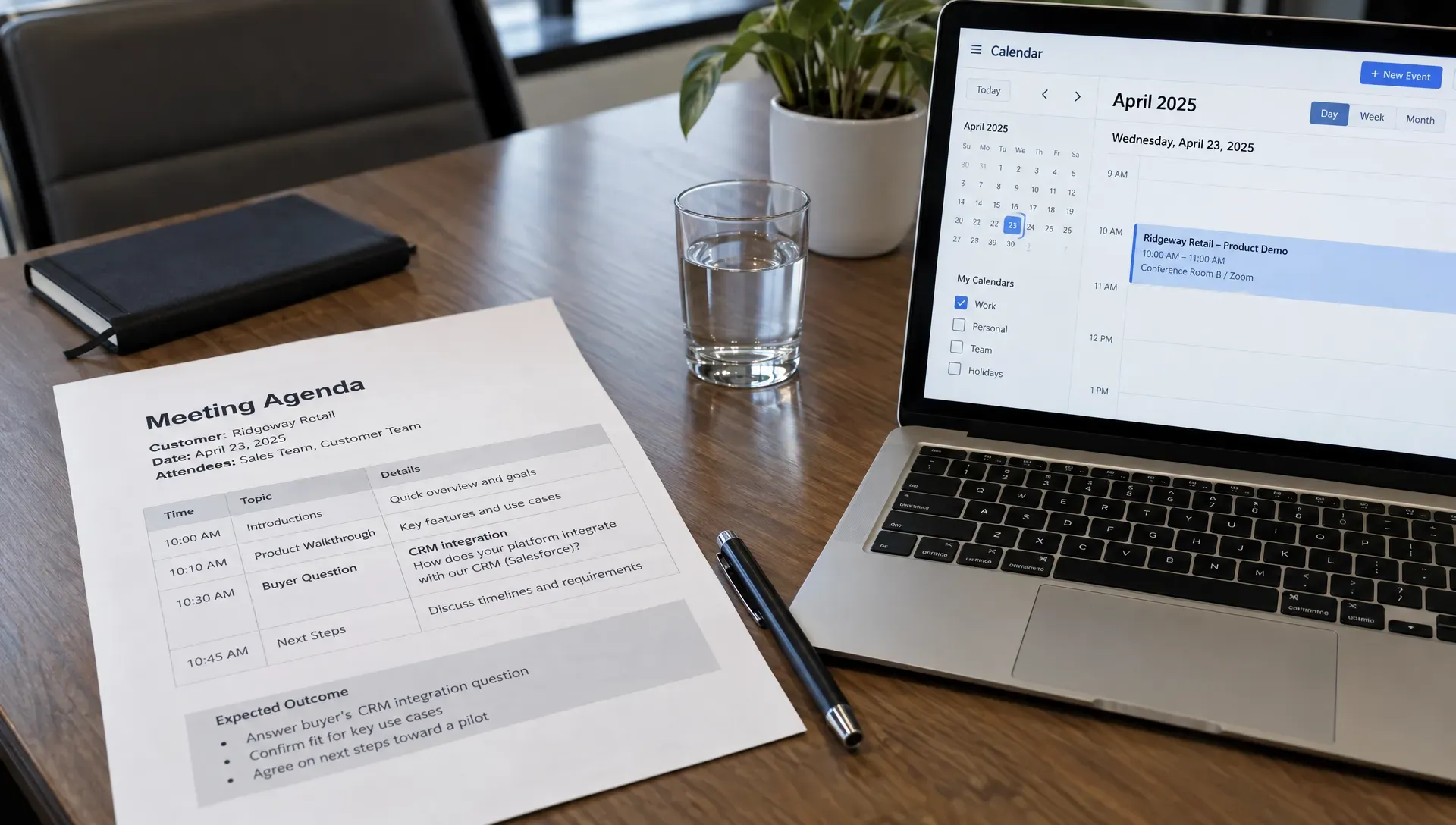
Someone asking whether your product supports a particular CRM integration may not want a full platform tour. They may need a straightforward answer before deciding whether a conversation is worthwhile.
Give them that answer when you can. If the answer depends on their setup, explain what needs checking and why a meeting would help. Do not turn every request for information into a scheduling transaction.
This is also a useful way to evaluate your demo request form: does it capture a real reason to meet, or simply move someone from a form to a calendar?
The booking handoff should preserve at least one buyer-stated question. “Wants a demo” describes the appointment type, not the reason the buyer might attend.
Offer the smallest useful next step
Match the meeting to the decision the buyer is trying to make. A focused integration discussion, a workflow walkthrough and a broader evaluation call serve different purposes.
For example, replace “Would you like a demo?” with:
“You mentioned that duplicate lead routing is slowing down your team. Would a focused walkthrough of routing and CRM handoff help you assess whether this fits your process?”
Use this only when the team can deliver that walkthrough. A specific promise that the rep cannot honor creates a different problem.
Keep qualification proportionate, too. Requiring a detailed questionnaire may increase apparent commitment while excluding buyers who have a legitimate need but little time. Capture enough context to make the meeting useful, not enough to complete discovery before it starts.
Make the calendar invitation explain why to attend
A useful invitation should make sense when the buyer opens it several days later, without needing to reconstruct the website conversation.
Include:
- A recognizable title: Name the company or workflow being discussed, rather than just “Demo.”
- The buyer’s question: Summarize the issue in language they used.
- A concrete outcome: Explain what they should be able to assess by the end.
- Accurate logistics: Show the duration, time zone, joining link and expected participants.
- An easy way to change plans: Provide a clear rescheduling or cancellation route.
For example:
Title: Lead routing walkthrough for Acme
Purpose: Review how inbound leads could move into your CRM without duplicate assignment. We’ll focus on routing rules and handoff, then identify anything that needs technical validation. No preparation required.
That is a sample promise, not a template to copy regardless of context. If preparation is required, state exactly what it is and why it matters.
Check the scheduling experience itself. An unclear time zone, broken meeting link or invitation that never reaches the attendee is an operational issue, not a motivation problem.
Replace reminder copy with useful pre-call context
If your current confirmation says only “Looking forward to connecting,” use that existing message to make the appointment more valuable. You do not need an additional email.
To reduce sales demo no-shows without increasing message volume, replace generic anticipation with evidence that the buyer’s question has been understood.
A useful message might say:
“You asked whether different business units can use separate routing rules. We’ll start there rather than running through the full product. If you have a routing example handy, feel free to bring it, but there’s no required homework.”
Where appropriate, include one relevant resource or a direct answer to an unresolved question. Avoid sending a content bundle that creates more work than the meeting itself.
For the operational side, this guide to automating sales follow-up without sounding robotic distinguishes repeatable CRM tasks from communication that needs human judgment. That distinction matters here: automation can reliably deliver context, but it should not invent what a rep will demonstrate or promise to resolve.
Preserve the buyer’s context through the sales handoff
A tailored invitation loses credibility if the next email asks questions the buyer already answered. It also sets up a poor experience if the rep opens with an unrelated presentation.
Give the meeting owner a concise brief containing the buyer’s stated need, relevant conversation history, unresolved concerns and the outcome promised at booking. Separate confirmed information from assumptions.
For example, “Asked whether Salesforce integration supports custom objects” is useful evidence. “Has approved budget for a Salesforce project” is not a valid inference from that question.
Before the call, the rep should check whether the promised agenda is deliverable. If technical validation requires a different colleague, resolve that before the scheduled time where possible. If the scope needs to change, explain the change honestly rather than letting the buyer discover it during the meeting.
This preparation supports attendance indirectly: it makes the communication before the call credible and gives buyers a reason to trust that showing up will be worthwhile.
Make rescheduling easier than disappearing
Some missed demos are avoidable even when the buyer cannot attend the original slot. Give them a low-effort way to change plans without writing an apology or explaining their calendar.
Avoid treating a reschedule as a failure that triggers a fresh sequence from the beginning. Update the existing appointment, stop obsolete messages and preserve the original context.
After a genuine no-show, send a neutral note that makes the next decision easy:
“We missed each other today. If reviewing your routing workflow is still useful, you can choose another time using the scheduling link in your invitation. If priorities have changed, a quick reply is enough and I’ll close the loop.”
Do not imply that you waited if no one actually joined, and do not manufacture urgency. If the buyer does not respond, follow your team’s defined follow-up policy rather than leaving an open-ended sequence running indefinitely.
Measure attendance without hiding lost demand
A lower no-show rate is not automatically an improvement. You could achieve it by making booking so difficult that fewer suitable buyers schedule anything.
Define a no-show consistently. One workable definition is an appointment where the prospect does not attend and has not cancelled or rescheduled before the scheduled start, using a documented grace period. Count a rep absence separately so it does not become a buyer no-show.
For resolved appointments, calculate:
No-show rate = prospect no-shows ÷ (held meetings + prospect no-shows) × 100.
Track advance cancellations and reschedules separately. Because they sit outside this formula, they must remain visible in your reporting.
- Measure: Original bookings that become held meetings within a defined window — What it helps you check: Whether booking commitments turn into conversations
- Measure: Qualified held meetings per comparable inbound audience — What it helps you check: Whether attendance gains preserve useful demand
- Measure: Cancellation and reschedule rates — What it helps you check: Whether missed appointments are shifting into another category
- Measure: No-shows that later become qualified held meetings — What it helps you check: Whether recovery produces more than another booking
Keep rescheduled appointments connected to the original booking so they do not inflate demand. Nudge’s guide to measuring meetings booked without inflating pipeline explains why bookings, attendance and qualification need separate treatment.
Test the booking promise before changing the cadence
Start with one booking source or buyer segment. Keep the existing reminder schedule unchanged and test a clearer meeting promise, a buyer-specific invitation and a more complete rep handoff.
If volume permits, compare groups over the same period. Otherwise, use a before-and-after comparison while documenting changes in traffic source, qualification rules and meeting availability. A small sample can suggest where to investigate, but it is not reliable proof that a wording change caused the result.
Choose the measurement window before reviewing outcomes. Give each booking cohort enough time to attend or reschedule, and evaluate qualified held meetings alongside no-shows.
The goal is to reduce sales demo no-shows while preserving access for suitable buyers. If attendance improves but qualified conversations decline, investigate whether the new process is filtering out demand rather than strengthening commitment.
Keep the reason for the meeting intact
Nudge supports B2B teams with AI website conversations, content-based answers with citations, meeting booking and sales meeting preparation briefs. Those capabilities can help preserve the connection between a visitor’s question and the conversation a rep prepares to have.
If that context currently disappears between booking and the call, explore Nudge’s Handoff Agent. Start with one practical standard: every booked demo should have a buyer-stated reason to happen and an owner prepared to address it.
Frequently asked questions
Should we stop sending demo reminders?
No. Keep essential confirmations and sensible calendar notifications. This approach focuses on improving the reason to attend instead of adding messages to compensate for an unclear booking promise.
How far ahead should prospects be able to book?
There is no universal limit. Offer near-term availability where practical, then compare attendance by booking lead time within similar buyer groups. Enterprise evaluations may legitimately require longer coordination.
Should buyers complete homework before a demo?
Require preparation only when the meeting genuinely depends on it. Explain the purpose and keep it proportionate. Optional context can help, but unnecessary homework adds friction without establishing meaningful commitment.
Can an AI sales assistant prevent missed meetings?
No tool can guarantee attendance. An AI assistant can support the process by answering visitor questions, capturing context and helping arrange meetings. Results still depend on buyer intent, accurate promises and the team’s execution.