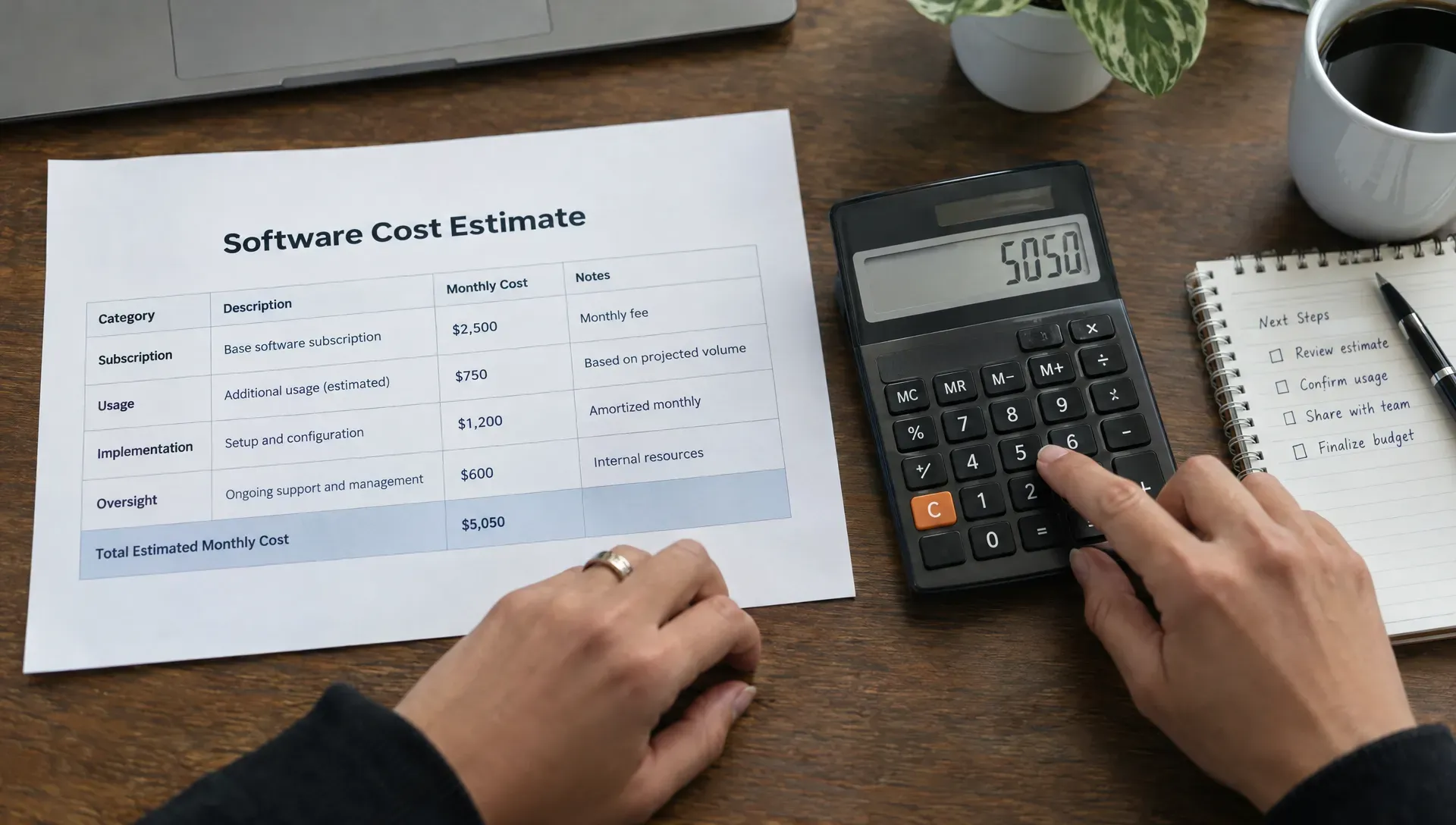
An AI based sales assistant costs more than its subscription. Your operating budget needs to include usage charges, integrations, human oversight and content maintenance, plus the implementation work required before launch. The useful number is total cost of ownership, not the advertised monthly price.
There is no single price across this category. A CRM writing assistant, an inbound website agent and an outbound prospecting system automate different work and use different billing units.
Below, you’ll find a cost framework, hypothetical budgets and a break-even calculation. The figures are planning examples, not vendor quotes or claimed market averages. Use them to structure a budget, then replace each assumption with your own numbers.
Start with the workflow and billing model
Before comparing prices, define the job you want done. Answering product questions and booking inbound meetings requires different infrastructure from researching accounts or transcribing calls.
Scope also determines what you can stop paying for. Adding software without retiring overlapping tools creates another expense, even when the new assistant performs well. Identify the existing licenses, manual processes and outsourced services it could realistically replace.
Seats, usage and outcomes
The billing model for an AI based sales assistant determines how costs change as adoption grows. Common models include:
- Per seat: Charges depend on licensed users, sometimes with separate requirements for administrators or managers.
- Per conversation or interaction: Costs rise with eligible visitor conversations, messages or sessions.
- Credits or consumption: Different actions consume credits, potentially at different rates.
- Per outcome: Charges depend on a defined event, such as a booked meeting or resolved conversation.
- Platform plus usage: A fixed subscription includes an allowance, with additional consumption billed separately.
Ask vendors to define the billing unit in writing. A conversation might mean one session, a time window or several interactions grouped together. A meeting charge might apply at booking rather than attendance.
Also confirm minimum commitments, included volumes, overage rates and whether unused allowances expire. Without those details, two similar-looking quotes may represent very different operating costs.
Calculate the total cost of an AI based sales assistant
Use two views: what leaves your bank account and what the operation consumes economically. Existing employees’ time may not create a new invoice, but it still has a cost.
First-year ownership cost = implementation + 12 × recurring monthly cost.
Normalized monthly cost = recurring monthly cost + implementation ÷ 12.
Twelve months is a budgeting convention here, not an accounting treatment. Choose another evaluation period if it better matches your contract or business case.
Separate launch work from recurring work
Implementation can include source-content cleanup, CRM field mapping, calendar routing, permissions configuration, testing and team training. Some of that work may be covered by a vendor fee; some may fall to your team.
Recurring costs include the subscription, consumption, connector fees, administration and quality review. For an AI based sales assistant, ongoing ownership also means keeping product answers current and investigating conversations that produced incorrect answers or poor handoffs.
Assign each task an owner and an estimated number of hours. Multiply internal time by a loaded hourly cost that includes compensation and relevant employer expenses. Do not count the same implementation hours again under a vendor services fee if that fee already covers them.
Include costs outside the assistant contract
Check whether the workflow also needs enrichment credits, email infrastructure, middleware, additional CRM access or external support. These are conditional expenses, not automatic requirements.
For a website-focused deployment, content readiness can matter more than adding another integration. Missing pricing guidance, contradictory product pages and unclear qualification rules all require someone to resolve them.
Keep the initial scope narrow. Our guide to what a sales assistant can handle without a rep can help separate automatable tasks from decisions that still need human judgment.
Three illustrative operating budgets
The following examples show how to build a budget for an AI based sales assistant. They are hypothetical allocations, not published prices, market ranges or Nudge pricing.
All figures are in US dollars. Internal work is valued at an assumed $50 per hour. The scenarios represent progressively broader deployments, not equivalent products at different prices.
- Monthly cost item: Software subscription assumption — Limited CRM workflow: $150 — Focused inbound workflow: $800 — Multiple connected workflows: $2,200
- Monthly cost item: Usage and consumption assumption — Limited CRM workflow: $50 — Focused inbound workflow: $200 — Multiple connected workflows: $800
- Monthly cost item: Connectors or middleware — Limited CRM workflow: $0 — Focused inbound workflow: $100 — Multiple connected workflows: $300
- Monthly cost item: Internal administration — Limited CRM workflow: $150 — Focused inbound workflow: $400 — Multiple connected workflows: $1,000
- Monthly cost item: Quality review and content upkeep — Limited CRM workflow: $50 — Focused inbound workflow: $100 — Multiple connected workflows: $300
- Monthly cost item: Recurring monthly total — Limited CRM workflow: $400 — Focused inbound workflow: $1,600 — Multiple connected workflows: $4,600
- Monthly cost item: One-time implementation — Limited CRM workflow: $600 — Focused inbound workflow: $2,400 — Multiple connected workflows: $9,000
- Monthly cost item: First-year ownership cost — Limited CRM workflow: $5,400 — Focused inbound workflow: $21,600 — Multiple connected workflows: $64,200
- Monthly cost item: Normalized monthly cost — Limited CRM workflow: $450 — Focused inbound workflow: $1,800 — Multiple connected workflows: $5,350
How to interpret the numbers
In the focused inbound example, administration takes eight hours each month and quality review takes two. Together, those activities account for $500 of the $1,600 recurring total.
The $2,400 implementation allowance could represent $800 in external services plus 32 internal hours at $50. That decomposition matters: a quote covering all implementation work should not also carry an unexplained duplicate labor allowance.
The normalized cost of this AI based sales assistant is $1,800 per month, but only $1,100 of the recurring budget represents software, usage and connectors. The other $500 represents employee capacity. Track both figures rather than presenting internal time as a new cash payment.
A lower subscription can still produce a higher ownership cost if it requires substantial manual maintenance. Conversely, a higher-priced product may be economical if it replaces existing spend and reduces operational work. Neither conclusion follows from the license price alone.
Build a downside case
Alongside your expected budget, model higher usage, slower implementation and more review time. Change the actual drivers rather than adding an unexplained percentage.
For example, increasing consumption from $200 to $600 and administration from eight to 14 hours adds $700 per month at the assumed labor rate. That raises normalized cost from $1,800 to $2,500 before any offsetting benefit.
Find the usage rules that can change your bill
An AI based sales assistant can become more expensive without producing more qualified opportunities. Traffic growth, repeated sessions, retries and broader deployment may increase consumption before they improve results.
Request worked billing examples using your expected volumes. Include a visitor who returns several times, a conversation that transfers to a rep and a meeting that is later canceled. Ask how test traffic, spam and failed actions are treated.
For credit-based pricing, translate credits into business activities. An allowance is difficult to evaluate unless you know how much it costs to answer a question, retrieve account information or complete a follow-up sequence.
Put limits around consumption
Confirm whether the platform supports spending alerts, enforceable limits and visibility into usage. An alert is not the same as a hard cap, and a hard cap may interrupt service.
Start with selected pages or workflows instead of enabling every capability simultaneously. Exclude internal testing from production reporting where possible and review usage by source. That makes it easier to distinguish useful demand from configuration problems.
For more detail on conversation-based charging, our chatbot pricing and ROI guide covers the mechanics. Here, the budgeting priority is connecting consumption to qualified sales activity rather than treating all interactions as equally valuable.
Budget for security, permissions and data handling
Security review is part of deploying an AI based sales assistant, not an optional task after the contract is signed. The work expands when the assistant can access CRM records, send messages or process sensitive prospect information.
Document what data enters the system, where it is stored, who can access it and how deletion works. Ask about retention, subprocessors, model-training use and export options. Do not assume that a vendor’s general security statement answers your specific workflow questions.
Use the narrowest permissions that allow the assistant to do its job. A tool that answers public product questions may not need broad access to opportunity records or permission to change customer data.
Identify the owner of each control
The NIST AI Risk Management Framework provides a useful structure for identifying and managing AI-related risks. It is not a substitute for reviewing vendor contracts or applicable legal obligations.
If call recording or transcription is in scope, include consent and notice requirements in that review. For website engagement and follow-up, examine tracking disclosures, communication permissions and opt-out handling as applicable.
For businesses in Réunion and Mayotte, MDSI’s IT and cybersecurity services illustrate the separate infrastructure support that may belong in an IT budget. Confirm which security and administration tasks your internal team, software vendor or external provider will actually own.
Include the resulting review and remediation work in implementation costs rather than treating it as free labor.
When a CRM-native feature is enough
You may not need a standalone product. If the immediate problem is drafting follow-ups, summarizing records or reducing manual CRM updates, an existing CRM feature deserves a first look.
Evaluate its incremental cost, not the full cost of a CRM you already need. However, include any required edition upgrade, additional seats and consumption charges. An apparently included capability can still change the bill elsewhere.
A standalone AI based sales assistant becomes worth evaluating when the required workflow extends beyond those native capabilities. That might involve visitor conversations, meeting booking, follow-up and sales handoffs that need to work together.
Compare completed workflows
Test the same task in both options, from initial interaction through the final CRM record and rep handoff. Compare the work required to configure, monitor and repair it.
Do not justify a separate product with features the team will not use. Likewise, do not choose a native feature solely because it avoids another vendor if substantial custom work is needed to close the gaps.
The relevant comparison is incremental ownership cost per useful outcome. Existing subscriptions, integration complexity and operational fit can change the answer for otherwise similar teams.
Calculate break-even using contribution, not pipeline
The financial case for an AI based sales assistant should distinguish booked meetings, qualified opportunities, closed revenue and contribution. They are not interchangeable measures of value.
For an inbound meeting workflow, a simple model is:
Expected contribution per incremental booking = attendance rate × qualification rate × win rate × contribution per won deal.
Each rate must match the preceding stage. Qualification is measured among attendees; win rate is measured among qualified opportunities. Contribution means revenue less the relevant delivery costs, not the full contract value.
A worked example
Assume the $1,800 normalized monthly cost from the focused inbound budget. Also assume 80% attendance, 50% qualification among attendees, a 15% win rate among qualified opportunities and $6,000 contribution per won deal.
The expected contribution per incremental booking is:
0.80 × 0.50 × 0.15 × $6,000 = $360.
At those assumptions, five additional bookings per month reach expected break-even. Six produce $2,160 in expected contribution, or $360 above the modeled monthly cost.
These are probability-weighted planning figures, not guaranteed monthly results. Small samples fluctuate and revenue may arrive several months after the original booking. Test a lower conversion case before approving the budget.
Keep time savings separate
An AI based sales assistant may also free employee capacity. If it saves 12 hours at $50 per hour, that represents $600 of potential capacity value, not automatically $600 of cash savings.
Report it separately unless it reduces overtime, avoids an otherwise necessary hire or produces measurable additional output. Do not count the same hours as both labor savings and the effort responsible for incremental sales.
Similarly, pipeline value is an early indicator, not realized return. Count only incremental outcomes and avoid crediting the assistant for meetings that would otherwise have arrived through a form or a rep.
Run a pilot that tests costs as well as conversions
A pilot should establish whether the workflow works operationally and whether the economics justify expansion. A fixed calendar window alone does not guarantee enough evidence, especially when traffic is low or the sales cycle is long.
Establish the baseline
Before launching an AI based sales assistant, record eligible traffic, existing contact and booking rates, attendance, qualification and rep handling time. Define qualification before results arrive so the criteria cannot drift toward a favorable conclusion.
Use a comparable holdout or randomized traffic split where feasible. Otherwise, document changes in traffic quality, campaigns, seasonality and rep availability. A before-and-after increase without those controls does not establish causation.
Keep the initial deployment narrow enough that someone can inspect conversations and identify failure patterns. Agree in advance on escalation rules for unsupported product claims, incorrect answers and booking failures.
Track unit economics and operating effort
Measure actual consumption and internal hours alongside outcomes. Useful measures include cost per incremental attended meeting and cost per incremental qualified opportunity. Show the underlying counts because a low-volume ratio can move sharply after one result.
Review answer accuracy, duplicate records, routing failures and complaints too. A workflow can generate meetings while creating expensive cleanup work or misleading prospects.
Set an expansion decision
Expand an AI based sales assistant only when the evidence supports both acceptable quality and a credible cost model. The threshold should reflect your deal economics, conversion lag and tolerance for operational risk.
Before committing, ask for a written quote tied to the tested volumes, billing definitions and support requirements. Confirm renewal terms, price-change provisions, data export and termination obligations. A successful pilot does not remove contract risk.
Turn the estimate into a scoped quote
Before purchasing an AI based sales assistant, document the workflow, eligible volume, required integrations and measurable outcome. Request separate figures for implementation, recurring fees, usage and support, then add your internal operating costs.
Nudge supports B2B visitor conversations, meeting booking, personalized follow-up, returning visitor identification and sales preparation briefs. If those match your needs, use the cost model above to evaluate the required scope. Compare the written quote against a realistic baseline and downside case before expanding.
Frequently asked questions
Is the subscription the biggest expense?
Not necessarily. Implementation and oversight can be substantial when content is inconsistent, integrations are complex or the workflow needs frequent review. Measure them rather than assuming a fixed ratio.
Can I run an assistant without technical staff?
Some narrow deployments may need little custom development, but someone must still own permissions, content accuracy, routing and performance review. Confirm vendor responsibilities before budgeting internal effort at zero.
Does every conversation need a human review?
The appropriate review level depends on the workflow and risk. Use stronger checks during launch and for sensitive interactions, then adjust based on observed performance rather than assuming oversight disappears.
Should I build instead of buy?
Compare complete ownership costs. A custom build adds engineering, evaluation, monitoring, security and maintenance responsibilities beyond model usage. It is not necessarily cheaper because the underlying API bill looks small.