An AI sales assistant can answer a buyer’s question, book a meeting or summarize a discovery call. Those are different jobs, and choosing the wrong category leaves the original bottleneck untouched. For B2B inbound teams, the useful question is where qualified interest disappears: on the website, during scheduling, between meetings or inside a fragmented CRM.
This comparison covers five platforms with different roles across that journey: Nudge, Dialpad, Avoma, HubSpot Sales Hub and Warmly. It separates their core capabilities from the workflows you should validate before buying. Start with your biggest conversion gap, then use the profiles and pilot framework to build a shortlist.
What an AI sales assistant does for inbound teams
For inbound sales, these tools help turn existing interest into a productive conversation. That can mean answering product questions on a website, collecting qualification details, routing a lead or preparing a rep for an upcoming meeting.
Other platforms work primarily after a conversation begins. They support business communications, capture meeting notes, analyze conversations or help maintain customer records. These capabilities can improve the same funnel without solving the same problem. Better call notes, for example, do not answer a pricing question from a visitor who never books.
The practical benefits are faster responses, less administrative work and more useful context at handoff. Whether those benefits translate into revenue depends on answer quality, lead fit and rep adoption. Teams defining automation boundaries can also review which sales tasks can run without a rep before deciding what requires approval.
Selection criteria that matter before the shortlist
Choose an AI sales assistant around a specific handoff, not the longest feature list. Write down what triggers the workflow, what information the system needs and what successful completion looks like. “Answer an integration question and offer an appropriate meeting” is testable; “improve sales productivity” is not.
Use four criteria to narrow the field:
- Workflow coverage: Does the platform act before, during or after the buyer conversation?
- Information quality: Can you control source material, inspect outputs and correct mistakes?
- Handoff reliability: Will the right rep receive the right context without duplicate records?
- Operational fit: Can your team maintain permissions, routing rules and content over time?
Separate required capabilities from attractive extras. A team losing website inquiries needs a different starting point from one struggling with discovery-call documentation. For a fuller procurement process, this guide to choosing AI sales assistant software explains how to turn those requirements into a vendor scorecard.
Compare the five platforms by workflow
This is a workflow-based shortlist, not a claim that all five products provide interchangeable functionality. Pricing, packaging and integration scope should be confirmed directly during evaluation.
- Platform: Nudge — Primary evaluation angle: Website conversations through sales handoff — Relevant capabilities: Visitor engagement, meeting booking, follow-ups and lead briefs — Key validation question: Can it move your actual visitor questions toward qualified meetings?
- Platform: Dialpad — Primary evaluation angle: Customer communications — Relevant capabilities: AI voice and digital agents, contact center and business communications — Key validation question: Does it improve the channels your inbound team already uses?
- Platform: Avoma — Primary evaluation angle: Meetings and revenue workflows — Relevant capabilities: Meeting notes, scheduling, conversation intelligence and CRM updates — Key validation question: Does useful meeting context reach the correct sales records?
- Platform: HubSpot Sales Hub — Primary evaluation angle: Sales within a broader customer platform — Relevant capabilities: Sales software connected with CRM, marketing and service software — Key validation question: Which required capabilities are included in your proposed configuration?
- Platform: Warmly — Primary evaluation angle: Visitor identification and buyer engagement — Relevant capabilities: Visitor identification, AI chat, nurturing and lead routing — Key validation question: Are identification signals actionable and routing decisions accurate?
1. Nudge
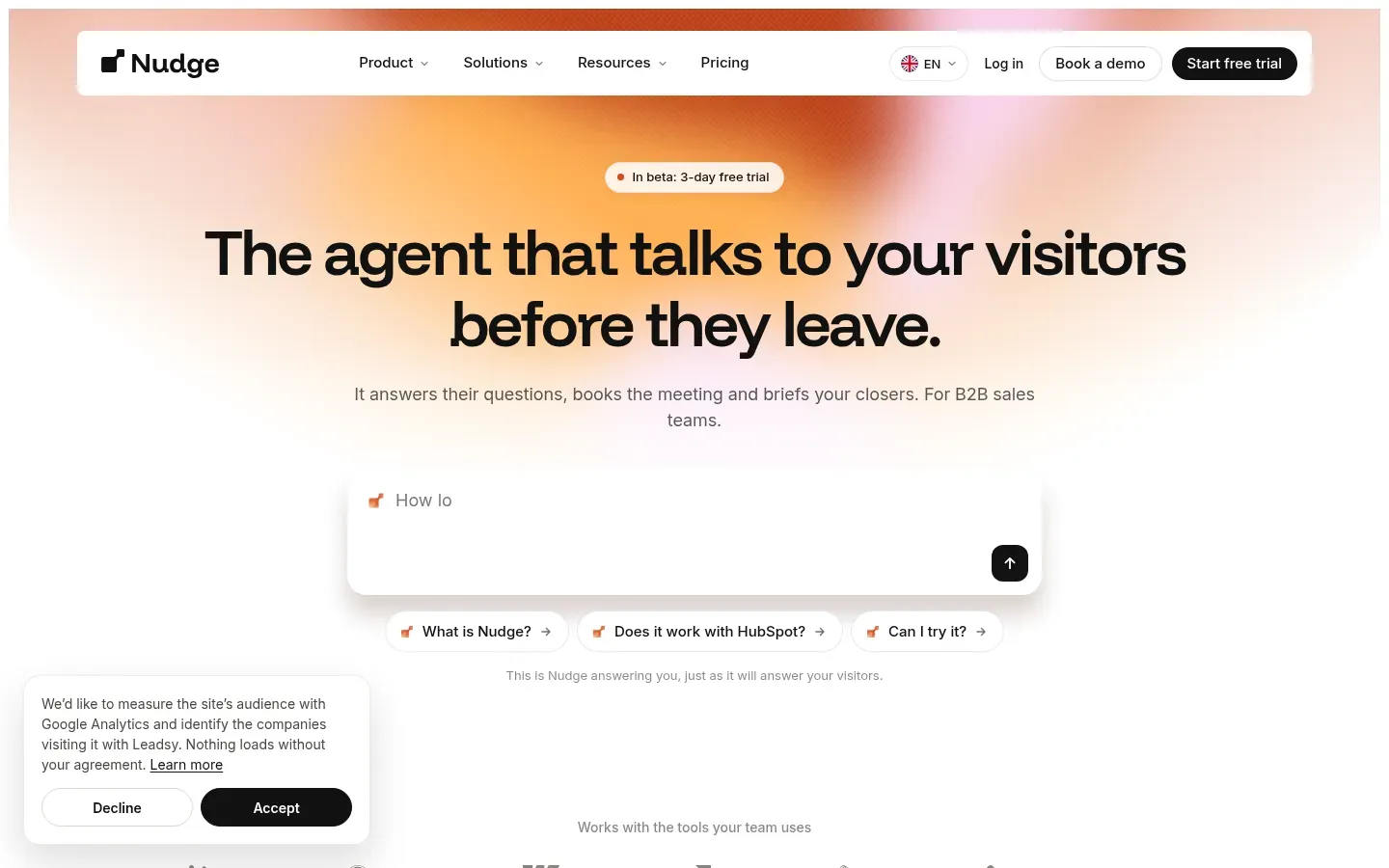
Nudge focuses on engaging B2B website visitors before they leave. It answers questions, books meetings and supports the subsequent sales handoff. Its four-agent approach also covers personalized follow-ups, returning visitor identification and preparation for sales conversations. That makes it relevant when the gap starts before a prospect reaches a rep.
Its capabilities include content-based answers with citations, CRM integrations, sales meeting preparation briefs and pipeline and conversion analytics. Teams can also ask questions about sales data. These functions connect the initial visitor conversation with the information sellers need later, rather than treating a booked meeting as the end of the workflow.
For a team selecting an AI sales assistant, Nudge’s distinguishing evaluation angle is continuity from website interest to follow-up and rep preparation. A useful demonstration should follow one prospect through that sequence, including a return visit and a question the approved content cannot answer.
Best fit: B2B inbound teams that want website conversations, booking and follow-up connected to seller context. Test whether cited answers accurately reflect your materials, whether meeting handoffs preserve qualification details and whether returning-prospect context is useful. Also establish who owns content maintenance so outdated positioning does not remain in buyer-facing answers. Agree on an escalation path for commercial exceptions and unsupported questions before launch.
2. Dialpad
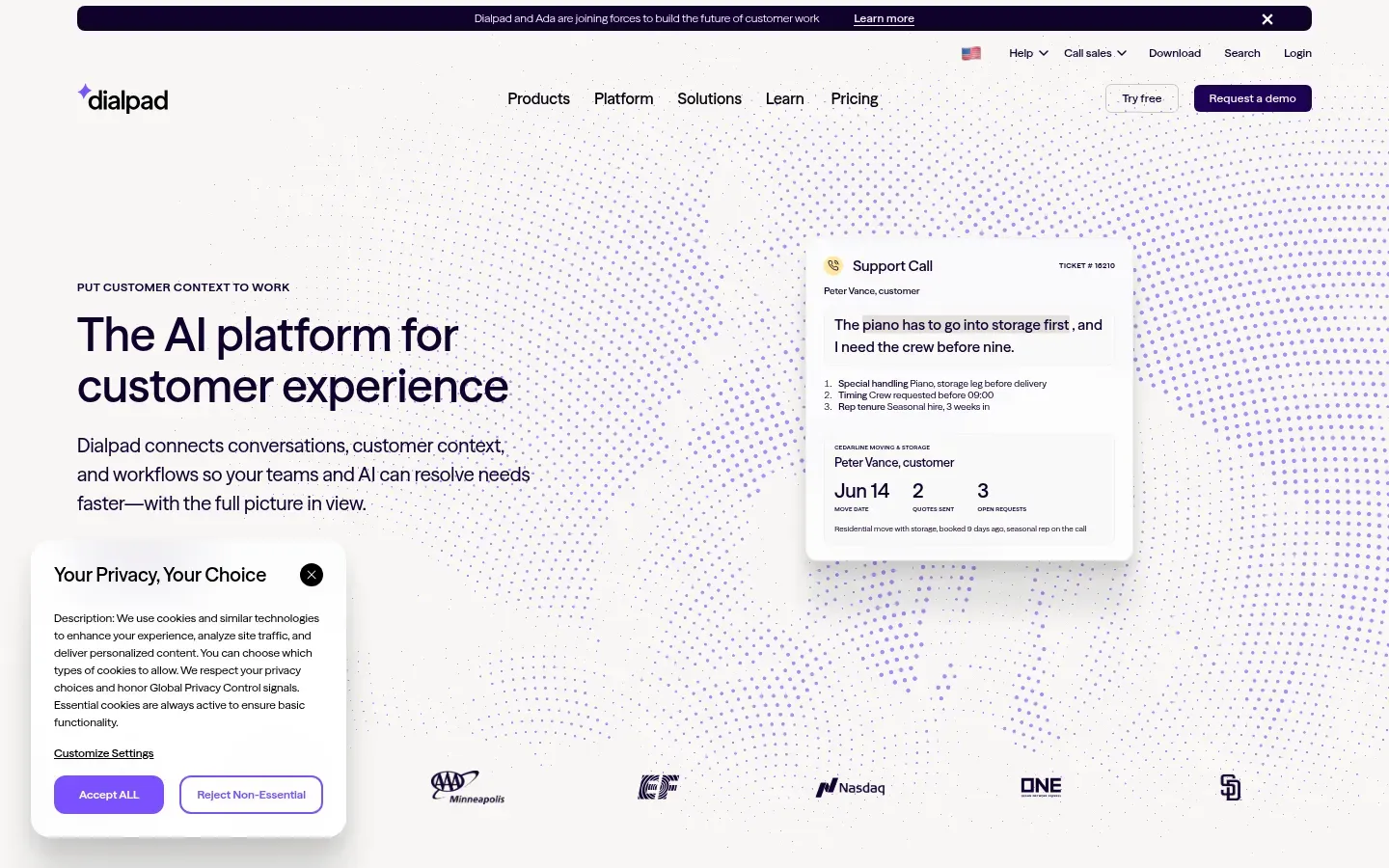
Dialpad connects customer conversations, context and workflows across business communication channels. Its offering includes AI voice and digital agents, a digital contact center, outbound sales tools and team collaboration through voice, video and messaging. Its center of gravity is communications rather than only website conversion.
That distinction matters for inbound teams handling phone inquiries or managing conversations across multiple channels. A communications-focused platform belongs on the shortlist when the operational problem involves receiving, handling and continuing those interactions. It should not automatically be treated as a substitute for a dedicated website engagement workflow.
When evaluating Dialpad as an AI sales assistant, use realistic inbound scenarios instead of a generic voice demonstration. Include an existing customer who reaches sales, a prospect who needs a specialist and a conversation that requires human intervention. Check how context survives each transfer and where the resulting information becomes accessible.
Best fit: Teams whose inbound sales process depends heavily on customer communications. Confirm which Dialpad products and capabilities are included in the proposed setup, along with relevant CRM connections. Evaluate implementation effort, administrator ownership and rep experience together. A capable communication system still needs clear routing rules and an agreed destination for sales context. Test those rules with actual team structures, including shared coverage and exceptions, before expanding deployment.
3. Avoma
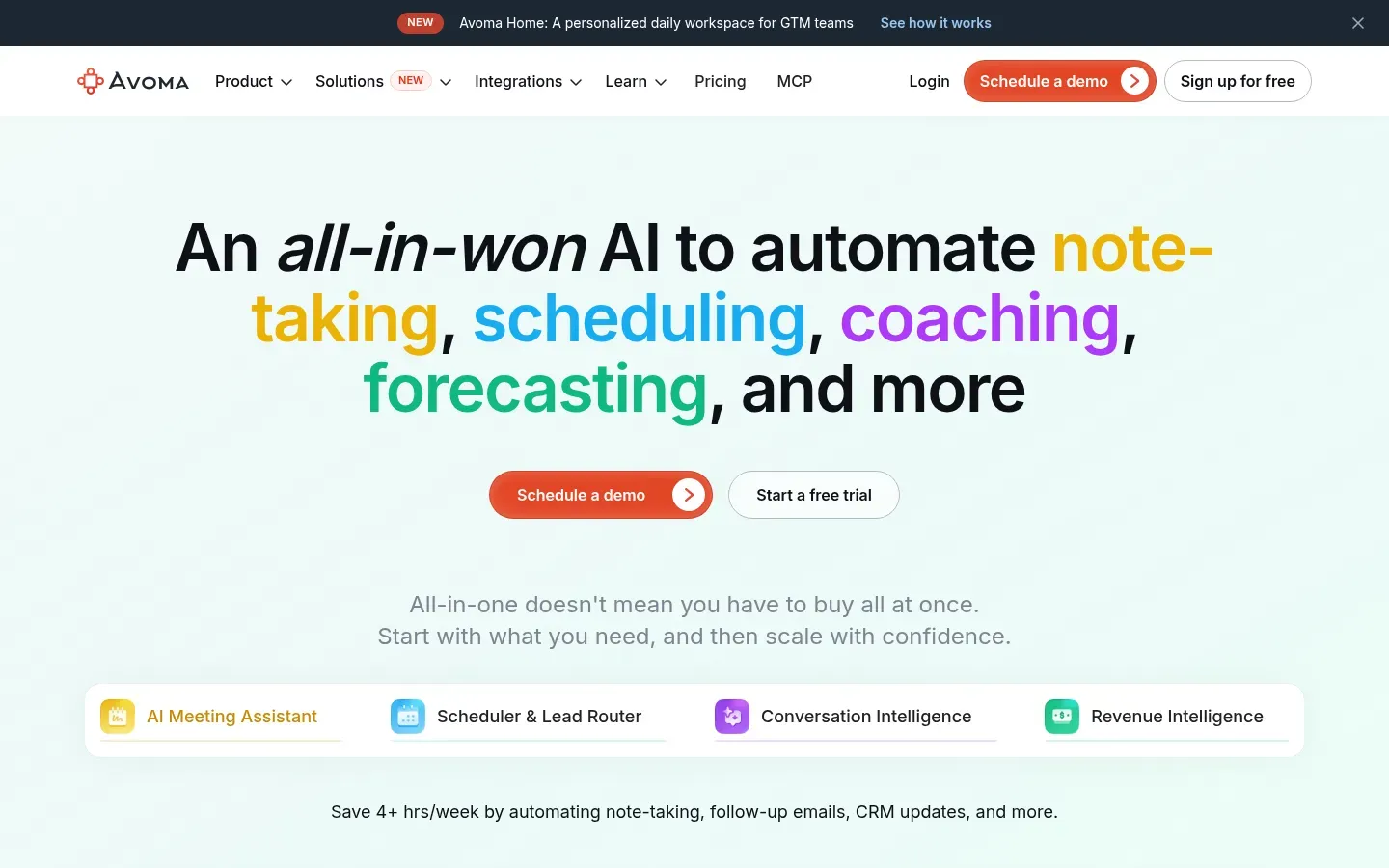
Avoma supports go-to-market teams with AI meeting note-taking, scheduling, coaching, forecasting and related sales workflows. Its capabilities include a scheduler and lead routing, conversation intelligence, revenue intelligence and CRM updates. It is relevant when inbound interest already produces meetings but the work surrounding those meetings remains inconsistent.
An inbound team might use this category to reduce manual documentation or improve visibility into discovery conversations. Scheduling and routing also place Avoma earlier in the journey than a notes-only product. Still, evaluate each workflow separately rather than assuming success in meeting capture proves success in lead assignment or revenue analysis.
Avoma is an AI sales assistant candidate when meeting execution and follow-through are the main constraints. The most revealing pilot compares generated notes with the actual conversation and checks whether decisions, objections and next steps remain correctly attributed. A fluent summary can still omit an important condition or present a tentative date as a commitment.
Best fit: Teams seeking meeting support alongside conversation and revenue workflows. Test CRM updates in a controlled environment, including the destination fields and record associations. Ask who can review or correct an update and what happens when account records are ambiguous. Include reps in the evaluation: useful notes must be accessible in their normal workflow, not merely available in another application they rarely open.
4. HubSpot Sales Hub
HubSpot Sales Hub belongs in a different buying conversation: sales software within a broader customer platform. HubSpot brings together CRM, marketing, sales, service, content and data management software. For an inbound team, that makes the existing customer-data environment central to the evaluation, not just an individual assistant feature.
The relevant question is whether sales assistance should live within the platform already supporting the buyer journey. Marketing context, customer records and sales activity often need to work together. However, sharing a vendor name does not establish that every desired workflow is available in your subscription or configured for your process.
When considering HubSpot as an AI sales assistant option, ask for a demonstration built around your actual configuration. Trace an inbound inquiry from its original marketing context through sales ownership and follow-up. Have the vendor identify which steps use included functionality, which require configuration and which depend on additional products or integrations.
Best fit: Teams that want to evaluate sales assistance alongside a broader CRM and customer-platform decision, especially when HubSpot is already part of the stack. Avoid treating platform consolidation as automatic workflow improvement. Test permissions, record quality and ownership rules first. If the underlying data is inconsistent, adding assistance can make that inconsistency easier to distribute rather than resolving it. Include both marketing and sales operations in acceptance testing.
5. Warmly
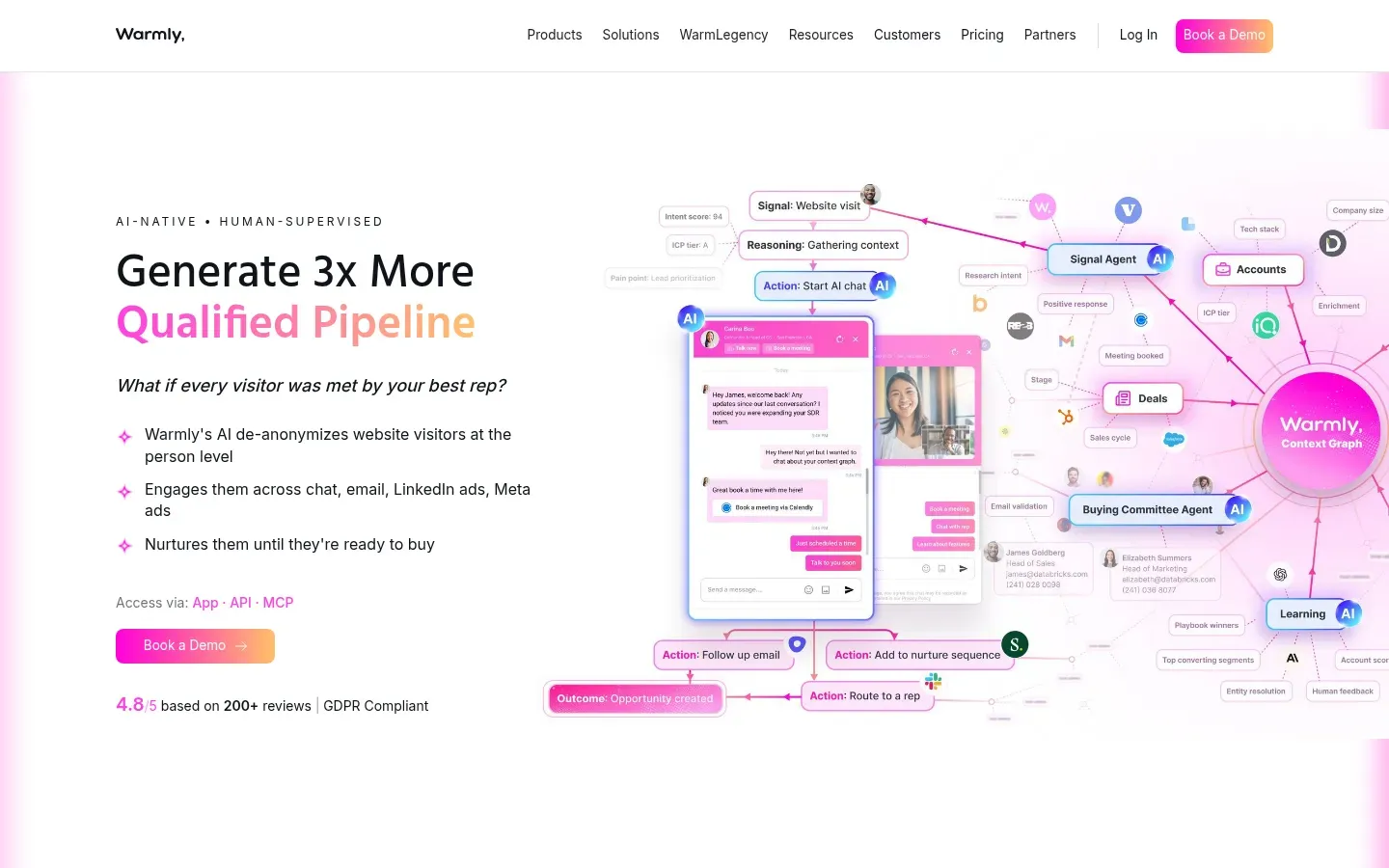
Warmly focuses on identifying website visitors and engaging buyers through AI chat, email, LinkedIn ads and Meta ads. Its capabilities include visitor identification, buyer nurturing and lead routing. That makes it relevant when inbound teams want to connect website activity with continued engagement rather than wait for every interested visitor to submit a form.
The key evaluation issue is signal quality. Visitor identification should not be interpreted as certainty about an individual buyer’s identity, authority or purchase intent. Ask what each signal represents, how uncertainty is expressed and what evidence is available before a rep or automated workflow acts on it.
Warmly is an AI sales assistant candidate for teams combining website signals with buyer engagement and routing. A practical pilot should inspect both the quality of identified accounts and the appropriateness of subsequent actions. More activity is not inherently useful if it reaches the wrong people or ignores existing account ownership.
Best fit: B2B go-to-market teams that need visitor intelligence connected to nurturing and engagement. Validate suppression rules, routing behavior and the relationship between automated touches and rep-led outreach. Confirm which channels your team can operate responsibly and measure separately. Otherwise, a combined campaign may make it difficult to tell whether a useful conversation came from chat, email, advertising or an existing relationship. Keep those attribution distinctions visible throughout the pilot.
Match the platform to the inbound use case
Start with the earliest broken handoff. If visitors leave with unanswered questions, evaluate website conversations and meeting booking first. Nudge is directly aligned with that workflow. If your priority is identifying visiting accounts and coordinating continued engagement, Warmly belongs in the comparison, with signal quality treated as a separate acceptance criterion.
If inbound buyers primarily call your business, evaluate Dialpad around those communication workflows. If booked meetings create documentation backlogs or inconsistent follow-through, assess Avoma. HubSpot Sales Hub deserves attention when the AI sales assistant decision is tied to a wider CRM and customer-platform strategy rather than a single isolated task.
Some teams will need more than one category, but overlapping automation needs an owner. Decide which system books meetings, which writes customer records and which controls follow-up. Two platforms acting on the same lead can create duplicate messages or conflicting ownership. Map that responsibility before connecting production systems, including the process for pausing automation when a rep takes over.
Validate performance with a controlled pilot
Establish a meaningful baseline
Choose one workflow, one owner and a defined audience. Record the current process before introducing automation. For website engagement, useful measures include eligible conversations, qualified meetings booked and qualified meetings attended. For meeting assistance, measure documentation time, correction effort and completion of agreed next steps.
Define denominators carefully. Meetings per eligible visitor and meetings per conversation answer different questions. Separate existing customers, job seekers and unsuitable inquiries from the buyer group you intend to serve. Where feasible, compare similar traffic or rep groups over the same period rather than attributing every change to the new tool. Record any campaign, staffing or routing changes that could affect the result.
Review quality alongside output
A successful AI sales assistant pilot should improve an operational outcome without creating unacceptable correction work. Review a sample of answers, bookings, summaries and record updates. Check accuracy, relevance, attribution and handoff completeness, not just whether the system produced an output.
Treat increased booking volume cautiously if attendance or qualification deteriorates. Likewise, count time spent reviewing and correcting notes when estimating administrative savings. Set stop conditions before launch, such as repeated unsupported product claims, misrouted meetings or inappropriate CRM changes. Expand only when the workflow passes both outcome and quality checks, with a named owner responsible for monitoring it after rollout.
Check data handling before expanding access
Limit collection and permissions
Map what information enters the system, where it is stored and which people or services can access it. Ask vendors about retention, deletion, subprocessors and whether customer information is used for model training. Request documentation rather than treating a broad security statement as an answer to each question.
Apply the same scrutiny to an AI sales assistant that writes into your CRM. Begin with limited permissions and establish review rules for consequential changes. For governance structure, the NIST AI Risk Management Framework provides a useful reference for identifying, measuring and managing AI-related risks. Translate that guidance into specific owners and controls, including a practical rollback procedure if an integration changes records incorrectly.
Protect sensitive conversations
For calls and meetings, determine applicable recording and consent requirements before enabling capture. Requirements vary by jurisdiction and context, so involve appropriate legal review. Give reps a clear process for situations where recording or automated processing is unsuitable, including how they can continue the conversation without losing essential follow-up tasks.
Healthcare-facing sales illustrates why collection boundaries matter. Dr. Iospa Psychiatry Consulting describes services spanning psychiatric care, psychotherapy and neuropsychological testing. A vendor selling operational software to such a practice should keep discovery focused on business requirements, not invite identifiable patient details into a sales system. Define similar boundaries for your own customers, and test whether automated questions respect them. Avoid using sensitive customer examples in demonstrations or pilot datasets when synthetic scenarios will do.
Start with one measurable handoff
Choose the point where inbound interest most often stalls and test the platform built for that job. For website conversations through booking, follow-up and seller preparation, put Nudge on your shortlist. Bring real buyer questions, your routing rules and a clear success measure to the evaluation. A narrow pilot with inspectable outputs provides a stronger buying basis than a broad demonstration of features.
Frequently asked questions
What does an AI sales assistant do?
It helps with defined sales tasks such as answering website questions, booking meetings, capturing notes or supporting follow-up. Capabilities vary substantially. Some platforms operate before a rep joins the conversation, while others primarily assist during meetings or with the work that follows them.
Can these platforms replace an inbound sales rep?
They can automate parts of an inbound workflow, but that is different from owning a complex buying process. Keep human responsibility for negotiation, unusual commercial requests, sensitive discussions and commitments that require judgment. Decide escalation rules before deployment rather than leaving the boundary implicit.
Which platform should a small B2B team evaluate first?
Start with the bottleneck, not team size alone. Nudge fits a website-conversation evaluation, Dialpad a communications evaluation and Avoma a meeting-workflow evaluation. HubSpot Sales Hub and Warmly address different platform and visitor-engagement priorities. Choose the smallest pilot that can test your actual need.
How should we compare costs without relying on headline prices?
Request a quote for the complete workflow, including required products, usage, integrations and implementation. Add internal administration and review time. Then compare cost per useful outcome, such as a qualified attended meeting, rather than cost per generated message or summary.