Website chat consent can cover a sales follow-up when the visitor clearly requests that specific contact, such as an emailed pricing sheet or a demo confirmation. It does not automatically authorize an ongoing sales sequence, a switch to text messages or outreach from another company. Permission to answer a question is not blanket permission to market.
There is a second distinction: some jurisdictions allow certain marketing emails without prior consent. That does not turn a chat interaction into consent. Your team still needs to meet the applicable marketing rules, privacy requirements and opt-out obligations.
For B2B teams using AI agents, these boundaries need to survive every handoff from the website conversation to the CRM and the salesperson. This guide provides an operational framework, not legal advice. Have counsel validate the rules for your recipients, channels and locations.
Start with what the visitor actually requested
A chat creates context, but context alone is not permission. Look at the visitor’s words, what your interface disclosed and the message you intend to send.
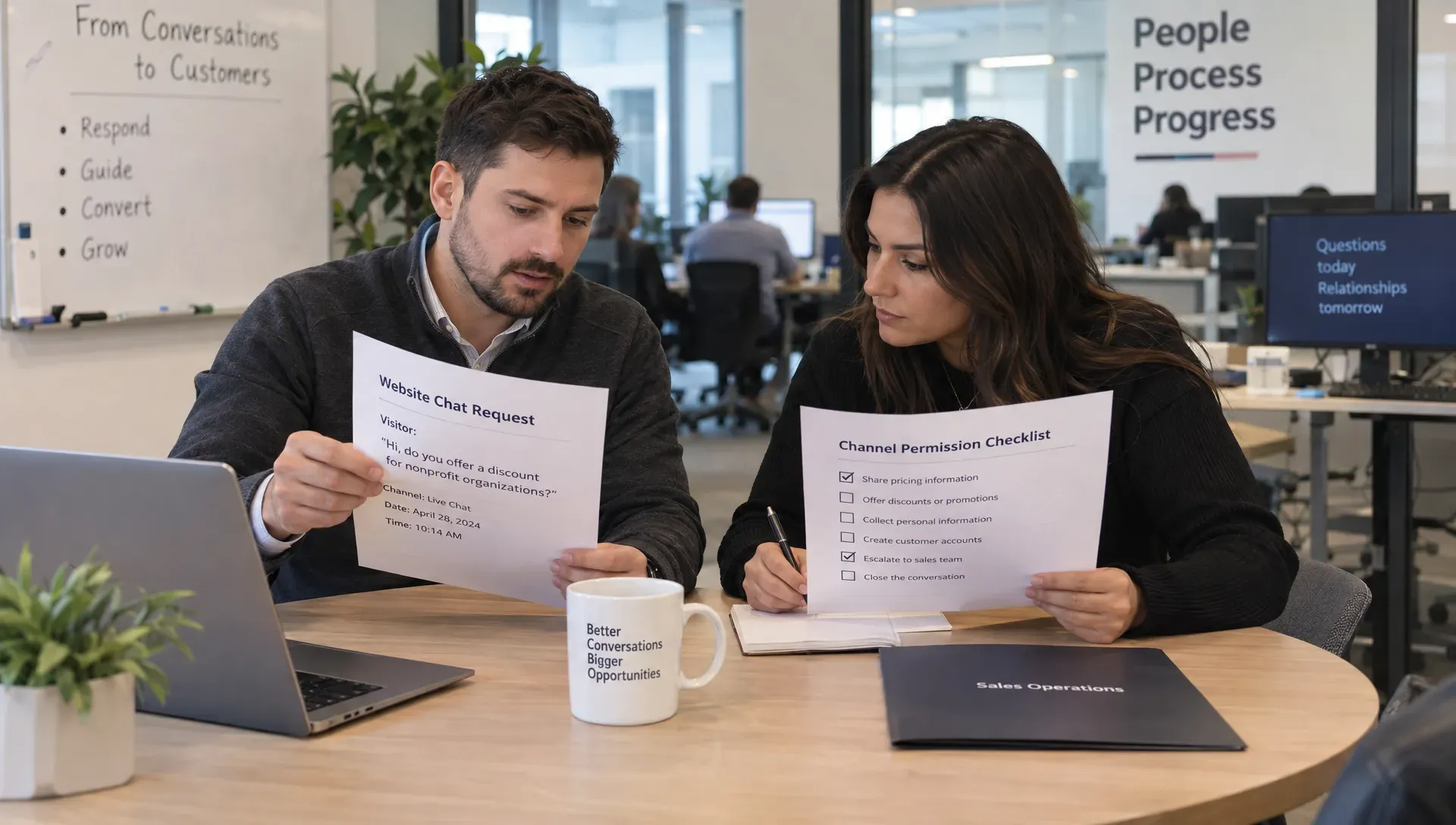
The following examples describe the scope of the visitor’s request, not a universal legal clearance:
- Website interaction: “Can you explain your integrations?” — What the request reasonably covers: An answer in the current chat — What it does not establish: Permission to find an email address and start a sequence
- Website interaction: “Email me the integration guide.” — What the request reasonably covers: Delivery of that guide to the supplied address — What it does not establish: An ongoing promotional subscription
- Website interaction: “Have a salesperson email me about our requirements.” — What the request reasonably covers: Sales contact about the stated requirements — What it does not establish: Unlimited outreach across channels or unrelated offers
- Website interaction: “Book a demo for Tuesday.” — What the request reasonably covers: Scheduling and necessary meeting communications — What it does not establish: Permission to add product promotions to every reminder
- Website interaction: Visitor selects a clear, optional email marketing checkbox — What the request reasonably covers: The stated email marketing purpose, if consent is valid — What it does not establish: SMS, partner marketing or materially different purposes
- Website interaction: A visitor returns to the pricing page — What the request reasonably covers: Another browsing interaction — What it does not establish: New consent or withdrawal of a previous opt-out
Providing an email address is not, by itself, evidence of marketing consent. It may simply identify where to send the answer the visitor requested.
Timing matters too. A requested pricing email sent promptly is different from a promotional sequence launched months later. There is no universal number of follow-ups that makes a sequence acceptable. Evaluate the request’s scope, the content and the applicable law rather than adopting a rule such as “three touches are always allowed.”
Website chat consent and lawful basis are different questions
Your workflow needs to answer two questions separately: can you process this person’s data for this purpose, and can you send this type of message through this channel?
A privacy notice explains data handling. A lawful basis supports the processing where required. Consent, when needed, must meet the relevant standard. None of these is interchangeable with a cookie preference or a generic “continue chatting” button.
United States: commercial email generally follows an opt-out model
At the federal level, CAN-SPAM does not generally require prior opt-in for commercial email, including B2B email. However, the FTC’s CAN-SPAM compliance guide sets requirements including accurate sender information, nondeceptive subject lines, a valid postal address and an effective opt-out mechanism. Opt-out requests must be honored within 10 business days.
That means a US marketing email might be permissible without chat consent, but your CRM should not label the recipient “consented” unless they actually consented.
Message classification also matters. A necessary meeting confirmation is not equivalent to a sales promotion. Adding promotional content can affect whether a message is treated as commercial under the primary-purpose test. Do not assume a “transactional” template name settles the question.
Other privacy, sector-specific and state rules may also apply.
United Kingdom: corporate and individual subscribers differ
The ICO’s guidance on B2B marketing distinguishes corporate subscribers from individual subscribers under PECR.
Unsolicited marketing email to corporate subscribers generally does not require PECR consent. But an identifiable employee’s details remain personal data, so UK GDPR obligations still matter, including transparency, an appropriate lawful basis and the right to object to direct marketing. Senders must identify themselves and provide a valid way to opt out.
Sole traders and certain partnerships receive the protections applying to individual subscribers. Marketing email generally requires consent unless a valid exception, such as the soft opt-in, applies.
The UK soft opt-in has specific conditions. These include obtaining details during a sale or negotiations for a sale, marketing your own similar products or services and offering an opt-out both when collecting the details and in every subsequent message. A generic chat interaction does not automatically satisfy those conditions.
European Union: GDPR is only one part of the assessment
Under the GDPR, processing personal data needs a valid lawful basis. But a legitimate-interests assessment does not override a separate requirement for marketing consent under applicable electronic marketing law.
National implementations of the ePrivacy rules differ, including their treatment of B2B recipients and existing-customer exceptions. Do not apply the UK corporate-subscriber approach across the EU or assume that every business address is exempt from consent requirements.
Where processing relies on consent, preserve evidence of a freely given, specific, informed and unambiguous choice. Where someone objects to processing for direct marketing, GDPR Article 21 requires that processing for that purpose to stop.
Texts and calls need their own review
Website chat consent for email is not permission to send promotional texts or place automated marketing calls. In the US, TCPA requirements depend on the technology, message and circumstances, with prior express written consent required for certain telemarketing calls and texts. State laws can add obligations.
The FCC’s guidance on unwanted calls and texts is a useful starting point. Keep phone-channel permissions separate from email permissions rather than storing one universal “contactable” flag.
Make the choice clear inside the conversation
The most useful interface separates fulfillment of a request from optional marketing. Visitors should understand what will happen without having to interpret a broad privacy-policy link.
For a requested resource
Use copy tied to the immediate task:
“We’ll email the integration guide to the address you provide. This does not subscribe you to sales updates.”
Preserve the visitor’s request alongside that disclosure. An agent’s summary saying “interested in integrations” is weaker evidence than the actual message, “Please email me the guide.”
For a requested sales conversation
Ask about the contact the person wants:
“Would you like someone from our sales team to email you about your CRM integration requirements?”
An affirmative answer establishes a clearer scope than “Can we stay in touch?” It still should not become permission for unrelated campaigns or a different channel.
For ongoing promotional email
Offer a separate, optional choice with a clear sender, purpose and channel:
“Send me product updates and sales offers from [Company] by email. I can unsubscribe at any time.”
Where you rely on consent, do not use a preselected checkbox or make unnecessary marketing consent a condition of receiving the requested answer.
Clarity is also a conversion issue. Space Dinosaurs’ ecommerce-focused guide to optimizing a website for conversion before buying traffic offers useful principles around relevance, trust and friction. On a B2B website, apply that usability discipline to contact choices: make them understandable, not hidden or compulsory.
Carry the permission record into every agent handoff
An accurate website chat consent record is useful only if downstream systems respect it. A website agent may understand the visitor’s request perfectly while a CRM workflow sees only “new lead” and starts an unrelated sequence.
For each contact event, preserve enough information to explain both the intended communication and why it is permitted. Useful fields include:
- Purpose and channel: Requested guide by email, requested demo scheduling or optional email marketing.
- Evidence: The visitor’s actual request or affirmative choice, plus the disclosure they saw.
- Timing and source: When and where the request or choice occurred, including the relevant notice version.
- Applicable assessment: Relevant jurisdiction information and the approved lawful-basis or marketing-rule assessment, where needed.
- Restrictions: Unsubscribes, objections, withdrawals and limits on particular channels or purposes.
Keep “requested contact,” “consented to marketing” and “marketing permitted under another assessed rule” distinct. Collapsing them into one field makes audits and suppression decisions harder.
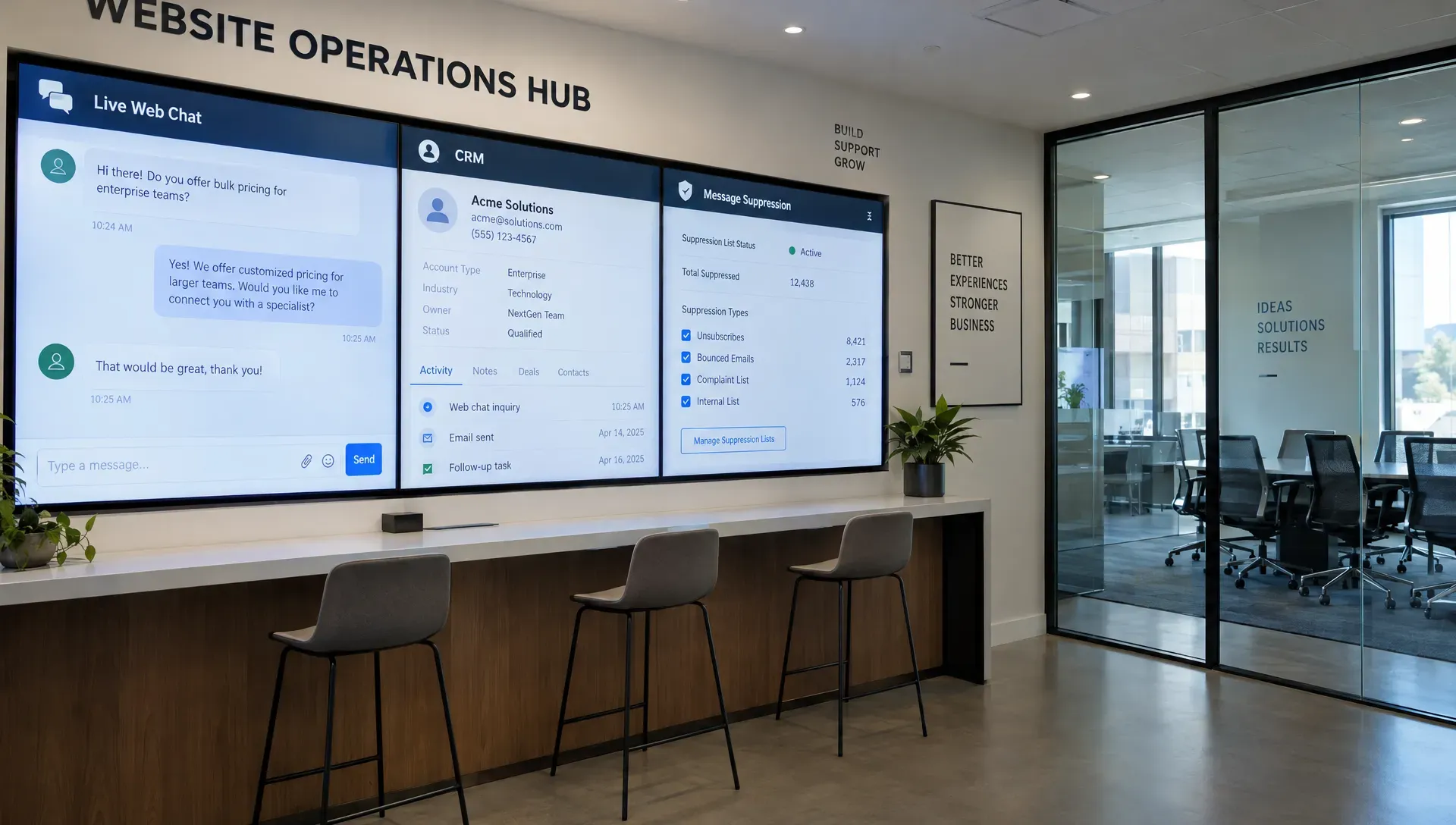
When reviewing a CRM connection, check whether permissions and conversation context survive the integration. Accurate field mapping matters as much as successful lead creation.
Put enforcement before message generation
A practical safeguard is to decide whether a message may be sent before asking an AI agent to write it. The permission check should consider purpose, channel, applicable rules and current suppression status.
Do not let a model manufacture consent from browsing behavior, job title or phrases such as “looks promising.” An agent can extract a possible request, but the sending decision needs reliable evidence and an approved policy.
If that evidence is missing, hold the promotional message for review. For genuinely requested administrative communications, use a separate, narrowly scoped process that does not quietly re-enroll someone in marketing.
Returning visitors and human handoffs do not reset the rules
A returning visitor may be a stronger sales signal, but recognizing them is not a fresh permission event. Tracking and identification also have their own privacy requirements. A prior marketing opt-out should not disappear because someone revisits a product page.
If that person starts a new conversation and requests a demo, assess the new request on its own scope. Necessary scheduling messages can be handled separately from a marketing subscription, subject to the applicable rules.
The same principle applies when a human rep takes over. Personalization does not create permission. A thoughtful email quoting a visitor’s question can still exceed what they requested. Build automated sales follow-up around the buyer’s actual conversation, but check permission before optimizing the copy.
Website chat consent should therefore travel with the lead, not remain buried in a transcript that later agents never consult.
Test the boundaries before enabling a sequence
Use realistic test conversations rather than checking only the happy path. Try a visitor who requests one document but declines updates, an existing subscriber who later unsubscribes and a returning prospect whose identity is uncertain.
Also test a lead with permission for email but no permission for texts. The system should not treat the presence of a mobile number as authorization to use it.
For every test, inspect the resulting CRM record and the actual send decision. Confirm that restrictions reach both automated workflows and human sales queues. A correct transcript is not enough if a separate campaign enrollment ignores it.
Finally, assign an owner for changes to notices, templates and eligibility rules. If the wording changes, your records should still show what earlier visitors saw. Website chat consent is an ongoing data-governance task, not a checkbox added once during launch.
Connect conversations without expanding their scope
Nudge helps B2B sales teams answer website questions, book meetings, follow up and prepare sales reps. When evaluating that workflow, define the boundary between a requested reply and ongoing marketing before connecting downstream outreach.
Start with one visitor journey and trace the request, disclosure, CRM record and sending decision. The goal is straightforward: deliver what the visitor asked for without silently turning that request into something broader.
Frequently asked questions
Does entering a work email in chat count as marketing consent?
Not by itself. It may provide an address for a requested reply. Marketing consent requires the relevant affirmative choice where consent is the basis being used, while some jurisdictions permit certain B2B emails under other rules.
Can a salesperson follow up manually if automation is blocked?
Manual outreach does not bypass marketing restrictions, privacy obligations or an objection. Review why the message was blocked before handing it to a rep.
Does accepting a privacy policy authorize sales follow-up?
A privacy notice explains processing; acknowledging it is not automatically specific consent to marketing. Avoid treating “I agree to the privacy policy” as permission for every channel and campaign.
Does a marketing unsubscribe prevent a requested meeting confirmation?
Not necessarily. A genuinely requested administrative message can be distinct from marketing. Keep it limited to the meeting and do not use it to restart promotional contact.